
Texas spittlebug
Clastoptera texana
Description
How to identify
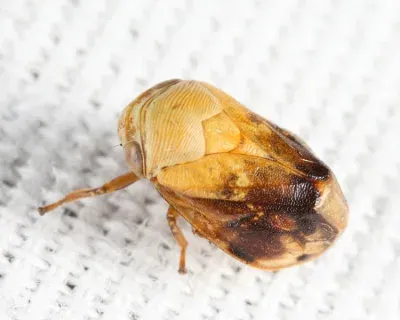
The Texas spittlebug (Clastoptera texana) belongs to the family Clastopteridae within the order Hemiptera. These insects are easily recognized by their compact, beetle-like appearance and highly developed jumping legs.
Adults are typically dark brown or black, often featuring light-colored bands on their wings. The most distinguishing feature of this species is the bubbly, foam-like substance created by the nymphs to protect themselves while feeding.
To identify the pest, one should look for white foamy masses, often referred to as "spittle," located in leaf axils or along young stems. Adult spittlebugs are elusive and will quickly jump away when disturbed.
Their sensory organs are highly attuned to vibrations, making them difficult to approach for manual removal. They favor humid environments where the protective foam does not dry out quickly, allowing them to thrive.
As a specialized phytophagous insect, the Texas spittlebug utilizes its piercing-sucking mouthparts to extract sap, which can cause significant physiological stress to the host plant over time.
What it damages
The Texas spittlebug targets a variety of host plants, including ornamental shrubs, fruit trees, and several perennial herbaceous species within its geographic range.
The nymphs and adults primarily feed on tender young growth, which is richer in nutrients than mature foliage. Heavy infestations are common in nurseries where high plant density facilitates rapid spread.
While feeding, the insect injects saliva containing enzymes that disrupt plant cell processes, often leading to localized necrosis or stunted growth in the affected areas of the host.
Severe infestations result in diminished yields for fruit-bearing plants, while ornamentals lose aesthetic value due to twisted, malformed stems and yellowing of the leaves.
Secondary damage occurs when the sugary honeydew excreted by the bugs promotes the growth of sooty mold, which coats the leaves and interferes with essential photosynthetic activity.
When it appears
The activity cycle of the Texas spittlebug begins in the spring when nymphs emerge from eggs that overwintered on the bark or stems of host plants.
The period of most intense feeding and growth occurs during late spring and early summer, coinciding with the rapid vegetative growth stage of most garden plants.
Adults typically emerge mid-summer, moving across plants to mate and search for new food sources. Peak adult activity is generally observed during the hottest months, July and August.
The insect passes through several nymphal stages, each requiring a continuous supply of fresh plant sap to maintain the integrity of their protective foam cover.
As autumn approaches, the population begins to decline as the insects lay eggs for the next generation, which remain in a dormant state until the following spring.
Signs of infestation
The most visible indicator of an infestation is the presence of frothy, white "spittle" masses found on stems, twigs, and the undersides of leaves.
Stunted growth, twisting of tender new shoots, or yellowing leaves that curl prematurely are common signs that the plant is being drained of its vital fluids.
The presence of a sticky substance on the foliage, often followed by a black, dusty coating, indicates that the plant has been feeding on honeydew produced by the spittlebugs.
During morning or evening hours, observant gardeners may notice adult insects jumping from foliage when the plant is lightly brushed or disturbed.
In cases of chronic infestation, one might see reduced vigor and premature leaf drop, signaling that the plant's overall health is being compromised by the pest.
Control measures
Management begins with regular garden monitoring and the manual removal of spittle masses if the population is low and confined to a small area.
For significant outbreaks, the use of systemic insecticides is often necessary to reach the insects hidden within the foam and effectively protect the plant.
Bio-rational controls, such as insecticidal soaps or horticultural oils, can be applied to break down the foam, exposing the nymphs to environmental stress and desiccation.
Pruning and destroying heavily infested branches at the end of the growing season is a crucial cultural practice to reduce the egg load for the following spring.
Maintaining optimal plant health through consistent watering and balanced fertilization ensures that plants are resilient enough to withstand minor feeding pressure without suffering significant damage.
Taxonomy
- Latin name
- Clastoptera texana
- Order
- Hemiptera (bugs, aphids, leafhoppers)
- Family
- Cercopidae
- EPPO code
- CLASTE
Discussion
No discussions yet — be the first.