
Alder spittlebug
Clastoptera obtusa
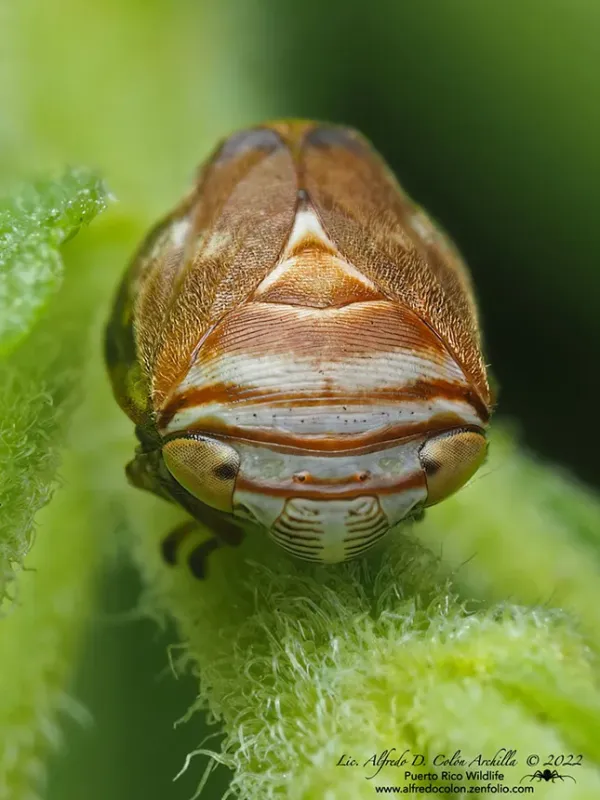
Description
How to identify
The Alder spittlebug (Clastoptera obtusa) belongs to the order Hemiptera and the family Aphrophoridae. The adult insect is a small bug approximately 5–6 mm in length, featuring a characteristic rounded body shape and a brownish color with transverse light-colored stripes.
A key feature of this insect is the specific camouflaging method used by the nymphs. They secrete a distinct foamy substance that completely envelops their body, creating the protective structure commonly known as "cuckoo spit."
The nymphs residing inside this protective foam have a yellowish-white color and a soft body. Adult individuals possess powerful hind legs adapted for jumping, which makes them highly mobile and complicates the process of detecting them within the tree canopy.
Adult spittlebugs are active during the day and capable of making sudden leaps at the slightest threat. Their appearance often mimics the texture of bark scales or small buds, which complicates visual monitoring of their population density.
The taxonomy of the species includes several closely related subspecies, but Clastoptera obtusa is most prominently found on broad-leaved trees, where it identifies optimal feeding grounds.
What it damages
This pest prefers plants from the birch family, primarily alder, but it often attacks fruit trees as well. The list of affected crops includes apples, pears, and various ornamental shrubs growing near forest areas.
Both nymphs and adults feed on plant sap by piercing young shoots and leaves. This leads to the disruption of the normal photosynthetic process and the general metabolism within the tissues of the infested plant.
Young trees in the phase of active vegetative growth are most sensitive to the pest's attack. Constant sap extraction weakens the tree, which can lead to stunted shoot development and deformation of leaf blades.
Secondary infections often develop at the puncture sites because the integrity of the epidermis is compromised. A tree weakened by the spittlebug becomes more susceptible to fungal diseases and adverse climatic factors, such as drought or frost.
In large plantations, massive outbreaks of the Alder spittlebug can lead to premature leaf fall and loss of market value for ornamental plants, which has significant economic implications for nurseries.
When it appears
The life cycle of the Alder spittlebug is closely linked to the seasonal dynamics of woody plant development. The species overwinters at the egg stage, with females laying eggs under the bark of young branches or within bud scales.
In early spring, coinciding with sap flow, the nymphs emerge from the eggs. This period matches the bud burst phase, when plant tissues are most saturated with moisture and nutrients essential for the pest's feeding.
Throughout spring and early summer, the nymphs develop actively, constantly renewing their foam nests. The maximum population density of nymphs is observed in May and June, when white foam clumps are clearly visible on the branches.
In mid-summer, the metamorphosis process is completed, and adult spittlebugs emerge from the foam. The adults continue to feed on plant sap without forming protective structures, becoming active flyers in the tree canopies.
By late summer and autumn, mating and egg-laying for the winter occurs. Thus, the pest develops in one generation per season, which determines the strategy for monitoring its population.
Signs of infestation
The primary and most noticeable sign of the Alder spittlebug's presence is the appearance of "foam nests" on branches. These white, saliva-like or soap-like foam structures are easily detected upon inspecting the undersides of leaves and the bases of young shoots.
Another indirect sign is leaf curling and the appearance of yellowish spots at the puncture sites. The plant reacts to tissue damage by losing turgor, which manifests visually as slight wilting in certain sections of the canopy.
The presence of a large number of adult individuals can be noticed by the sudden leaping of insects if a branch is gently shaken. They scatter in different directions, which is characteristic of many froghopper species.
In areas with a high density of the pest, sticky droplets known as honeydew can be observed beneath the trees. This is a byproduct of insect metabolism, on which sooty mold often grows, causing darkening of the bark and leaves.
- Presence of white foamy clumps on young branches.
- Deformation and yellowing of leaf blades.
- Appearance of a sticky coating on shoots.
- Premature leaf fall during heavy infestations.
- Mass scattering of insects when branches are shaken.
Control measures
Effective management of the Alder spittlebug begins with agronomic measures. Regular sanitary pruning and the removal of heavily infested branches in spring significantly reduce the pest population by eliminating egg-laying sites.
When the first signs of foam nests are detected on small plots, manual removal or washing the foam away with a high-pressure water jet is effective. Mechanical destruction of the foam leaves the nymph vulnerable to predators and sunlight.
In cases of massive garden infestation, the use of systemic insecticides is recommended. Products based on neonicotinoids or pyrethroids show high efficiency by penetrating plant tissues and affecting sap-sucking pests.
Application should be performed during the nymph emergence period, before they form dense protective foam. Follow-up treatments should be conducted if necessary, while adhering to the pre-harvest intervals specified in the product instructions.
Biological control methods include attracting natural enemies of spittlebugs, such as parasitoid wasps and predatory bugs. Creating favorable conditions for beneficial insects in the garden helps keep the pest population at a safe level.
Taxonomy
- Latin name
- Clastoptera obtusa
- Order
- Hemiptera (bugs, aphids, leafhoppers)
- Family
- Cercopidae
- EPPO code
- CLASOB
Discussion
No discussions yet — be the first.