
Spittlebug (Clastoptera achatina)
Clastoptera achatina
Description
How to identify
Clastoptera achatina, commonly known as a type of spittlebug, belongs to the family Aphrophoridae within the order Hemiptera. These insects are easily recognized by their unique lifestyle during the nymph stage.
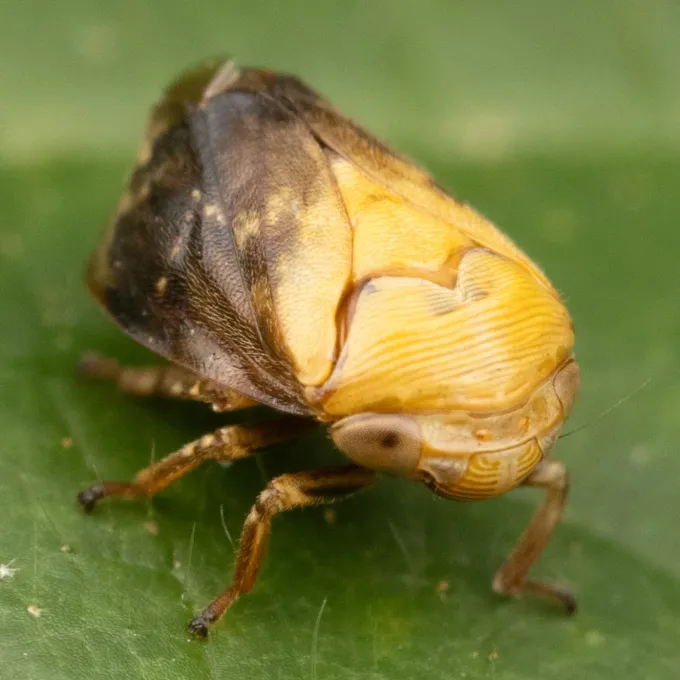
The adult insect is small, measuring about 5–6 mm in length. It possesses a broad head and compound eyes, with wings that are held roof-like over its body when at rest.
The body color is typically brown to blackish with distinct markings. The specific name achatina refers to the patterned look on the wings, reminiscent of agate stones.
Nymphs are soft-bodied and pale in color. They are almost never seen without the protective foam or "spittle" that they produce from their anus, which serves as a camouflage and a moisture barrier.
This protective mass is created by forcing air into the fluid secreted by the nymphs, which keeps them hidden from predators and protects their delicate bodies from desiccation.
What it damages
This species primarily targets plants within the Rosaceae family. Common hosts include apple, pear, cherry, and various ornamental shrubs often found in domestic gardens.
As sucking insects, both nymphs and adults use their specialized mouthparts to pierce plant tissues and feed directly on the xylem and phloem sap.
Heavy feeding by Clastoptera achatina results in stunted growth of young shoots. Leaves may curl, yellow, and lose their vitality due to the constant loss of nutrients.
The presence of foam blocks the stomata on the leaf surfaces, which hinders gas exchange and negatively affects the plant's photosynthesis processes.
Repeated or high-density infestations can severely weaken young trees, making them susceptible to secondary pathogens, fungal diseases, and environmental stress.
When it appears
The winter is typically passed in the egg stage, with the eggs deposited under the bark or near the buds of host plants. Hatching occurs during the spring as temperatures rise.
The nymphal stage is most visible during late spring and early summer (May to June). This is when they actively feed and produce the characteristic spittle nests.
Adult insects usually emerge by mid-summer. They are highly mobile and tend to move across the plant or fly to nearby trees to continue feeding and eventually mate.
The life cycle is generally univoltine, meaning there is one generation per year. However, temperature fluctuations can influence the exact timing of emergence in different regions.
By late summer, adult females lay eggs for the following year. Once the eggs are secured, the cycle remains dormant until the arrival of the next spring season.
Signs of infestation
The most diagnostic sign of an infestation is the appearance of white, frothy foam masses on the stems and leaf axils. These masses are unmistakable in their appearance.
Affected plants often show signs of wilting or chlorosis on the new growth. If left untreated, the tips of the branches may become twisted or fail to develop normally.
Plants infested with spittlebugs may also exhibit a sticky honeydew-like residue that can attract ants and promote the growth of black sooty mold on the foliage.
A closer inspection of the foam will reveal the presence of one or more nymphs. When disturbed, the nymphs usually move deeper into the foam for protection.
Distorted leaves and stunted shoot development are reliable indicators that the tree has been under pressure from these insects for a significant part of the growing season.
Control measures
For small-scale infestations, mechanical removal is highly effective. Simply washing the foliage with a strong jet of water will remove the foam and dislodge the nymphs.
Cultural practices such as proper pruning to improve air circulation and sunlight penetration can make the tree canopy less favorable for egg-laying and nymph development.
In cases of severe infestation, systemic or contact insecticides are recommended. Applications should be timed to hit the nymphs before they are fully protected by their foam.
Integrated Pest Management (IPM) should involve encouraging natural predators such as ladybugs, lacewings, and specific predatory wasps that hunt nymphs.
- Regular monitoring of young nursery plants.
- Removing weeds that may act as alternative hosts.
- Applying dormant oil sprays if egg masses are detected.
Taxonomy
- Latin name
- Clastoptera achatina
- Order
- Hemiptera (bugs, aphids, leafhoppers)
- Family
- Cercopidae
- EPPO code
- CLASAC
Discussion
No discussions yet — be the first.