
Soybean hawkmoth
Clanis
Description
How to identify
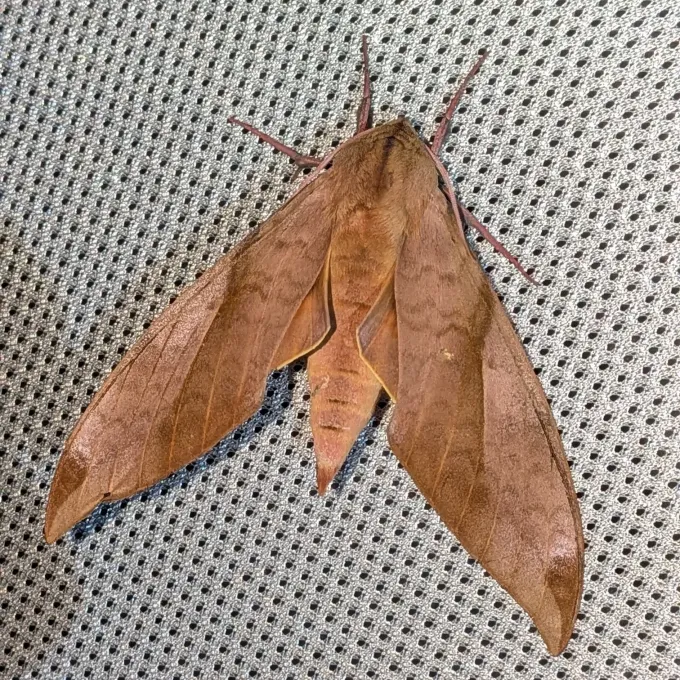
The Soybean hawkmoth (Clanis bilineata) is a large moth belonging to the family Sphingidae. The wingspan of the adult moth typically ranges from 80 to 100 mm, featuring brownish or ochre camouflage patterns that blend in with natural environments.
The larvae, known as caterpillars, are prominent due to their large size, reaching up to 10 cm in length. They are bright green with pale diagonal side stripes, which perfectly mimic the leaf veins of the soybean plant.
A distinctive feature of the caterpillar is a horn located on the posterior end of the body, a trait shared by many members of the Sphingidae family. They possess powerful mandibles suited for rapid consumption of vegetation.
Pupae are large, dark brown, and are typically found buried in the soil. They overwinter in this stage, protected from surface environmental conditions until the following spring.
The life cycle involves complete metamorphosis, consisting of four distinct stages: egg, larva, pupa, and adult. The developmental rate is highly influenced by ambient temperature and host availability.
What it damages
The primary host plant for this pest is the soybean (Glycine max). The larvae are specialized feeders that cause significant foliage loss throughout their development period.
Besides soybeans, the larvae may feed on various other leguminous plants. This polyphagous behavior allows the population to sustain itself even in diverse agroecosystems.
Damage is characterized by extensive defoliation, which severely reduces the plant's photosynthetic capacity. This leads to stunted growth, poor pod formation, and significant yield reductions.
In high-density outbreaks, the caterpillars can completely strip plants of their leaves, leaving only main stems. This leaves the soybean plant unable to recover or produce viable seeds.
Economic damage is most severe if infestation occurs during critical growth stages such as flowering or grain filling, as the plant cannot compensate for the lost foliage.
When it appears
Adult moths typically emerge in late spring or early summer, depending on soil temperatures and regional climate patterns. Mating occurs shortly after emergence.
Females deposit eggs on the undersides of soybean leaves. The eggs hatch after an incubation period of one to two weeks, initiating the larval stage.
The peak activity period for feeding larvae occurs during mid-summer. This coincides with the vegetative stage of the soybean crop, providing abundant food for the caterpillars.
Depending on the latitude and climate, there may be one or two generations per year, with the second generation often causing more widespread damage in late summer.
As temperatures begin to drop, mature larvae descend into the soil to pupate. The pupal stage enters diapause to survive the winter months, buried deep enough to avoid frost.
Signs of infestation
Early signs of infestation include small, irregular holes in the leaf blades. As the larvae grow larger, they consume entire leaf sections, leaving only the primary veins behind.
The presence of large, dark frass (droppings) on the soil beneath soybean plants is a definitive indicator of an active caterpillar population feeding above.
Caterpillars are often difficult to spot during the day as they rest on the underside of leaves or along stems. Their cryptic coloration makes them blend in seamlessly with the plant.
Stunted growth or wilting in specific patches of the field often suggests the presence of feeding larvae. Visual inspection of the canopy at night or dusk is often more effective than daytime scouting.
Heavy defoliation in patches across the field is a clear indicator of a severe infestation that requires immediate attention and potential intervention.
Control measures
Cultural control methods such as deep autumn plowing are effective. This disturbs the soil, bringing pupae to the surface where they become vulnerable to desiccation and natural predators.
Crop rotation is essential for long-term management. By alternating soybeans with non-leguminous crops, the life cycle of the pest is interrupted, reducing the local population pressure.
Chemical control involving insecticides is most effective when applied during the early larval stages, as young caterpillars are much more susceptible to treatment than late-instar larvae.
Biological control using Bacillus thuringiensis (Bt) based formulations is a widely recommended option. These products are specific to lepidopteran pests and minimize impact on beneficial insects.
Integrated Pest Management (IPM) strategies, including the use of pheromone traps, help monitor moth flight times, allowing for targeted and timely interventions only when necessary.
Taxonomy
- Latin name
- Clanis
- Order
- Lepidoptera (butterflies)
- Family
- Sphingidae
- EPPO code
- CLNISP
Discussion
No discussions yet — be the first.