
Chalcophora mariana
Chalcophora mariana
Description
How to identify
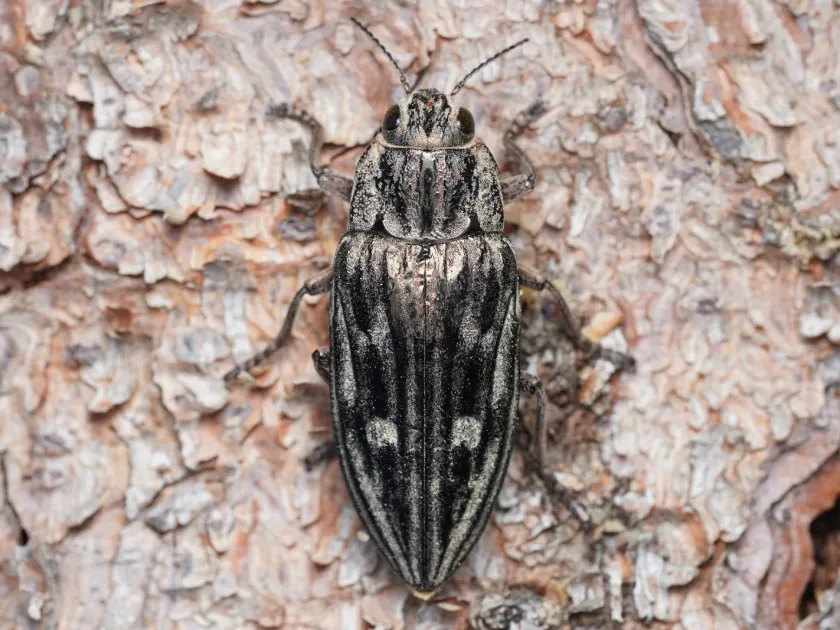
Chalcophora mariana, commonly known as the metallic pine borer or the large pine borer, is a member of the Buprestidae family. It is one of the largest species of wood-boring beetles found in European forests.
Adult beetles typically measure between 25 and 30 millimeters in length. Their bodies are elongated and slightly flattened, with a distinct metallic bronze or copper-black coloration that shines in sunlight.
The elytra (wing covers) are characterized by prominent longitudinal ridges and depressions, giving the beetle a rugged, sculptural appearance. This adaptation helps them blend in with the texture of pine bark.
The larvae are white, legless, and have a significantly widened thorax. They possess strong mandibles that allow them to tunnel efficiently through the thick bark and inner layers of dead or dying coniferous trees.
The lifecycle of this beetle is quite lengthy, often taking two to four years to complete. The duration of the development stage is highly dependent on ambient temperature and the nutritional quality of the wood.
What it damages
This species primarily attacks coniferous trees, with a strong preference for Scots pine (Pinus sylvestris). In some cases, it may also infest spruce trees that are already under significant physiological stress.
The damage is primarily caused by the larvae, which bore extensive galleries between the bark and the sapwood. These tunnels destroy the vascular system, preventing the transport of water and nutrients throughout the tree.
Infested trees often show signs of premature needle yellowing and thinning of the crown. While the beetle prefers weakened trees, large populations in drought-stricken areas can occasionally attack trees that appear healthy.
The tunneling activity creates entry points for various fungal pathogens and secondary wood-boring insects, which accelerates the decay and death of the tree.
Beyond the loss of individual trees, Chalcophora mariana causes economic damage by reducing the quality of timber, making the wood unsuitable for construction or high-end woodworking purposes.
Signs of infestation
The most reliable sign of an infestation is the presence of oval-shaped exit holes on the surface of the bark, which correspond to the shape of the adult beetle as it emerges.
A careful inspection of the tree trunk often reveals patches of loose or peeling bark. Beneath these patches, one can find intricate larval galleries filled with frass, a powdery mixture of wood debris and waste.
The crown of a heavily infested tree will gradually change color, moving from green to yellow and eventually red-brown as the tree dies. This process often starts from the upper branches.
Small piles of wood dust accumulating at the base of the tree are also indicators of active tunneling within the stem or major branches.
During the warm summer months, adult beetles can sometimes be spotted sunning themselves on the bark of infested pine trees, as they require heat to remain active.
Control measures
The most effective strategy for managing Chalcophora mariana is maintaining forest hygiene. Regularly removing dead, dying, and weakened trees prevents the buildup of beetle populations.
Sanitary logging operations should be conducted during the winter months, before the larvae pupate and emerge as adults in the following spring or summer.
The use of trap trees, which are left in the forest to attract adult females for egg-laying, is a common technique. These trees must be removed and debarked before the next generation of beetles emerges.
In high-value areas like urban parks or nurseries, protective netting or targeted insecticide applications may be used to prevent adult beetles from accessing the trunks.
- Regular forest health surveys to detect infestations early.
- Prompt removal of logging residue to prevent habitat creation.
- Promotion of biodiversity to encourage natural predators such as woodpeckers.
Taxonomy
- Latin name
- Chalcophora mariana
- Order
- Coleoptera (beetles)
- Family
- Buprestidae
- EPPO code
- CHACMA
Discussion
No discussions yet — be the first.