
Japanese pine sawyer
Chalcophora japonica
Description
How to identify
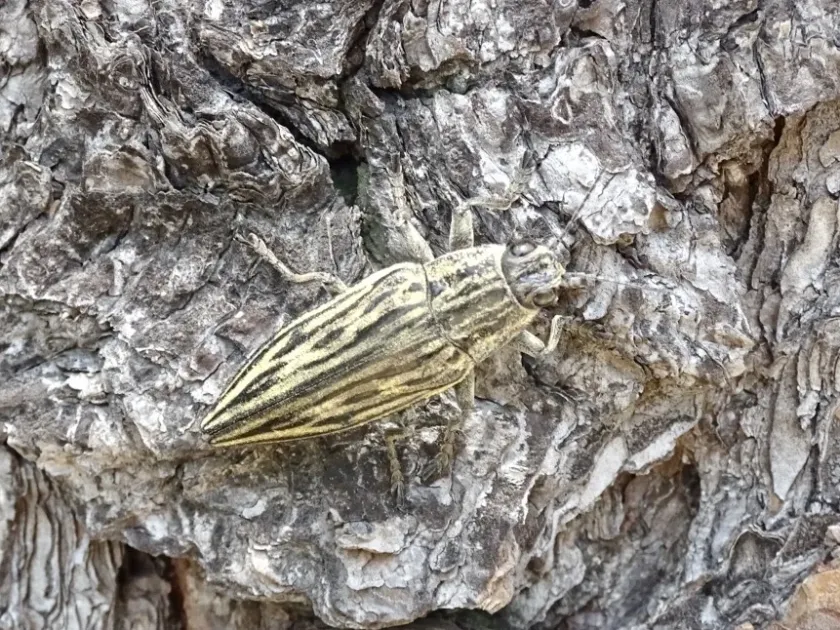
The Japanese pine sawyer (Chalcophora japonica) is a large beetle belonging to the Buprestidae family, order Coleoptera. Adult beetles are characterized by their elongated, robust bodies with a striking metallic bronze or nearly black sheen.
Adult individuals typically measure between 30 and 45 millimeters in length, making this species one of the largest and most distinct members of the Buprestidae family found in its range.
The head and pronotum of the beetle feature deep punctures and fine, wavy grooves, providing a highly textured and durable exterior surface.
Larvae are legless, flattened at the anterior end, and equipped with strong mandibles adapted for excavating galleries through dense woody tissues. They usually appear white or yellowish.
The insects are primarily diurnal, often basking in direct sunlight on the trunks of host trees, which makes them easier to spot during the warmer summer months.
What it damages
The primary hosts of this pest are various coniferous species, particularly those in the genus Pinus (pines), as well as certain cedar and spruce species commonly found in forests and ornamental plantations.
Damage is primarily caused by the larvae, which burrow into the bark to feed on the cambium and phloem layers, effectively girdling the tree and interrupting nutrient transport.
In cases of severe infestation, the larval galleries can completely encircle the trunk, leading to the rapid decline and eventual death of the affected tree.
Adult beetles also cause minor damage by feeding on needles and young tender bark on twigs, although this is generally less destructive than the internal damage caused by the larvae.
Affected trees lose their vigor and economic value, often becoming attractive to secondary pests such as bark beetles or wood wasps, accelerating the decay process.
When it appears
Adult beetles emerge in late spring, with activity continuing throughout the summer months. Peak activity is typically observed in June and July when warm temperatures facilitate flight and mating.
Females lay eggs in the crevices of the bark, typically targeting weakened or stressed trees. The egg-laying process is staggered, allowing the population to persist under varying climatic conditions.
Upon hatching, larvae immediately bore into the wood. Larval development is slow and can span several years, depending on tree health and local environmental temperature regimes.
Pupation occurs within specifically excavated chambers deep inside the wood. Once the pupal stage is complete, the adult beetle chews a characteristic exit hole to emerge.
The emergence of the next generation usually occurs in the latter half of the summer, beginning a new cycle of maturation and egg-laying for the subsequent year.
Signs of infestation
The most prominent sign of an infestation is the presence of large, oval-shaped exit holes on the bark of the host tree, where adult beetles have vacated the wood.
Beneath the bark, one can often find extensive, flat galleries packed with frass (larval excrement). In advanced stages, the bark may peel away in large sections due to structural failure.
Needle yellowing and premature needle drop are common symptoms, indicating that the tree’s internal vascular system has been compromised by the feeding activities of the larvae.
Resin exuding from the bark (resinosis) is another indicator, as the tree attempts to "pitch out" the invading larvae as a natural defense mechanism against the borer.
Because the infestation weakens the tree, other wood-boring insects may colonize the site, leading to a complex pattern of damage and overall tree decline.
Control measures
Sanitation is the most effective management strategy; this involves identifying, cutting, and removing heavily infested trees to eliminate breeding sites for the beetle population.
Promoting overall tree vigor through adequate irrigation, fertilization, and careful pruning helps increase the tree's natural resistance to colonization by the sawyer.
During the adult flight period, applying systemic or contact insecticides to the trunk can help reduce the population of adults before they lay eggs on susceptible trees.
Pheromone-based monitoring traps can be utilized to track population trends and determine the most appropriate timing for intervention in parks or pine nurseries.
- Regular inspection of forest margins and ornamental stands.
- Removal of fallen timber to reduce breeding habitat.
- Application of biological control agents like entomopathogenic fungi.
Taxonomy
- Latin name
- Chalcophora japonica
- Order
- Coleoptera (beetles)
- Family
- Buprestidae
- EPPO code
- CHACJA
Discussion
No discussions yet — be the first.