
Sika deer
Cervus nippon
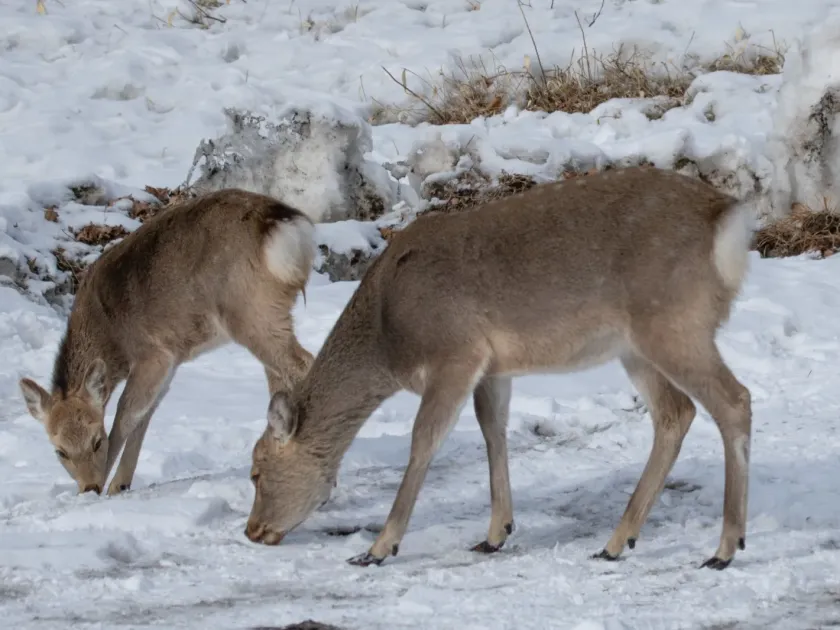
Description
How to identify
The Sika deer (Cervus nippon) is a mammal belonging to the order Artiodactyla and the family Cervidae. Adult individuals reach a height of 90–110 cm at the shoulder and weigh up to 100–130 kg.
A distinctive feature is the reddish-brown coat with white spots arranged in rows along the back and sides. In winter, the fur becomes duller and coarser, making the spotting less visible.
Males possess branched antlers, which they shed annually in April. These animals are primarily crepuscular, possessing sharp hearing and a keen sense of smell, making them difficult to detect in the field.
Breeding occurs once a year, with the rutting season lasting from late September to early November. Deer often stay in herds, which increases the scale of damage when they invade agricultural fields.
High adaptability allows the species to occupy various landscapes, including forest edges adjacent to agricultural land, making them a significant risk factor for farmers.
What it damages
The animals cause significant damage to orchards, especially young plantings of apple, pear, and stone fruit trees, by browsing on bark and young shoots.
Cereal crops, such as winter wheat and barley, suffer severely as deer consume them during early growth stages in autumn and spring.
Crops such as soybeans, corn, rapeseed, and sunflowers are damaged, where deer not only consume the green biomass but also trample large areas of the planting.
In ornamental and forestry nurseries, deer browse on the apical buds of saplings, leading to distorted stems and the degradation of future commercial material.
A specific danger is winter bark stripping, where animals peel the bark, exposing the wood and leaving the tree vulnerable to fungal infections and pests.
When it appears
Maximum pest activity in fields is observed in early spring, when natural forage in the forest is scarce and winter crops begin to grow intensively.
In autumn, pests actively visit cereal and vegetable fields, selecting the most succulent and nutritious plant parts to accumulate fat stores before winter.
The winter period is characterized by increased interest in young orchards, where animals feed on tree shoots and bark due to limited access to forage under the snow.
In summer, damage may decrease if natural forage in forest areas is sufficient; however, in dry years, deer more frequently enter irrigated crop fields.
The annual population cycle involves periods of high mobility for young deer, increasing the risk of damage to new areas in mid-summer.
Signs of infestation
Key signs of presence include characteristic hoof prints on moist soil, which are easily distinguishable from those of domestic livestock.
Browsed shoot tips with ragged edges (unlike the clean cuts typical of lagomorphs) clearly indicate feeding by ungulates.
Bark stripped at a height of 1–1.5 meters above the ground indicates winter feeding activity, often accompanied by antler rubs on tree trunks.
Accumulations of oval-shaped droppings on field edges are a reliable sign of regular visitation by a herd.
Trampled vegetation, well-worn trails inside crop fields, and bird behavior changes can also signal the presence of the pest.
Control measures
The most effective protection method is the installation of permanent fences at least 2–2.5 meters high, preferably using chain-link or galvanized wire.
Electric fences have proven effective, as they use low-voltage pulses to safely deter animals from field boundaries.
The use of visual and auditory deterrents, such as reflective tapes, ultrasonic emitters, or motion-activated floodlights, offers only temporary relief.
Application of repellents to tree bark or around field perimeters helps reduce the attractiveness of protected plots to wild ungulates during critical periods.
- Organizing feeding stations deep in the forest to lure the herd away from crop plantings.
- Regular monitoring of the perimeter by game wardens.
- Timely harvesting to minimize the duration of pest access to forage.
Taxonomy
- Latin name
- Cervus nippon
- Family
- Cervidae
- EPPO code
- CERVNI
Discussion
No discussions yet — be the first.