
Red deer
Cervus elaphus
Description
How to identify
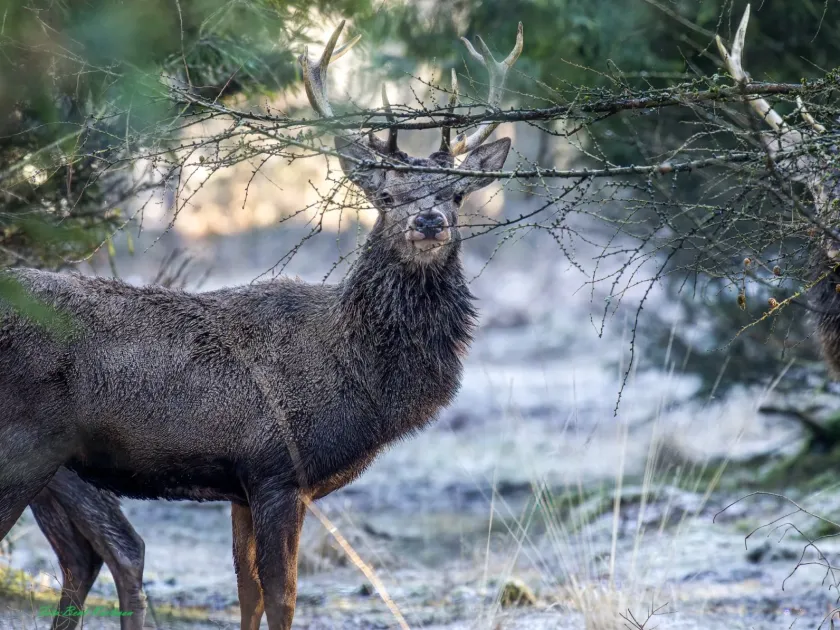
The Red deer (Cervus elaphus) is a large mammal belonging to the Cervidae family and the Artiodactyla order. Males are known for their large, branched antlers which they shed annually.
These animals are characterized by their sturdy build and seasonal color changes, typically reddish-brown in summer and grayish-brown in winter for camouflage.
Red deer are highly social and herd-dwelling, with peak activity occurring during twilight and at night. They rely on their keen senses of smell and hearing to detect danger.
Their life cycle involves seasonal migrations, with rutting taking place in the autumn and fawns born in the late spring, coinciding with the rapid growth of agricultural crops.
High population densities in certain regions force these animals to expand their foraging range, leading them to exploit cultivated agricultural lands.
What it damages
Red deer cause significant economic loss in forestry by browsing on terminal buds and shoots of young saplings, often causing stunted growth or tree deformation.
In agriculture, they target winter cereals, rapeseed, and various pasture grasses. Feeding by large herds can destroy significant portions of a crop within a single night.
Orchards are particularly vulnerable, as deer strip the bark from young trees, which makes the trees susceptible to fungal infections and can lead to death.
Physical trampling is another major source of damage; large herds moving across a field can flatten crops, rendering them unsuitable for mechanical harvesting.
Additionally, they may damage stored hay or forage piles during harsh winters when natural food sources are scarce.
When it appears
The most intense foraging pressure on agricultural fields occurs during the late autumn and winter months when natural forest forage is insufficient.
In early spring, deer are frequently observed in fields of winter wheat, attracted by the nutrient-dense succulent green sprouts.
Summer feeding involves grazing on herbaceous plants and younger crops, often leading to damage in gardens and peripheral areas of fields.
Autumn migration patterns and the rutting season increase the likelihood of deer passing through agricultural plots, causing mechanical damage to crops.
Weather severity is the primary driver of their migration, with deep snow cover effectively pushing them toward human-inhabited areas.
Signs of infestation
Distinctive hoof prints in soft soil are the most reliable indicator of deer presence, identifiable by their characteristic size and shape.
Browse marks on branches, where shoots appear cleanly cut at an angle, indicate active feeding by deer rather than smaller herbivores.
Bark damage or "fraying" on the lower trunk of trees, sometimes up to two meters high, is a clear sign of rutting activity or hunger-driven feeding.
Fecal droppings and beaten paths leading from the forest edge into the field provide evidence of established routes used by the herd.
In snowy conditions, sightings of "beds" or flattened areas where the herd has rested are key indicators of their nearby habitation.
Control measures
Physical exclusion through high-tensile wire fencing or mesh netting is the most effective way to prevent deer from entering sensitive agricultural and nursery areas.
Acoustic and visual deterrents, such as motion-activated lights or sound-based scare tactics, can provide effective short-term relief from nocturnal feeding.
Chemical repellents applied to tree trunks or along field borders can deter deer by creating olfactory barriers that animals find unpleasant.
Integrated wildlife management, including the provision of dedicated forage plots inside forests, helps minimize the attraction of deer to farmland.
- Installing high exclusion fencing.
- Using motion-activated deterrents.
- Applying commercial taste-based repellents.
- Managing deer density via local authorities.
Taxonomy
- Latin name
- Cervus elaphus
- Family
- Cervidae
- EPPO code
- CERVEL
Discussion
No discussions yet — be the first.