
Puss moth
Cerura vinula
Description
How to identify
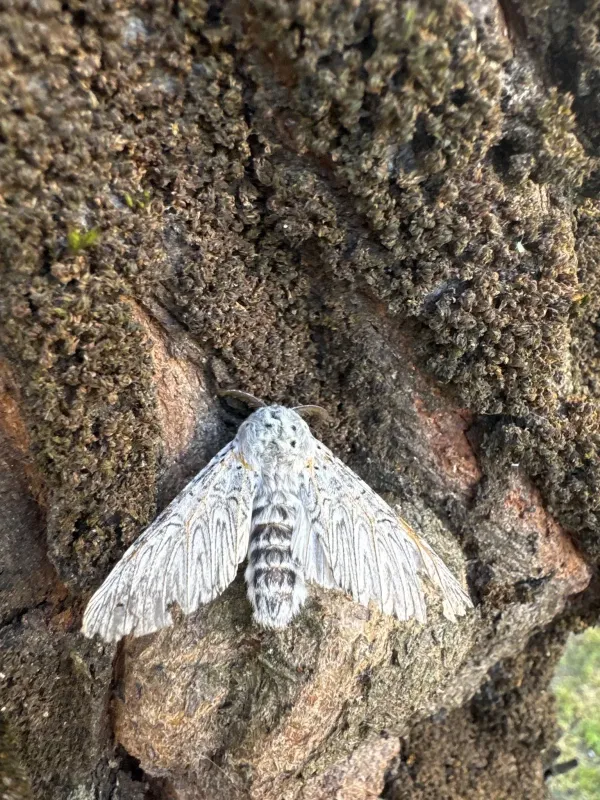
The Puss moth (Cerura vinula) is a large moth belonging to the Notodontidae family. Its wingspan ranges from 60 to 80 mm, making it quite noticeable.
The moth has a distinctive grey-white appearance with dark, intricate patterns that provide excellent camouflage against tree bark during the day.
The caterpillar is highly distinctive, featuring a bright green body with a purple-brown dorsal stripe and two whip-like tails at the rear end.
These tails contain eversible red threads used to deter predators, a unique defense mechanism among European moth species.
When threatened, the caterpillar adopts a defensive posture, inflating its thorax and presenting its red-spotted face, which looks intimidating.
What it damages
The larvae primarily feed on the foliage of willow (Salix) and poplar (Populus) trees, which are the main host plants for this species.
Young caterpillars skeletonize the leaves, while larger larvae consume the entire leaf blade, leaving only the midribs intact.
Heavy infestations can cause significant defoliation, which stresses the tree and reduces its ability to perform photosynthesis effectively.
In nurseries, repeated damage to young saplings can lead to stunted growth and increased susceptibility to fungal diseases.
While mature trees can usually withstand moderate defoliation, repeated annual attacks can lead to the decline of vulnerable or stressed specimens.
When it appears
The adults are typically active from late spring to early summer, with the peak flight period usually occurring in May and June.
After mating, females lay eggs singly on the leaves of host trees, and larvae emerge after a short incubation period of about ten days.
The caterpillar stage lasts throughout the summer months as the larvae grow and undergo several instars before they are ready to pupate.
Pupation occurs in a very tough, wood-like cocoon that is camouflaged with bark fragments to blend seamlessly with the tree trunk.
The pupa overwinters inside this cocoon, emerging as an adult moth the following spring to restart the biological cycle.
Signs of infestation
The presence of Puss moth larvae is indicated by characteristic leaf damage, starting from the upper canopy and moving downwards.
Droppings (frass) on the ground or on lower leaves are a clear sign that caterpillars are feeding in the canopy above.
Visual identification of the large, vibrantly colored caterpillars is the most reliable way to confirm an infestation on poplar or willow.
Hard, lumpy cocoons found on the bark of trunks in late autumn are reliable indicators of where the next generation will emerge from.
In the spring, empty pupal cases or the presence of the large, furry moths near the base of trees may signify local breeding activity.
Control measures
Manual removal of caterpillars is highly effective in small gardens or on young trees, as they are relatively easy to spot and collect.
Biological control using Bacillus thuringiensis sprays is recommended to manage populations without harming beneficial insect predators.
Systemic insecticides may be used in commercial nurseries to protect saplings, but they should be applied according to local environmental regulations.
Winter maintenance, such as inspecting trunks for cocoons and scraping them off, significantly reduces the population for the next season.
- Encouraging insectivorous birds, which are natural predators of moth larvae.
- Using sticky bands on trunks to monitor and capture larvae moving on the tree.
- Maintaining tree health through proper irrigation to increase tolerance to defoliation.
Taxonomy
- Latin name
- Cerura vinula
- Order
- Lepidoptera (butterflies)
- Family
- Notodontidae
- EPPO code
- CERUVD
Discussion
No discussions yet — be the first.