
Poplar kitten
Cerura multiscripta
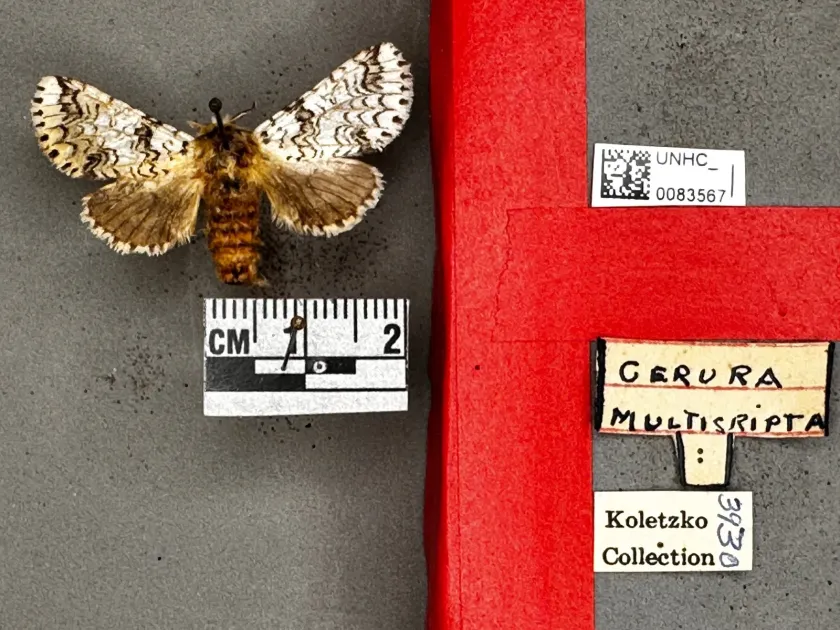
Description
How to identify
The poplar kitten (Cerura multiscripta) is a moth belonging to the family Notodontidae. Adult moths are relatively large with a wingspan of 60–70 mm, characterized by complex, cryptic patterns on their forewings that resemble wood grain.
The larvae are highly distinctive, featuring a vibrant green base color with a broad, brownish-purple saddle marking on the back. They possess two long, tail-like appendages on the posterior end.
When threatened, the larva displays its defensive mechanisms by elevating the front of its body and whipping its tails. It can also eject a form of formic acid to ward off potential predators such as birds and ants.
The pupal stage is protected within a very dense, silk-reinforced cocoon that is intricately camouflaged against the bark of the host tree. This makes it exceptionally difficult to spot during winter dormancy.
The biological development follows a complete metamorphosis: egg, larva (five instars), pupa, and adult. Most populations in temperate regions are univoltine, though some may produce a second brood.
What it damages
The primary hosts for this species are members of the Salicaceae family, specifically Salix (willow) and Populus (poplar) species. They prefer young, succulent leaves during the early stages of their growth.
In cases of high population density, these larvae can cause significant defoliation of trees in parks, riverbanks, and plantations. The larvae feed on the leaf blade, often consuming the entire leaf except for the midribs.
Young larvae often skeletonize leaves, while older stages consume them entirely. This behavior can lead to stunted growth and reduced vigor in saplings that are already struggling with environmental stress.
Repeated annual defoliation by this pest weakens the tree's health, making it more susceptible to secondary fungal infections and wood-boring insect attacks that take advantage of the tree's compromised state.
While the economic impact is usually localized, outbreaks in willow nurseries can lead to significant financial losses due to the loss of marketable biomass and the costs of corrective pesticide applications.
When it appears
Adult moths emerge in late spring, typically during May and June. They are primarily nocturnal, spending their days resting on tree trunks where their coloration provides excellent camouflage.
Egg-laying occurs shortly after mating, with eggs deposited individually or in small clusters on the underside of host leaves. The incubation period lasts approximately one to two weeks depending on temperatures.
The larval feeding phase is the most active part of the lifecycle, occurring throughout the summer months of June, July, and occasionally August if a second generation occurs.
Pupation takes place toward the end of summer or early autumn. The larvae construct their hard, bark-like cocoons on the stems or trunks of host plants, where they remain throughout the winter.
The exact timing of the lifecycle stages can fluctuate based on the local climate, with warmer southern regions often showing earlier activity compared to colder northern environments.
Signs of infestation
The most visible sign of an infestation is leaf damage, ranging from small holes to completely eaten leaves. Observing the canopy for ragged edges is a good starting point for monitoring.
Accumulation of frass (caterpillar droppings) on the ground underneath the tree is a strong indicator of an active feeding colony present in the branches above.
Careful inspection of the tree trunks, especially in crevices and near branch unions, may reveal the tough, camouflaged cocoons left behind from previous seasons or during the pupal stage.
Adult moth presence can be monitored using ultraviolet light traps, which are effective for assessing the population pressure before the caterpillars hatch and begin feeding.
Increased bird activity, particularly by insectivorous species, around willow or poplar stands can sometimes serve as a natural indicator that a caterpillar population is active in the canopy.
Control measures
Manual collection of larvae is a viable and environmentally friendly solution for small-scale infestations, such as in private gardens or on individual ornamental trees.
Biological control using Bacillus thuringiensis (Bt) is highly effective against young larvae and is recommended to preserve beneficial insect populations in the vicinity of the infested trees.
Chemical control with systemic or contact insecticides is reserved for major outbreaks where mechanical and biological methods are insufficient to prevent severe crown damage.
Sanitation practices, including the removal and destruction of fallen leaves and organic debris around the base of the trees in autumn, can help reduce the number of overwintering pupae.
Maintaining tree vigor through proper irrigation and fertilization is essential for helping the trees withstand and recover from the stress caused by caterpillar herbivory during the summer.
Taxonomy
- Latin name
- Cerura multiscripta
- Order
- Lepidoptera (butterflies)
- Family
- Notodontidae
- EPPO code
- CERUMU
Discussion
No discussions yet — be the first.