
Catalpa sphinx moth
Ceratomia catalpae
Description
How to identify
The Catalpa sphinx moth (Ceratomia catalpae) belongs to the Sphingidae family. Adult moths are typically drab, mottled brown or grey in color, which provides excellent camouflage against the bark of host trees.
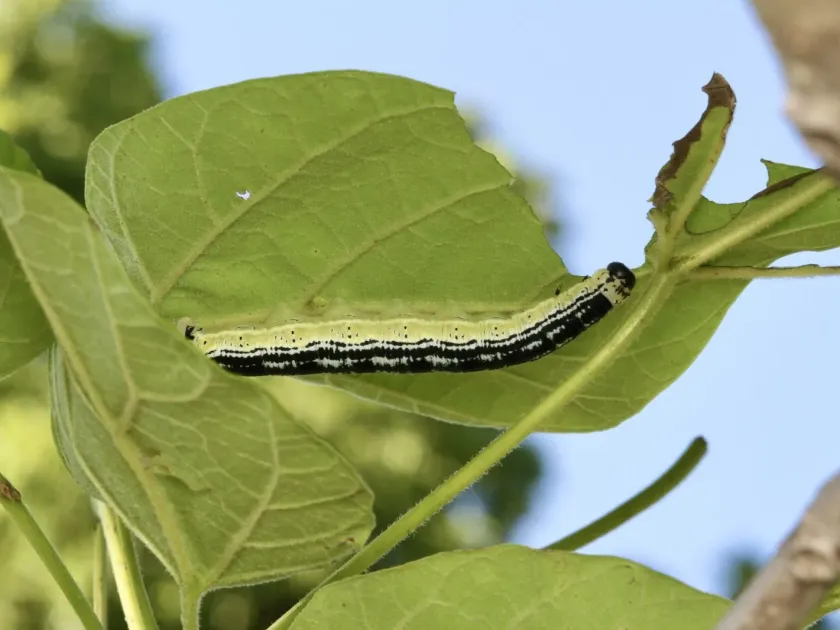
The larval stage, known as the Catalpa worm, is the most recognizable. These caterpillars grow up to 3 inches long and typically feature a black stripe down the back with yellow sides, ending in a distinct horn.
The life cycle involves complete metamorphosis, with the pupal stage occurring underground. In warmer climates, these insects can complete multiple generations within a single growing season.
Overwintering takes place in the soil as pupae, making the moths well-adapted to surviving varying winter temperatures within their native range.
Adult moths are nocturnal and rarely seen, while the caterpillars are the primary life stage observed by gardeners and arborists during the summer months.
What it damages
The Catalpa sphinx moth is a specialist herbivore, feeding almost exclusively on trees within the genus Catalpa, including both northern and southern catalpa species.
Young larvae feed in colonies, causing noticeable skeletonization of the leaves. As they mature, they disperse throughout the tree canopy and consume entire leaves.
Severe infestations can result in complete defoliation of a tree, which causes significant stress to the host plant and can hinder its physiological development.
Repeated annual defoliation, while rarely lethal to mature trees, significantly reduces their ornamental value and overall health, leaving them susceptible to secondary stressors.
In nursery environments, the impact is more pronounced, as young trees require adequate leaf surface for photosynthesis and proper development.
Signs of infestation
The most immediate sign of an infestation is the presence of frass (caterpillar droppings), which look like dark, granular pellets accumulating on the ground beneath the tree.
Visible thinning of the canopy is common, as leaves are consumed. Often, the leaf veins remain, but the leaf tissue is completely removed, resulting in a tattered look.
Egg masses can be found on the undersides of leaves during the spring. They are usually laid in clusters, appearing as small, shiny, yellowish patches.
Active caterpillars are generally quite easy to spot when looking up into the canopy, as they are large and move relatively quickly when feeding.
- Accumulation of dark pellet-like frass on the soil
- Tattered or missing leaf blades in the canopy
- Visible large, horn-backed caterpillars
- Sudden branch defoliation during mid-summer
Control measures
For smaller trees or light infestations, manual picking of the caterpillars and placing them into soapy water is an effective and non-toxic control strategy.
Biological control using sprays containing Bacillus thuringiensis (Bt) is highly recommended, as it selectively targets the larvae while preserving beneficial garden insects.
If the infestation is extensive and threatens the health of larger specimen trees, systemic or contact insecticides may be applied by a certified arborist.
Tilling or disturbing the soil beneath the canopy in late fall or early spring can help expose and destroy overwintering pupae, reducing the next generation's population.
Monitoring the trees frequently starting in late spring ensures that control measures can be taken before the caterpillars reach their most destructive, mature stage.
Taxonomy
- Latin name
- Ceratomia catalpae
- Order
- Lepidoptera (butterflies)
- Family
- Sphingidae
- EPPO code
- CERICA
Discussion
No discussions yet — be the first.