
Coffee bee hawkmoth
Cephonodes picus
Description
How to identify
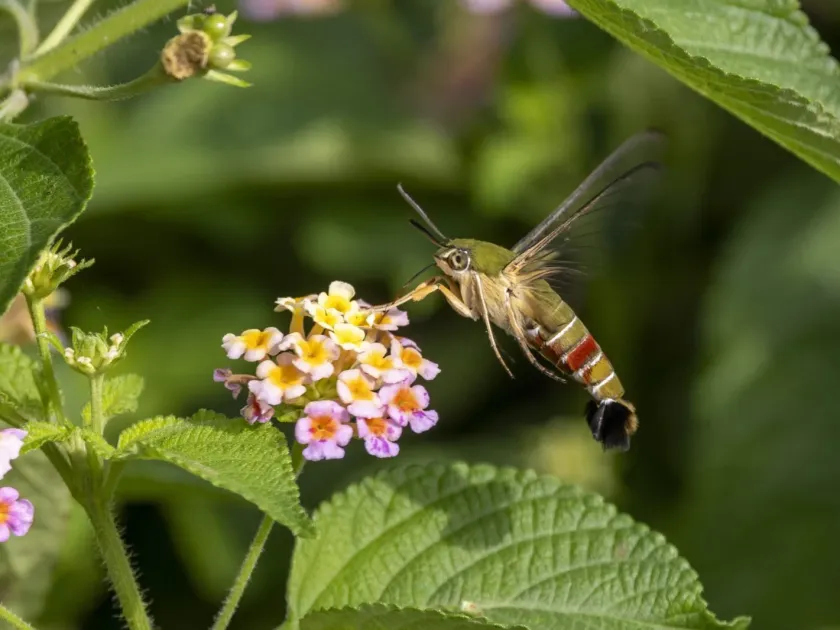
The adult coffee bee hawkmoth (Cephonodes picus) belongs to the family Sphingidae and the order Lepidoptera. This insect features characteristic transparent wings because the scales fall off shortly after its first flight.
The body of the moth is covered with dense green and yellow hairs, making it look like a large bumblebee or hummingbird when hovering over flowers. The wingspan ranges from 40 to 60 millimeters, and the abdomen ends in a prominent fan-shaped tuft of scales.
The larvae go through several developmental stages, changing color from light green to darker shades with bright lateral stripes. A characteristic horn is located at the end of the caterpillar's body, which is typical for all members of the hawkmoth family.
The life cycle includes complete metamorphosis: egg, larva, pupa, and imago. In warm tropical climates, the pest can produce several generations within a single calendar year.
Imago activity occurs mainly during daylight hours, unlike many other members of the family that are nocturnal.
What it damages
The primary food source for the larvae of this pest are plants of the Rubiaceae family, including Coffea arabica.
In addition to coffee trees, the caterpillars actively feed on gardenia foliage, causing significant damage to ornamental plantings in gardens and greenhouses.
Plants lose a significant part of their leaf surface, leading to impaired photosynthesis and a weakening of the crop's overall immunity.
During mass outbreaks, the pest can completely strip branches of the plant, which critically reduces the yield of coffee plantations.
Young seedlings are the most vulnerable, as they often cannot recover after caterpillar damage and eventually die.
Signs of infestation
The first visual sign of the pest's presence is eaten leaf edges and characteristic holes through the leaf blades.
Excrement in the form of small dark granules can often be found under damaged plants, which is a reliable indicator of infestation.
Upon careful inspection of the underside of leaves, single or clustered eggs can be found, laid by the female primarily along the central vein.
The caterpillars themselves, despite their camouflage, become visible when they reach a large size, especially during the morning or evening hours.
Stunted plant growth, yellowing, and premature leaf drop also indicate a severe infestation by the pest.
Control measures
The mechanical control method involves regular manual collection of caterpillars, which is effective for small areas or low population density.
The use of biological insecticides based on Bacillus thuringiensis allows for the destruction of young larvae without harming beneficial pollinating insects.
Chemical protection includes spraying with contact-stomach insecticides if the economic threshold of damage is exceeded.
An important element of prevention is maintaining high biodiversity in the area to attract the hawkmoth's natural enemies, such as birds and predatory insects.
Timely sanitary pruning and the destruction of plant debris help reduce the population of pupae overwintering in the soil layer under the plant.
Taxonomy
- Latin name
- Cephonodes picus
- Order
- Lepidoptera (butterflies)
- Family
- Sphingidae
- EPPO code
- CEPOPI
Discussion
No discussions yet — be the first.