
Coffee clearwing moth
Cephonodes hylas
Description
How to identify
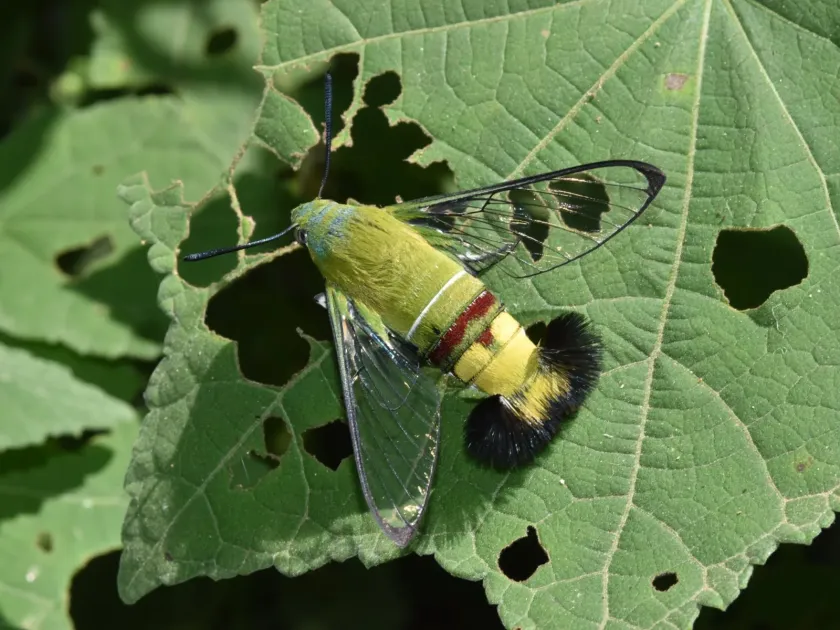
The coffee clearwing moth (Cephonodes hylas) is a striking insect belonging to the order Lepidoptera, family Sphingidae. The adult has a unique appearance: clear, transparent wings with a dark border and a greenish body, which often leads to it being mistaken for a hummingbird in flight.
The wingspan of the adult ranges from 45 to 60 mm. Most of the scales on the wings are shed shortly after emergence from the pupa, leaving the wings almost entirely transparent. The abdomen features a broad reddish-brown band, which is a key diagnostic feature for the species.
Eggs are spherical, light green in color, and are typically laid singly on the underside of young host plant leaves. The larvae progress through five instars, changing color from light green to darker shades as they grow, and develop a characteristic horn on the posterior end of the body.
The pupa is dark brown or black in color. Pupa development occurs in the soil, where the larva burrows after completing its feeding stage to construct a loose cocoon made of silk and soil particles.
The biology of this species is closely linked to tropical climates, where generations can overlap continuously throughout the year. Adults are diurnal, feeding on nectar while hovering in flight, a trait that distinguishes them from many other hawkmoth species that are crepuscular or nocturnal.
What it damages
The primary host plant for the larvae is coffee (Coffea arabica). The pest can cause significant damage to plantations, reducing the overall vegetative mass and vigor of the shrubs.
In addition to coffee plants, the larvae feed on the foliage of various ornamental species. Their host range includes plants from the Rubiaceae and Verbenaceae families, which expands the potential impact on agricultural landscapes.
In its natural habitat, the pest is also found on wild shrubs, creating a continuous reservoir of infestation for adjacent agricultural fields.
The high consumption rate of older instar larvae often leads to complete defoliation of individual branches. This disrupts photosynthesis, which ultimately has a negative impact on coffee bean yield.
Extensive damage to young shoots renders the plant vulnerable to secondary infections that enter through tissues damaged by the insect's mouthparts.
Signs of infestation
The first sign of infestation is the appearance of irregularly shaped holes in the leaves. Larvae actively feed on the leaf blade, starting from the edges and progressing toward the midrib.
Small, dark granular droppings (frass) under the shrub canopy are a clear indication of larval presence and active feeding. The accumulation of these signs indicates that the pest population is thriving.
Upon closer inspection of the leaf undersides, one can often find eggs or early-stage larvae. The larvae tend to hide on the lower surface to avoid direct sunlight.
In cases of mass infestation, noticeable stripping of terminal shoots occurs. Intense feeding slows down the plant's growth, which visually manifests as a stunting of new shoot development.
Damaged leaf tissues often develop necrotic spots along the edges of the chewed areas, resulting from mechanical damage and subsequent cell oxidation.
Control measures
The foundation of population control in small-scale holdings is the mechanical collection of larvae. Regular inspection of plants and manual removal of larvae are effective in keeping the pest population at a low level.
The use of biological control agents, such as formulations based on Bacillus thuringiensis, has proven highly effective against early-instar larvae without harming beneficial entomophages.
On a commercial scale, when the threat of significant crop loss arises, contact-stomach insecticides approved for use on coffee plantations may be employed.
- Thinning of canopy density to improve ventilation.
- Removal of weeds that serve as alternative hosts for the pest.
- Encouraging natural enemies such as predatory wasps and parasitoid wasps.
Monitoring adult flight using light traps is a critical aspect, allowing for the precise timing of control measures during the peak period of larval emergence.
Taxonomy
- Latin name
- Cephonodes hylas
- Order
- Lepidoptera (butterflies)
- Family
- Sphingidae
- EPPO code
- CEPOHY
Discussion
No discussions yet — be the first.