

Pest · Coleoptera (beetles) · affects Cereals, Tomato, Common hop
Ground beetle (Zabrus tenebrioides)
Carabus
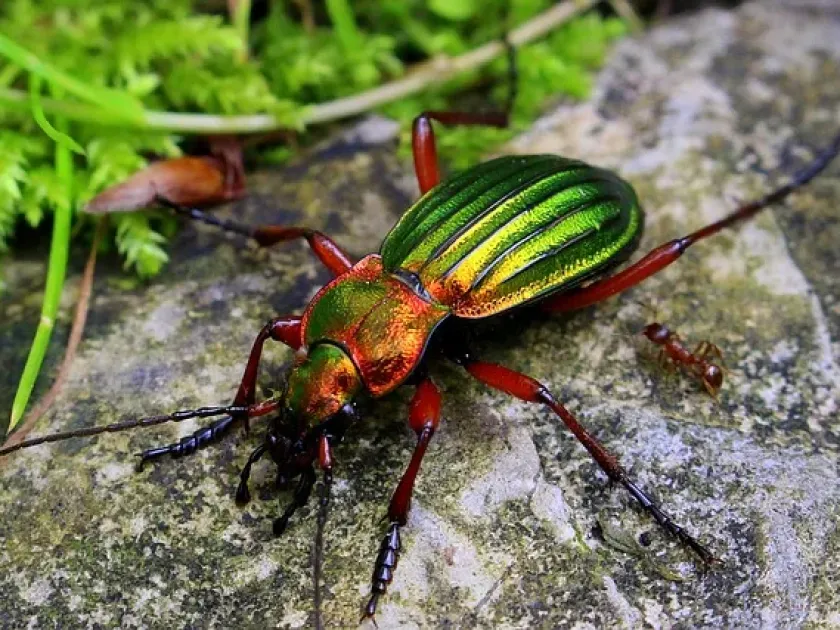
Description
How to identify
The ground beetle (Zabrus tenebrioides), often referred to as the cereal ground beetle, is a significant pest of cereal crops, distinct from many beneficial predatory beetles.
Adult beetles are typically 12–16 mm long, possessing a black or dark brown body with a slight metallic luster, and are characterized by a robust, convex shape.
The larvae are yellowish-brown, spindle-shaped, with well-developed legs, making them highly mobile and capable of moving through the soil horizon.
The life cycle involves full metamorphosis, including egg, larval, pupal, and adult stages, with each stage uniquely adapted to cereal ecosystems.
Unlike most Carabidae which are beneficial predators, both adults and larvae of this species are specialized herbivores targeting wheat and other grasses.
What it damages
Larvae cause severe damage during the autumn, feeding on young cereal sprouts, often destroying them completely by chewing the leaves down to the nodes.
In the spring, larvae continue to feed, causing thinning of the crop and creating empty patches within the field where the stand is destroyed.
Adult beetles damage the crop during the maturation stage by feeding on the grain in the ears, which leads to significant yield losses and reduced crop quality.
The most severe damage is observed in monoculture systems where wheat or barley is grown repeatedly on the same land without proper rotation.
Heavy infestations can lead to total loss of the crop on specific parts of the field, requiring expensive reseeding operations.
When it appears
The life cycle begins in late summer when eggs are deposited into the soil during the preparation of land for winter cereal crops.
Larvae hatch in the autumn, establishing feeding sites near the developing seedlings, where they remain active until temperatures drop significantly.
Overwintering occurs in the soil, with larvae resuming their feeding behavior as soon as the soil warms up during the early spring months.
Pupation takes place in earthen cells located within the soil during the late spring, lasting for several weeks before the emergence of the new adult generation.
Adult beetles emerge in early summer, becoming active during the ripening of the cereal crops and completing the annual cycle.
Signs of infestation
The primary sign of infestation is the presence of shredded or ragged leaves on young seedlings, particularly in the fall, which is a telltale sign of larval feeding.
Observation of small vertical burrows in the soil near damaged plants often reveals the presence of larvae lurking just beneath the surface.
During the spring, the appearance of bald patches in the field indicates areas where the beetle population has successfully decimated the early crop stands.
Infected ears at harvest time exhibit missing or partially eaten grains, which is a direct consequence of adult beetle activity during the maturation phase.
Increased activity of birds (such as rooks) in specific areas of the field often acts as a biological indicator of high beetle concentrations.
Control measures
Crop rotation is the most critical cultural practice, as it breaks the pest's cycle by removing the continuous availability of cereal hosts.
Deep autumn plowing serves as an effective mechanical method, burying larvae deep into the soil and destroying their natural shelters and feeding sites.
Seed treatment with systemic insecticides provides essential protection for seedlings during the most vulnerable stages of development in the autumn.
In cases of economic threshold exceedance, chemical insecticide applications during the vegetation period help to mitigate further spread and crop damage.
- Strict adherence to optimal sowing windows for winter crops.
- Prompt removal of volunteer grains (groundkeepers) post-harvest.
- Regular field scouting to detect the onset of larval activity.
Content graph
Connections · Ground beetle (Zabrus tenebrioides)
Most often together:
Marketplace
Products · 1
Biology
Taxonomy
- Latin name
- Carabus
- Order
- Coleoptera (beetles)
- Family
- Carabidae
- EPPO code
- CARASP
Community
Discussion
No discussions yet — be the first.