
Black buprestid
Capnodis cariosa
Description
How to identify
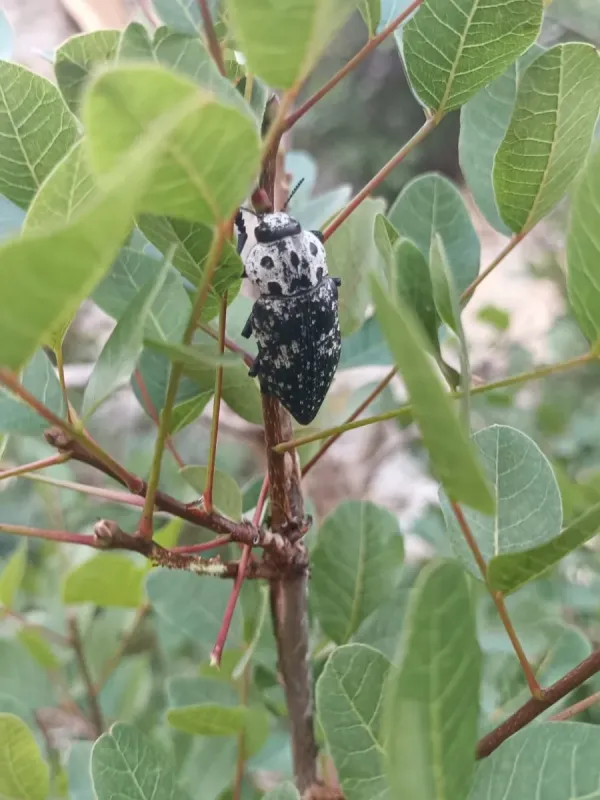
The black buprestid Capnodis cariosa belongs to the family Buprestidae, order Coleoptera. It is a large beetle, measuring 20 to 30 mm in length, with a distinct black or dark-bronze coloration featuring small light-colored spots on the elytra.
The beetle's body is oval and somewhat flattened, covered in a tough chitinous exoskeleton. The larvae are legless, yellowish-white, and recognizable by their significantly enlarged thoracic segment, which gives them the appearance of having a shield-shaped head.
Adults are known for their high survival rate and strong flying capability, allowing them to rapidly infest orchards. They are secretive, usually preferring to rest on sun-drenched parts of tree trunks, where their dark color provides camouflage.
The life cycle of this pest is prolonged and often spans two to three years, depending on regional climatic conditions. It thrives in arid and hot environments where trees are under water stress.
They overwinter mainly as larvae of various instars deep within the wood, although adults can also overwinter in the soil or under bark debris, making detection difficult during the dormant season.
What it damages
The primary hosts of the black buprestid are stone fruit trees, including cherries, sweet cherries, apricots, peaches, plums, and almonds. Less frequently, the pest may be found on pome fruit trees.
The larval stage is the most destructive; larvae bore winding tunnels under the bark and into the cambial layer of trunks and major branches. This disrupts nutrient flow and vascular health, leading to severe tree decline.
Infestation of the root collar and roots by larvae often causes premature wilting and the death of young saplings that have not yet established robust growth. In mature trees, larval tunneling triggers severe gummosis.
Adult beetles feed on buds, young leaves, and tender bark of new shoots, causing secondary damage, especially during the mass emergence periods in spring and early summer.
Mass infestations can lead to total orchard decline, as weakened trees become highly susceptible to opportunistic secondary pests and various wood-decaying fungal pathogens.
When it appears
Adult emergence from overwintering sites begins in spring when temperatures consistently rise above 18–20 degrees Celsius. Peak activity occurs during the hot summer months of June and July.
Mating and oviposition occur throughout the summer. Females lay eggs in small clusters within bark crevices or directly into the soil at the base of the tree near the root collar.
Newly hatched larvae quickly bore into the bark, starting a feeding cycle that continues until the onset of cold weather. During this time, they are highly active and most vulnerable to natural predators.
As autumn approaches, larvae burrow deeper into denser wood layers to prepare for winter diapause. The feeding cycle resumes in the spring if the tree remains viable.
The pest's population dynamics are strongly correlated with temperature; in drought years, the damage potential increases significantly due to the compromised immune systems of the host trees.
Signs of infestation
An early sign of infestation is the appearance of gummosis (oozing sap) on trunks and main branches. Clear or amber-colored resin droplets indicate tissue damage caused by larval boring.
Close inspection of the bark reveals characteristic oval-shaped exit holes, which are created by adults emerging after the completion of their metamorphosis.
Leaves on infested branches may turn yellow, curl, and drop prematurely. In severe cases, individual branches die back, eventually leading to the death of the entire tree crown.
When peeling back the bark of infested trees, one can find flat, winding galleries filled with brown "frass" (wood dust), which is a definitive indicator of larval activity.
Piles of fine wood shavings at the base of the tree often indicate that larvae are actively boring into the root system or the base of the trunk.
Control measures
- Ensure optimal irrigation to prevent water stress, as drought-weakened trees are the primary targets for this pest.
- Perform regular sanitary pruning and promptly remove and destroy dead, dying, or heavily infested trees that serve as breeding reservoirs.
- Apply white-washing to trunks and the base of scaffold branches using lime mixed with insecticides to deter females from laying eggs.
- Manually collect and destroy adults during the early morning hours when beetles are sluggish and easily shaken off onto collection cloths.
- Utilize systemic insecticides during peak flight periods for chemical protection in young orchards or high-density commercial plantings.
Taxonomy
- Latin name
- Capnodis cariosa
- Order
- Coleoptera (beetles)
- Family
- Buprestidae
- EPPO code
- CAPNCR
Discussion
No discussions yet — be the first.