
Coal buprestid
Capnodis carbonaria
Description
How to identify
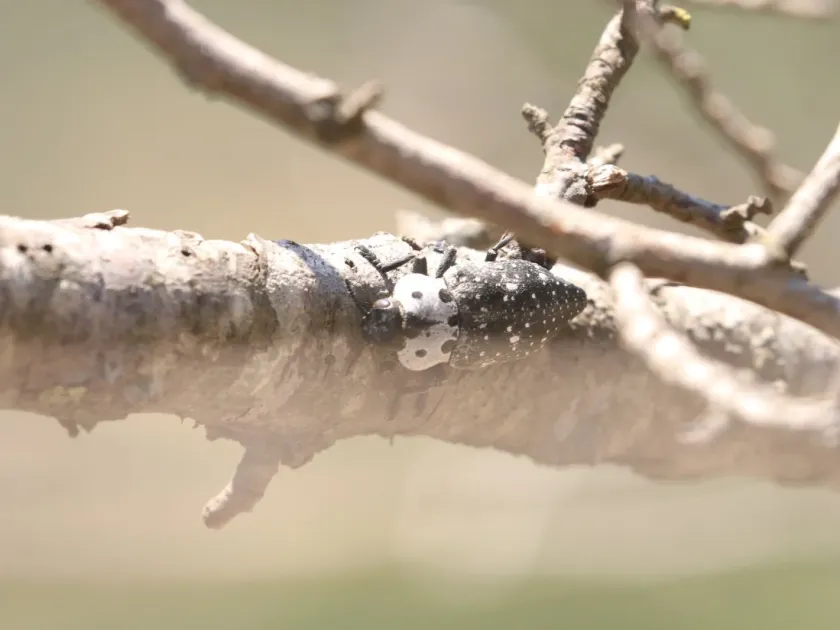
The Coal buprestid (Capnodis carbonaria) is a beetle species belonging to the family Buprestidae, often referred to as metallic wood-boring beetles. The adult beetle is 15–20 mm long, featuring a distinct coal-black color with a dull, matte finish.
The body is somewhat flattened and elongated, with finely punctured elytra. The larvae are legless and white, characterized by a significantly enlarged thoracic segment, which serves as a primary diagnostic feature when inspecting the wood.
Adult beetles are highly thermophilic and prefer sunny, well-lit areas of the tree canopy. They are agile insects capable of rapid movement and flight, often seeking out trees exposed to direct sunlight.
The life cycle is closely linked to the condition of the tree's wood, where larval development occurs. Depending on climatic conditions, the complete life cycle typically takes one to two years to complete.
Females lay eggs in bark crevices, particularly around the root collar. These egg-laying sites are often well-camouflaged, making early detection of the pest quite challenging for orchardists.
What it damages
The primary damage is caused by the larvae, which bore intricate galleries under the bark and into the wood, disrupting the flow of water and nutrients. This weakens the tree significantly, leading to reduced yield and decline.
This pest mainly targets stone fruit species such as apricots, peaches, cherries, and plums. Adult beetles also contribute to the damage by feeding on foliage and buds, further stressing the tree.
Young orchards are particularly vulnerable, as larval tunneling at the root collar can lead to the rapid death of saplings. Established trees may survive for some time but gradually lose vigor and productivity.
Outbreaks are most common during drought years when trees suffer from water stress. Such conditions make the trees more susceptible to infestation by adult beetles looking for suitable egg-laying sites.
- Premature yellowing and leaf drop.
- Dieback of skeletal branches.
- Evidence of small, D-shaped exit holes in the bark.
- Accumulation of sawdust-like frass at the base of the trunk.
- Reduced annual shoot growth.
When it appears
Adult beetle emergence begins in late spring, around May and June, continuing throughout the hot summer months. This period is when they are most active in feeding and mating.
The peak egg-laying period occurs during the height of summer, as high temperatures facilitate the subsequent development of the larvae. Females can lay several hundred eggs throughout the season.
Upon hatching, larvae immediately bore into the bark. They spend the entire duration of their development protected within the tree's woody tissue, which also serves as their overwintering site.
In the spring, as temperatures rise, the larvae resume active feeding. Pupation occurs within specially constructed cells inside the wood, after which the new generation of adults emerges.
Developmental timing is heavily influenced by regional weather patterns. In cooler regions, the life cycle may be extended, making the pest populations harder to track and control effectively.
Control measures
The most effective strategy is to maintain tree vigor through proper irrigation and balanced fertilization. Healthy, fast-growing trees are better able to resist or tolerate minor infestations.
Mechanical control includes pruning and burning heavily infested branches or removing dead trees entirely, including the root system, to eliminate breeding sites for the larvae.
Insecticide applications are most effective during the adult flight period to prevent egg-laying. Systemic pesticides can be utilized to target adults feeding on the foliage.
Regular monitoring of the root collar and bark is essential. Removing loose, old bark during the winter can reduce potential egg-laying sites and reveal early signs of larval activity.
Encouraging natural predators, such as insectivorous birds and parasitic wasps, can help suppress beetle populations. Integrated pest management (IPM) remains the best long-term approach for orchards.
Taxonomy
- Latin name
- Capnodis carbonaria
- Order
- Coleoptera (beetles)
- Family
- Buprestidae
- EPPO code
- CAPNCA
Discussion
No discussions yet — be the first.