
Black flat-headed borer
Capnodis
Description
How to identify
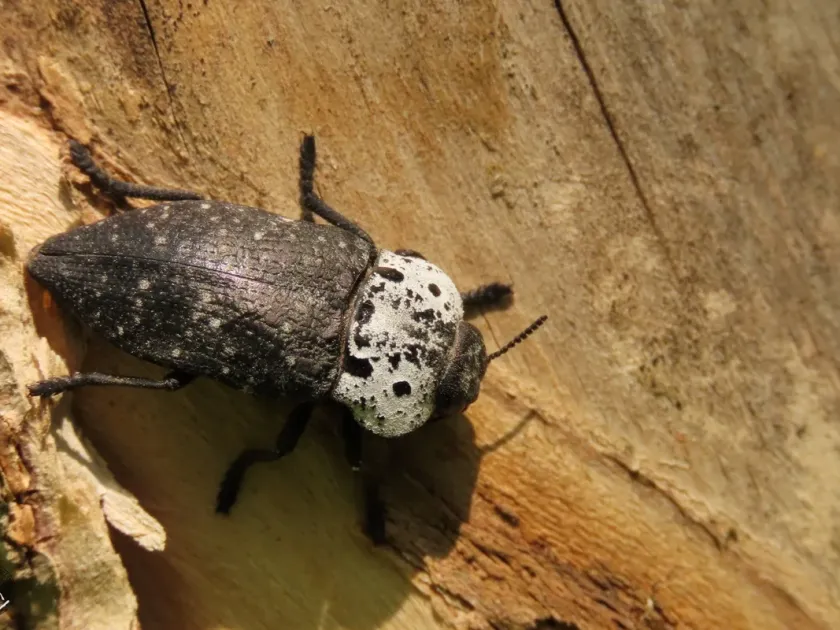
The black flat-headed borer Capnodis tenebrionis belongs to the Buprestidae family, order Coleoptera. Adult beetles are large, measuring 20 to 30 mm in length, with a matte coal-black body coloration.
Their elytra display small grayish spots, providing excellent camouflage against tree bark. The head and pronotum have a distinct coarse punctuation, which is a key diagnostic feature for professional identification.
Larvae are legless, cream-colored, and grow up to 70 mm long. The anterior part of the larva's body is significantly widened, making it easily distinguishable during inspection of damaged tree trunks.
The life cycle typically spans one to two years depending on local climatic conditions. Adults are highly resilient and capable of feeding on the bark of young shoots, which helps them survive and prepare for the breeding phase.
Breeding occurs in summer, with females laying hundreds of eggs in the soil near the root collar or directly into bark crevices. This high reproductive capacity allows the pest to rapidly colonize entire orchards.
What it damages
The black flat-headed borer is a destructive pest primarily targeting stone fruit crops. Key hosts include apricots, peaches, cherries, almonds, plums, and occasionally apple trees.
Larvae cause the most significant damage by boring galleries into the root system and root collar. This activity disrupts the transport of nutrients and water, progressively weakening the host plant.
Adult beetles damage the tree above ground by feeding on buds, leaves, and young shoot bark. This leads to premature leaf drop and increased susceptibility to secondary infections or environmental stress.
Heavy larval infestation causes stunted growth, yellowing foliage, and eventual tree death. Young saplings are particularly vulnerable and can be destroyed rapidly if they are infested soon after planting.
Mass outbreaks can lead to the total collapse of commercial orchards within a few years. Consequently, monitoring the root health of trees in high-temperature, arid climates is critical for farm management.
Signs of infestation
Visible boreholes on the bark near the root collar are the primary sign of infestation. These wounds are frequently accompanied by heavy gumming, a common defense response in stone fruit species.
Orchard inspections often reveal wilting branches and yellowing leaves that do not improve with irrigation. This indicates that larval galleries have severely damaged the root cambium.
Adult beetles can be spotted on the tree canopy during hot, sunny summer days. They tend to hide in branch forks or under loose bark to avoid predators and extreme heat.
Frass (larval excrement) resembling fine wood dust or sawdust can often be found near the base of the tree. Clearing the soil around the trunk helps in identifying these entry points early.
The drying and death of major scaffold branches or the entire tree is a late sign of infestation. At this stage, the infestation has reached a level where tree recovery is usually no longer possible.
Control measures
Good agricultural practices are the first line of defense, focusing on regular irrigation and proper nutrition to ensure trees have the vigor to resist initial larval attacks.
Chemical control involves targeting adult beetles during their emergence period. Spraying the canopy with contact or systemic insecticides in the evening is highly effective due to the beetles' activity patterns.
Cultural methods include regular soil cultivation around the trunk to disrupt egg-laying sites and discourage larvae. Keeping the base of the tree free of weeds and debris is also recommended.
Severely infested or dead trees must be removed completely, including the root system, and burned. Leaving stumps in the ground provides a reservoir for the pest, making their removal mandatory.
The use of pheromone traps is highly recommended for monitoring population dynamics and timing pesticide applications accurately. Integrated pest management (IPM) provides the most reliable long-term protection for orchards.
Taxonomy
- Latin name
- Capnodis
- Order
- Coleoptera (beetles)
- Family
- Buprestidae
- EPPO code
- CAPNSP
Discussion
No discussions yet — be the first.