
Canna leaf roller
Calpodes ethlius
Description
How to identify
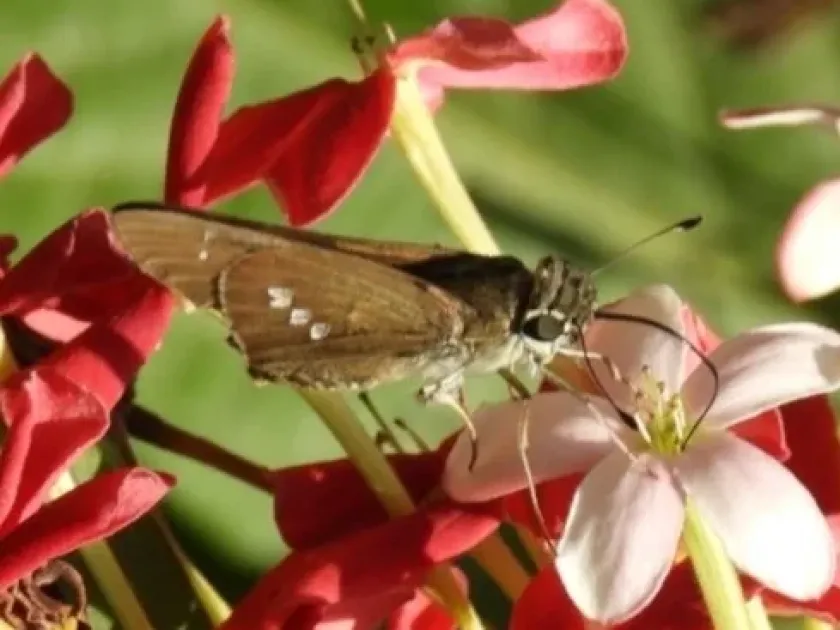
The Canna leaf roller (Calpodes ethlius) is a skipper butterfly belonging to the Hesperiidae family. It is a well-known pest that specifically targets plants in the Cannaceae family.
Adult moths have a wingspan of approximately 5 cm. Their wings are dark brown, adorned with semi-transparent, yellowish-white spots, making them distinct from other garden insects.
The larvae progress through several instars. Early instars are pale, while mature caterpillars reach up to 6 cm in length, possessing a translucent green body with a distinct dark head capsule.
Pupation occurs within a shelter created by the caterpillar itself. The pupa is greenish-brown and is safely tucked inside a tightly rolled, silk-secured leaf.
The life cycle is rapid in warm climates, allowing for multiple generations per year, which often leads to sustained pest pressure throughout the growing season.
What it damages
Canna lilies are the primary hosts for this pest. In garden settings, the Canna leaf roller can cause devastating damage to both ornamental foliage and flowers.
The larvae are voracious feeders that consume significant amounts of leaf tissue, often starting from the edges or creating large holes in the center of the leaf.
Heavy infestations lead to complete defoliation of the plants, which severely restricts the plant's ability to undergo photosynthesis and store energy for future growth.
The physical destruction of leaves not only ruins the plant's aesthetic value but also makes the plant prone to stress-induced diseases and stunted development.
If not controlled, high populations can result in the total destruction of an entire canna planting, turning a healthy bed into a collection of skeletonized stalks.
Signs of infestation
The most recognizable sign of an infestation is the presence of rolled leaves. The caterpillar spins silk threads to fold the leaf into a protective tube.
Accumulated dark granular frass (excrement) around the leaf rolls is a clear indication that caterpillars are currently active and feeding on the plant.
Irregular bite marks along the margins of the leaves are characteristic of the earlier stages of caterpillar development before they begin rolling the leaves.
When infestation is severe, the entire foliage may appear withered or burned due to the lack of intact leaf tissue remaining on the plant stems.
Close inspection of the undersides of young leaves often reveals the small, cream-colored eggs laid singly by the female moth during the evening hours.
Control measures
Manual removal of the rolled leaves is an effective and environmentally friendly method for managing low-level infestations in small home gardens.
Biological controls such as sprays containing Bacillus thuringiensis are highly effective against these larvae and help maintain the ecological balance of the garden.
For more severe outbreaks, application of systemic insecticides can be considered to protect the plant from further consumption by the growing larvae.
Sanitation practices, including the removal and destruction of dead foliage at the end of the season, significantly reduce the carry-over of pupae for the next year.
- Regular plant monitoring
- Hand-picking of larvae
- Use of Bacillus thuringiensis sprays
- Proper autumn garden cleanup
Taxonomy
- Latin name
- Calpodes ethlius
- Order
- Lepidoptera (butterflies)
- Family
- Hesperiidae
- EPPO code
- CLPOET
Discussion
No discussions yet — be the first.