
Promethea silkmoth
Callosamia promethea
Description
How to identify
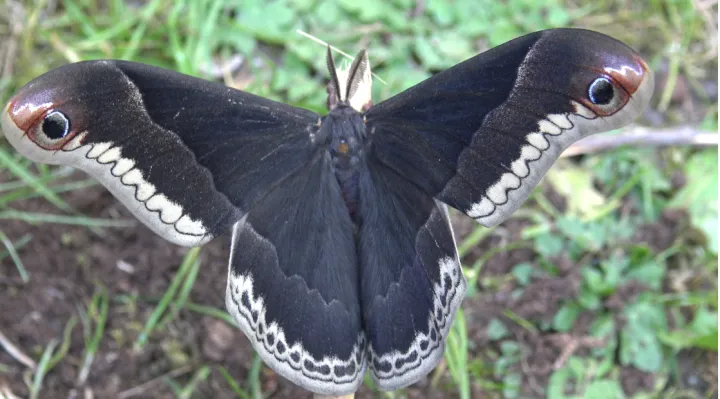
The Promethea silkmoth (Callosamia promethea) belongs to the Saturniidae family, order Lepidoptera. It is a large nocturnal moth characterized by significant sexual dimorphism.
Males are dark brown to nearly black, while females exhibit lighter reddish-brown shades. The wingspan of an adult moth typically ranges from 80 to 95 millimeters.
The larvae go through several developmental stages (instars), transitioning from yellowish-green to bluish-green, featuring distinct black and red tubercles on their bodies.
The overwintering stage is the pupa, housed within a tough, silk-lined cocoon firmly attached to the host plant's twigs by a silk stalk.
The species is native to North America, inhabiting deciduous forests, urban parks, and home gardens rich in diverse woody vegetation.
What it damages
The primary damage is caused by the larval stage, which feeds voraciously on foliage. When populations are high, larvae can cause partial or total defoliation of branches.
The pest favors a wide array of host plants, particularly within the Rosaceae and Oleaceae families. It shows a strong preference for wild cherry, apple, and lilac trees.
Larvae are also frequently found on maple, tulip trees, sassafras, and various birch species, utilizing them as their main nutrient source.
While the Promethea silkmoth rarely kills healthy, mature trees, intense feeding weakens the tree's immune system, leaving it susceptible to secondary pathogens and further infestations.
- Defoliation of leaf blades
- Reduction in canopy photosynthetic activity
- Stress and weakening of young saplings
When it appears
The life cycle is generally univoltine, meaning one generation per year. Adults emerge in late spring or early summer to mate and lay eggs.
The period of active larval feeding occurs during the summer months, specifically from mid-June through August, when they are most conspicuous on the foliage.
Pupation occurs in late summer as the larvae construct protective cocoons. The pupae remain attached to the twigs throughout the autumn and winter seasons.
Adult emergence for the next generation happens in the following spring once temperatures reach the necessary threshold for successful metamorphosis.
Local environmental factors, including temperature and humidity, dictate the precise timing of emergence and the rate of larval growth each growing season.
Signs of infestation
The first signs of infestation are ragged leaf edges and skeletonized sections of foliage present on the tree branches.
The presence of larvae themselves, which are easily visible due to their size and colorful tubercles, provides immediate confirmation of the pest's presence.
During the winter, infestations are evidenced by empty cocoons dangling from bare twigs. These cocoons are securely attached to the stem, making them easy to spot.
Accumulated frass (larval droppings) beneath the canopy of a tree may also indicate that larvae are feeding in the upper portions of the tree crown.
Careful inspection of tree branches during the fall and winter months allows for the mechanical removal of cocoons, preventing re-infestation in the upcoming spring.
Control measures
The most effective control method is the manual collection and destruction of cocoons during the winter months, which significantly reduces the population for the next season.
For smaller garden settings, biological controls such as products containing Bacillus thuringiensis (Bt) are effective and safe options against young larvae.
In cases of significant infestation, broad-spectrum insecticides may be used, though applications must be timed correctly during the most vulnerable larval stages.
Maintaining tree vigor through proper pruning and the removal of heavily damaged or diseased branches is a vital part of integrated pest management.
Encouraging natural predators, such as birds and predatory insects, helps regulate Promethea populations and keeps them at a non-damaging level within the local ecosystem.
Taxonomy
- Latin name
- Callosamia promethea
- Order
- Lepidoptera (butterflies)
- Family
- Saturniidae
- EPPO code
- CAOSPR
Discussion
No discussions yet — be the first.