
Calleta silkmoth
Callosamia calleta
Description
How to identify
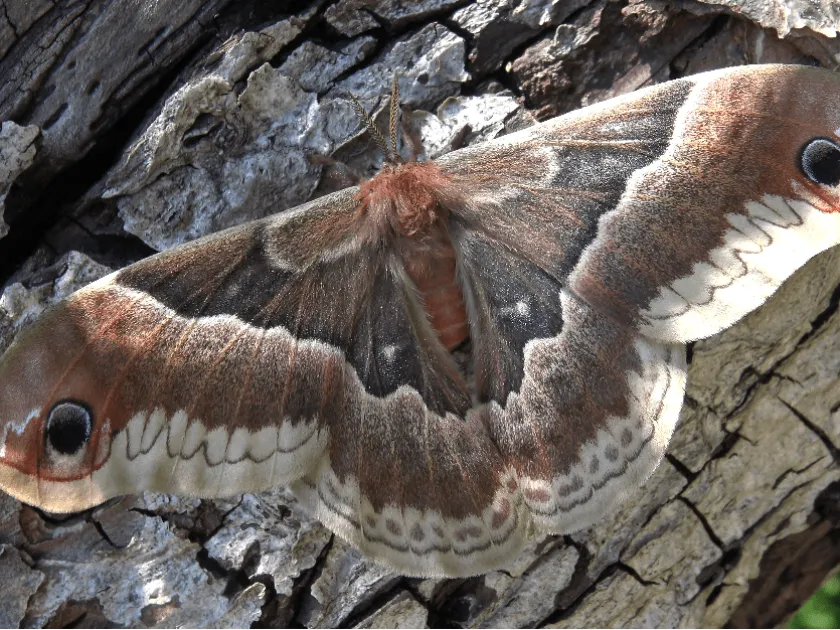
The Calleta silkmoth (Callosamia calleta) is a large moth belonging to the family Saturniidae, known for its significant wingspan of 10–12 cm and intricate wing patterns.
Adult moths are characterized by transparent or white central spots on their wings, which are a hallmark of the species within its natural desert and arid habitats.
Taxonomically, it belongs to the order Lepidoptera, and as an adult, it does not feed, having evolved to rely solely on the energy reserves accumulated during its larval stage.
Larvae undergo multiple instars, changing appearance from yellowish caterpillars with black spots to bright green forms with distinctive tubercles or protrusions on their bodies.
The life cycle is typical of many saturniids, where the moth relies on camouflage and specific timing to avoid predation in its natural environment.
What it damages
Calleta larvae are polyphagous, feeding on a wide variety of woody plants and shrubs, which can result in significant defoliation when populations are high.
Damage is caused by the caterpillars as they consume leaves, often stripping a branch of its foliage and leaving only the stems and central veins behind.
While they naturally prefer arid-zone shrubs and specific trees, they can impact ornamental plants and young nursery stock if present in high numbers.
Young plants are particularly vulnerable, as repeated defoliation stunts their growth and reduces their overall resistance to environmental stressors and diseases.
In addition to direct foliage loss, the presence of these larvae can make the tree more susceptible to secondary infestations by wood-boring insects or fungi.
When it appears
The lifecycle of the Calleta silkmoth is closely tied to seasonal temperature and moisture patterns, typically resulting in one or two generations per year.
The species overwinters in the pupal stage inside a tough, spindle-shaped cocoon that is firmly attached to the host plant's branches.
Adult emergence typically occurs during the warmer months, allowing the life cycle to align with the active vegetative growth phase of the host plants.
Egg-laying begins shortly after mating, with the larval stage following as temperatures rise, ensuring that the caterpillars have access to fresh foliage.
Shifts in local weather conditions or climate change may alter the emergence timing, requiring growers to remain observant throughout the spring and summer.
Signs of infestation
The presence of Calleta is most easily identified by the accumulation of large, pellet-like frass (excrement) deposited beneath infested branches.
Noticeable foliage consumption, ranging from notched leaves to complete defoliation of twigs, is a primary indicator of larval activity in the canopy.
The most distinctive sign is the presence of large, sturdy cocoons hanging from branches, which protect the developing pupae during the dormant season.
- Presence of large, distinctively bumpy caterpillars.
- Irregular leaf edges and skeletal remains of leaves.
- Spindle-shaped, silk-wrapped cocoons on thin twigs.
- Pellet-like droppings on the soil or lower leaves.
Regular visual inspections, especially of the upper canopy and outer branches, help in identifying egg clusters and young larvae before they cause widespread damage.
Control measures
Mechanical control is highly effective for smaller gardens; simply collecting and destroying the cocoons during the winter prevents the next generation from emerging.
Biological control using formulations containing Bacillus thuringiensis is an efficient way to manage larval stages while maintaining safety for non-target species.
Ensuring host plants are healthy through proper irrigation and balanced fertilization helps them tolerate larval feeding without long-term damage to the tree's health.
Chemical intervention should be considered only as a last resort, using targeted, low-toxicity insecticides that minimize impact on beneficial pollinators and predators.
Promoting local biodiversity, including attracting birds and parasitoid wasps, provides a sustainable, natural method for keeping populations under control.
Taxonomy
- Latin name
- Callosamia calleta
- Order
- Lepidoptera (butterflies)
- Family
- Saturniidae
- EPPO code
- CAOSCA
Discussion
No discussions yet — be the first.