
Caenoplana
Caenoplana
Description
How to identify
Caenoplana belongs to the order Tricladida and the family Geoplanidae. These organisms are land flatworms known for their flattened, elongated, and highly flexible bodies.
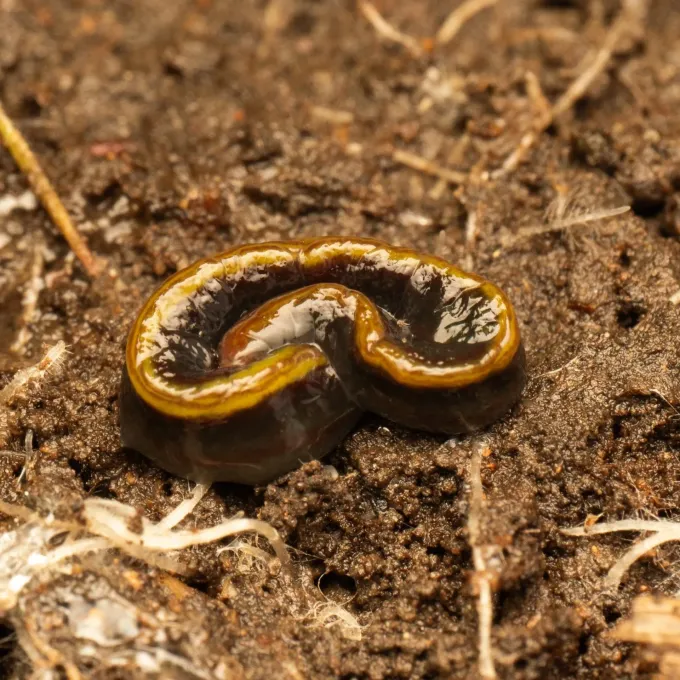
They typically reach 5 to 12 centimeters in length. Their coloration ranges from dark brown to yellowish, often featuring distinctive stripes running along the length of their body.
The worm lacks a skeleton, allowing it to easily squeeze into small soil cracks or the drainage holes of plant pots.
They possess specialized sensory organs on their anterior end, enabling them to navigate the environment and locate prey, even in complete darkness.
Being nocturnal by nature, they prefer humid and sheltered environments, which often allows them to remain undetected in a garden setting for long periods.
What it damages
The primary concern regarding Caenoplana is its predatory nature towards earthworms, which are essential for healthy soil structure.
By consuming earthworms, these flatworms destroy the natural soil aeration process and deplete the beneficial microfauna that supports plant growth.
While they do not directly consume plant tissues, their negative impact on soil health leads to inhibited root development and overall plant weakness.
In greenhouses, their presence causes soil compaction and a decrease in the quality of the substrate, hindering the long-term productivity of crops.
As a result, plants grown in infested soil may show signs of stress, yellowing leaves, or reduced growth rates, mimicking nutrient deficiency symptoms.
When it appears
The activity level of Caenoplana is strictly dictated by moisture levels and ambient temperatures, as they require high humidity to survive.
They are most active during the spring and autumn months, favoring mild temperatures and frequent rainfall that keeps the soil consistently damp.
During hot or dry summer periods, they retreat deep into the soil or under dense mulch to avoid desiccation, entering a state of reduced metabolic activity.
Heavy rainfall events often trigger surface activity, making them easier to spot on pavements, greenhouse walls, or the surface of wet soil.
Overwintering occurs primarily through egg-laying, with resilient cocoons that can survive cold temperatures until the environment becomes favorable again.
Signs of infestation
A sudden, unexplained decline in the earthworm population in the top 15 centimeters of soil is often the first indicator of a Caenoplana infestation.
Traces of dried, mucus-like slime trails on the surface of the soil or along the edges of pots and containers are characteristic signs of their nocturnal movement.
During the night, physical observation using a flashlight on moist garden surfaces can reveal the flatworms actively hunting for prey.
Stunted growth or poor performance of potted plants that appear otherwise healthy may suggest that the soil quality is being compromised by these predators.
Careful inspection of garden debris, flowerpots, and stones can reveal their egg cocoons, which look like small, rounded objects adhered to surfaces.
Control measures
Currently, there are no specific chemical pesticides effective against Caenoplana, necessitating a focus on integrated cultural and mechanical management.
The most effective strategy is the manual collection and destruction of observed individuals during the early morning or evening hours when they are active.
Implementing strict quarantine protocols for new plants and soil media is crucial to prevent the introduction of eggs or adults to a clean site.
Reducing excessive soil moisture and avoiding thick mulch layers near the base of stems can make the environment less hospitable for the flatworms.
In cases of severe infestation, replacing the top layer of soil or heat-treating the substrate is recommended to eliminate the population and their cocoons.
Taxonomy
- Latin name
- Caenoplana
- Family
- Geoplanidae
- EPPO code
- CAEPSP
Discussion
No discussions yet — be the first.