
Cypress borer
Buprestis cupressi
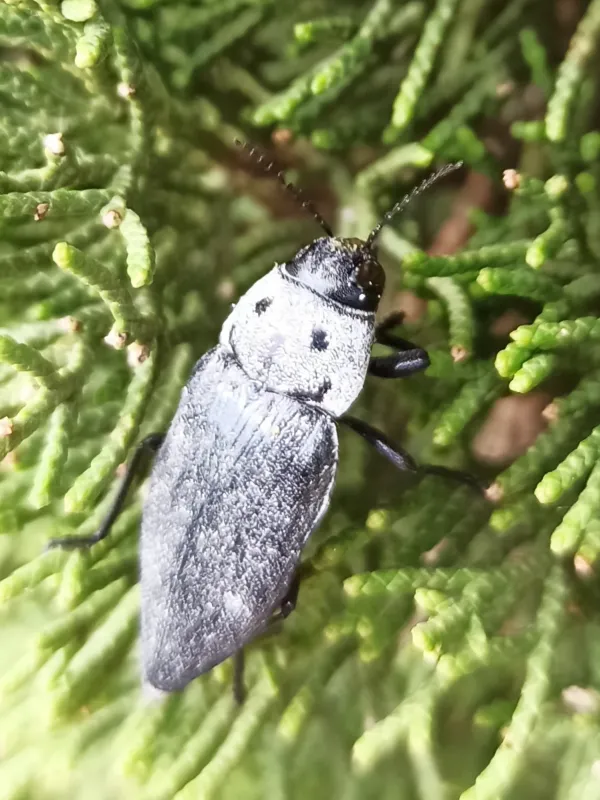
Description
How to identify
The cypress borer (Buprestis cupressi) belongs to the Buprestidae family, commonly known as jewel beetles. Adult beetles are elongated, measuring 10–15 mm in length, and possess a distinct metallic sheen on their exoskeleton.
Their coloration typically ranges from dark green to bronze, providing excellent camouflage against the bark of host trees. They are equipped with strong mandibles and hard wing covers (elytra) that protect them from environmental stressors.
Larvae are legless, white, and flattened in the thoracic region, which helps them maneuver effectively within the tree tissue. They have a powerful head capsule adapted for boring through wood fibers.
The insect undergoes a complete metamorphosis, including egg, larval, pupal, and adult stages. Depending on the climate, the lifecycle usually spans from one to two years.
Adults are diurnal and most active during sunny weather, when they feed on conifer needles and search for mates. Their flight activity is a critical phase for pest management strategies.
What it damages
The cypress borer primarily attacks members of the Cupressaceae family, including cypress, juniper, and thuja. It tends to target trees already stressed by drought, mechanical injury, or poor growing conditions.
Larvae feed on the phloem and cambium layers, creating irregular winding galleries beneath the bark. This disrupts the tree’s nutrient and water transport systems, often leading to branch dieback and eventual tree mortality.
Because the larvae live entirely beneath the bark or within the wood, external signs of infestation are often not visible until the damage is severe, making early detection extremely difficult.
Severe infestations can lead to the rapid decline of individual trees. Young specimens can succumb to the borer in just a single growing season if the infestation is heavy enough.
In addition to direct structural damage, the borer weakens the tree’s defense systems, making it highly susceptible to secondary attacks by fungi and other wood-decaying pathogens.
When it appears
Adult flight usually begins in late spring, around May, and continues through July. This is the optimal time for observation and potential chemical intervention.
Females lay eggs in bark crevices or near pruning wounds. After hatching, the larvae bore into the tree, beginning their life cycle inside the wooden tissues where they remain protected.
Overwintering occurs primarily in the larval stage. Larvae spend the winter deep inside the trunk or branches, protected from low temperatures by the thick wood layer.
Pupation takes place in the spring within specialized chambers constructed by the larvae. Soon after, the adult beetles emerge by cutting characteristic exit holes through the bark.
The intensity of the infestation and the rate of development are heavily influenced by ambient temperature; warmer summers often correlate with higher beetle survival rates.
Signs of infestation
The most reliable indicator of an active infestation is the presence of small, oval-shaped exit holes on the trunk or large branches, marking where adults have emerged.
- Yellowing and browning of needles on isolated branches.
- Resin bleeding (oozing) at the entry points where larvae have bored into the bark.
- Loose or peeling bark in sections heavily infested with larval galleries.
- Top-down dieback or death of significant sections of the tree canopy.
- Frass (sawdust-like debris) accumulating at the base of the trunk or in bark crevices.
Control measures
Cultural control is the most effective approach: perform regular sanitation pruning to remove dead or dying branches, which serve as primary breeding sites for the borer.
Maintain tree vigor through proper irrigation and fertilization. A healthy, stress-free tree is naturally better equipped to resist or survive low-level borer infestations.
Chemical control is limited to the adult flight period. Systemic insecticides applied to the canopy and trunk during late spring can help protect trees from new egg-laying adults.
Severely infested trees should be removed and destroyed immediately to prevent the adults from emerging and spreading the infestation to nearby healthy conifers.
In landscape management, pheromone traps are utilized for monitoring the presence and density of the beetle population, allowing for more targeted control efforts without widespread chemical usage.
Taxonomy
- Latin name
- Buprestis cupressi
- Order
- Coleoptera (beetles)
- Family
- Buprestidae
- EPPO code
- BUPRCU
Discussion
No discussions yet — be the first.