
Eurasian Eagle-Owl
Bubo bubo
Description
How to identify
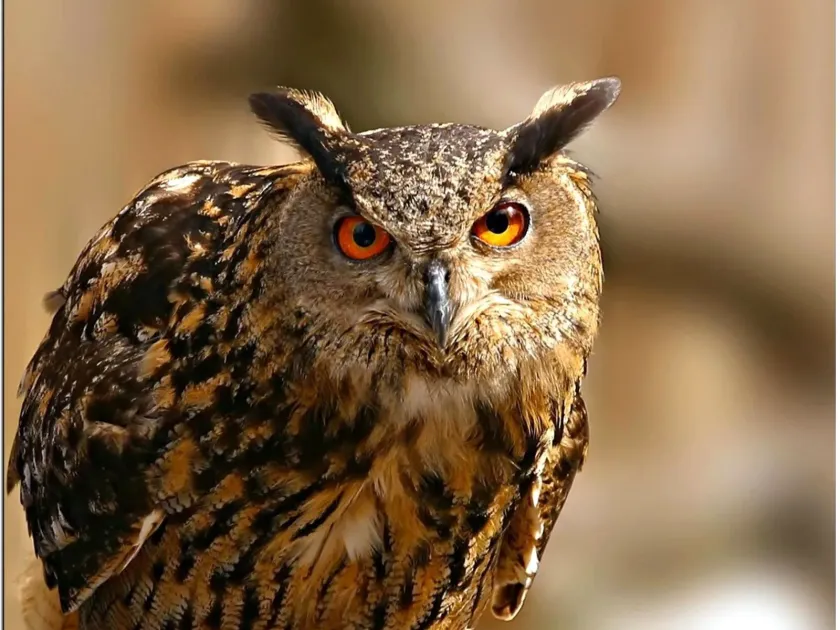
The Eurasian Eagle-Owl (Bubo bubo) is one of the largest members of the Strigidae family within the Strigiformes order. Adults are characterized by their massive size, a wingspan of up to 190 cm, and distinctive ear tufts.
Their plumage is heavily patterned with dark, buff, and black streaks, providing excellent camouflage against cliffs, rocky outcrops, or dense woodland backgrounds.
Eagle-Owls possess large, glowing orange or amber eyes, which provide exceptional night vision, essential for nocturnal hunting activities in various environments.
Their feet are powerful and covered in feathers, which provide insulation and protection. They are equipped with sharp, strong talons capable of gripping and dispatching large prey items.
The flight of this owl is remarkably silent due to the soft, comb-like serrations on the leading edges of their flight feathers, which suppress the sound of air rushing over their wings.
What it damages
It is crucial to clarify that the Eurasian Eagle-Owl is not a pest of agricultural crops, as it is a strictly predatory species that does not feed on vegetation.
The economic impact of this species on agriculture is primarily linked to occasional opportunistic attacks on free-ranging domestic poultry, such as chickens and ducks.
While Eagle-Owls may hunt beneficial small mammals or hedgehogs, they are often beneficial to agriculture due to their diet, which consists largely of rodents and crop-damaging birds.
By keeping rodent populations in check, these birds provide a significant ecological service, acting as natural pest controllers in the vicinity of farmlands.
There is no direct damage caused by this owl to crops, roots, stems, or fruits, as their physiological requirements are met exclusively through the consumption of animal protein.
When it appears
The Eurasian Eagle-Owl is a sedentary species that remains in its territory throughout the year. They are most active during the breeding season, which begins in late winter.
During the spring, when the young are being raised, the adults are under significant pressure to provide food, leading to more frequent hunting activity near rural areas.
In autumn, juvenile dispersal occurs, which may lead to transient individuals appearing in new territories, including those near agricultural fields and forest borders.
During winter months, these owls may be observed hunting more frequently in open areas or near barns where rodent density is higher, making them more visible to local farmers.
Their life cycle is closely integrated with the population dynamics of local small mammals and hares, which dictate their movement and hunting success throughout the seasons.
Signs of infestation
One of the primary signs of an Eagle-Owl's presence is the accumulation of pellets — regurgitated masses of indigestible hair, feathers, and bones found under their favorite perches.
The male's deep, resonant hooting calls, which can be heard over long distances during the night in the breeding season, are a clear indicator of their presence.
Remains of prey, including piles of feathers from birds or skeletons of small mammals left in open fields or near forest edges, are signs of their successful hunting.
Large, distinct claw marks found in soft mud or snow provide physical evidence of their presence and hunting path during nocturnal activities.
Farmers might also observe the birds silhouetted against the sky on high vantage points such as power lines, poles, or old trees near the farm edges.
Control measures
In most regions, the Eurasian Eagle-Owl is a protected species under law, and harming or killing them is strictly prohibited and carries severe legal penalties.
The best strategy for poultry protection is the construction of sturdy, wire-mesh enclosures that prevent large owls from accessing livestock pens at night.
Non-lethal deterrents, such as motion-activated lights or ultrasonic sound emitters, can be effective in discouraging these birds from approaching farmyards.
Maintaining a clean farm environment that discourages the presence of rats and mice will naturally reduce the attractiveness of the area to large predators like the Eagle-Owl.
Integrating these owls into farm management as natural rodent controllers is often more beneficial than attempting to drive them away from the landscape.
Taxonomy
- Latin name
- Bubo bubo
- Family
- Strigidae
- EPPO code
- BUBOBU
Discussion
No discussions yet — be the first.