
Hairy dragonfly
Brachytron pratense
Description
How to identify
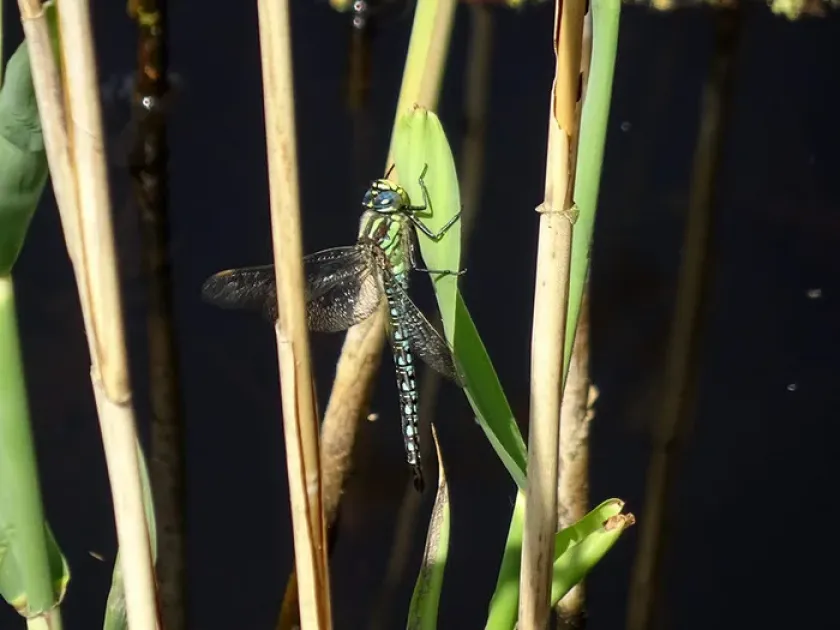
The Hairy dragonfly, scientifically known as Brachytron pratense, belongs to the Aeshnidae family. It is a medium-sized dragonfly characterized by a distinct hairy appearance on its thorax, which serves as a primary field identification feature.
Adults typically measure between 55 and 60 mm in length with a wingspan ranging from 70 to 80 mm. The males are particularly notable for their vibrant blue and yellow abdominal spots against a dark background, while females exhibit more subdued yellow markings.
The larvae are aquatic predators equipped with a specialized labial mask designed for capturing prey. They inhabit stagnant or slow-moving waters, blending into the surrounding aquatic vegetation, which provides both shelter and hunting grounds.
This species is well-known for its early emergence in the spring, often being one of the first dragonflies observed in rural and agricultural landscapes. Their flight pattern is agile and powerful, allowing them to patrol large areas efficiently.
The species is widespread across the Palearctic region. It favors sunny, well-vegetated habitats near ditches, ponds, and wetlands, often occurring in proximity to agricultural fields and irrigation channels.
What it damages
From an agronomical standpoint, Brachytron pratense is not classified as a plant pest. It does not feed on crops, and therefore it does not cause direct economic damage to cultivated plants or vegetable production.
In specific cases, such as in fish farming or aquaculture, the larvae can be viewed as an issue because they are voracious predators of fish fry. High population densities in small nursery ponds might potentially impact fish stocking success.
Adult dragonflies are generalist predators and may catch beneficial insects, including bees. However, in the context of large-scale farming, the overall impact on pollination services is usually considered minimal and within the range of natural fluctuation.
There is no evidence of crop tissue damage caused by this species beyond minor punctures on aquatic plants during oviposition. This activity is restricted to the banks of water bodies and does not affect the yield of terrestrial crops.
In most ecosystems, the presence of Hairy dragonflies is beneficial, as they act as a natural control for populations of mosquitoes, gnats, and other nuisance dipterans, contributing to a better environment near agricultural work zones.
When it appears
The lifecycle of the Hairy dragonfly is primarily aquatic, with the larval stage lasting for two to three years. Larvae are active throughout the year, even during colder months, as they reside underwater in stable environmental conditions.
The emergence of adults usually occurs between April and June. This early timing is a key ecological strategy that allows them to thrive before the peak activity of larger, more competitive dragonfly species.
Adults have a relatively short lifespan of approximately 4 to 6 weeks. During this time, the primary objectives are foraging, territorial patrolling, and mating, followed by egg-laying in suitable vegetation.
Activity levels are highly dependent on solar heat and ambient temperature. During cloudy or rainy weather, they remain inactive, often resting deep within grasses or shrubs to minimize heat loss and avoid predation.
The development of the larvae is heavily influenced by water temperatures. Warmer spring seasons typically lead to earlier adult emergence, while extended cold spells can cause a noticeable delay in the life cycle progression.
Signs of infestation
The most reliable sign of the species' presence is the observation of adults patrolling near the edges of ponds or irrigation canals. Their specific flight behavior, characterized by short hovering bouts, is highly distinctive.
The presence of exuviae (cast-off larval skins) on reeds, rushes, or other emergent plants during late spring is a definitive indicator that the species has successfully completed its life cycle in the immediate vicinity.
Small slits or punctures on the stems of aquatic plants indicate successful oviposition. While these signs are subtle, they confirm the species is breeding within the monitored water body.
Territorial defense by males is another behavioral sign. If multiple males are seen interacting or aggressively pursuing one another over a specific section of a ditch, it suggests the area is a prime breeding site.
Observing a high number of dragonflies in areas with many flying insects confirms their role as predators, and in many cases, this indicates a balanced ecosystem where natural prey control is occurring.
Control measures
Under normal circumstances, no control measures are required for Brachytron pratense. They are considered natural components of the agro-ecosystem, and their presence generally reflects a healthy, balanced habitat.
In aquaculture environments where larvae might be problematic, mechanical management is the preferred approach. This includes clearing excessive emergent vegetation from pond edges to reduce suitable larval hiding spots.
The use of chemical insecticides should be strictly avoided in these habitats. Not only are dragonflies beneficial, but the aquatic environments they inhabit are highly sensitive to chemical runoff, which could cause greater ecological harm.
Maintaining the water flow in irrigation channels and keeping them free of dense weeds can effectively limit the population density of these dragonflies without the need for harmful chemical interventions.
- Regular mechanical cleaning of water channels.
- Monitoring of larval populations in fish-sensitive areas.
- Preservation of natural vegetation for non-pest insect balance.
Taxonomy
- Latin name
- Brachytron pratense
- Family
- Aeshnidae
- EPPO code
- BRHTPR
Discussion
No discussions yet — be the first.