
Early bumblebee
Bombus pratorum
Description
How to identify
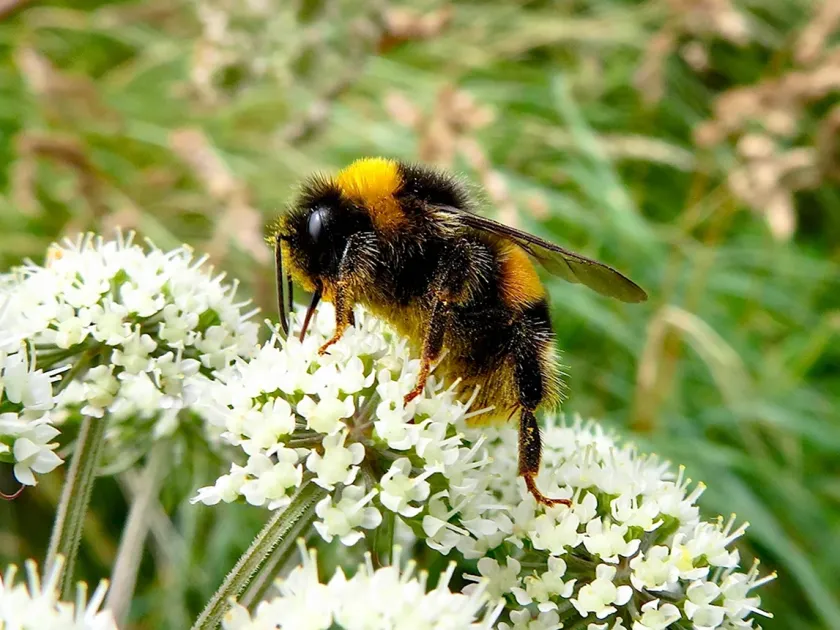
The early bumblebee (Bombus pratorum) is one of the smallest and most distinctive species of bumblebees found across Europe. It is easily identified by its small size, a yellow collar on the thorax, and a bright orange-red tip on its abdomen, which sets it apart from larger relatives.
The life cycle begins in early spring when the hibernating queen emerges to establish a new colony. They are opportunistic nesters, choosing abandoned rodent burrows, tall grass, or even gaps in tree trunks and man-made structures to create their nests.
While often mislabeled as a pest by those unfamiliar with their role, early bumblebees are essential pollinators. They are among the first insects to emerge in the spring, making them critical for the pollination of early-blooming fruit trees and berry bushes.
Their colony structure is typical for the genus, consisting of a queen, workers, and drones. They are generally peaceful and will only show defensive behavior if their nesting site is directly disturbed or threatened by human activity.
The presence of Bombus pratorum is a strong indicator of a healthy, pesticide-free environment. Their ability to forage in lower temperatures than most other bees gives them a unique ecological advantage in the early season.
What it damages
The early bumblebee is not a plant-feeding pest, as it does not consume leaves, stems, or roots. Any perceived damage is indirect and usually occurs only when the bee attempts to access nectar from flowers that are difficult to penetrate.
Occasionally, when floral structures prevent easy access, bumblebees may bite a hole at the base of the flower to reach the nectar. This behavior, known as 'nectar robbing', can sometimes lead to flower abortion or slight deformities in the developing fruit.
This is mostly observed in greenhouse settings or on specific crops like tomatoes and beans. However, the damage is purely cosmetic in the vast majority of cases and does not warrant any form of intervention or control measures.
In industrial agriculture, the pollination benefits provided by these bees far outweigh any minor physical damage to the flowers. Removing these pollinators would result in significantly lower crop yields, negating any short-term perceived gains.
It is crucial to correctly identify the source of crop damage before acting. Many signs of decline attributed to bees are actually caused by aphids, thrips, or fungal infections, which are the true agricultural pests.
When it appears
As the name suggests, the early bumblebee is one of the first species to be active, often appearing as early as March. This coincides perfectly with the blossoming of many fruit crops, making them vital for early-season pollination.
The peak activity of the colony usually occurs between May and June. During this time, workers are constantly foraging to support the growing brood, providing high-efficiency pollination services throughout the garden or field.
In late summer, the colony enters its final phase. The workers decline in number as the queen focuses on producing new queens and drones for the following season. By late summer, the old colony naturally dies out.
New queens find suitable spots to hibernate in the soil or under leaf litter, surviving the winter in a state of diapause. This cycle ensures their survival and emergence early in the following spring.
Agricultural planning should respect this timing, avoiding the use of any disruptive chemicals during the peak blooming period when these insects are most busy working for the gardener's benefit.
Signs of infestation
Signs of bumblebee activity are easily confused with other insects. If you notice small punctures at the base of the flower petals, it is a classic sign of 'nectar robbing', though this does not always indicate a significant problem.
- Occasional flower drops after heavy foraging activity.
- Small holes at the base of the floral tube.
- Frequent movement of fuzzy insects around blossoms.
- Increased fruit set in areas where these bees are observed.
Nests are often hidden and hard to spot. They may appear as untidy patches of moss or dry grass near the soil level, which are easily overlooked by gardeners during routine maintenance tasks.
If you see these bees, you should observe them from a distance. Their presence is a sign that your garden ecosystem is balanced and capable of supporting complex pollinator networks, which is a success in itself.
Control measures
There is no need for control measures against the early bumblebee. Because they are beneficial pollinators, protecting them is a standard practice in sustainable agriculture and organic gardening.
If their presence in a greenhouse is considered problematic, use physical barriers rather than chemicals. Installing fine mesh netting over doors and vents is an effective and safe way to keep them out while maintaining airflow.
Strictly avoid the use of insecticides during the flowering season. These chemicals are highly toxic to bumblebees and can cause the total collapse of their colonies, leading to long-term issues with pollination and pest management.
To discourage them from focusing on a specific crop, plant a strip of diverse, native wildflowers nearby. This creates an attractive alternative food source, naturally drawing them away from your main crop rows.
Acceptance and preservation are the best tools for an agronomist. By understanding the biology of Bombus pratorum, growers can benefit from free pollination services that keep their crops productive and their gardens thriving.
Taxonomy
- Latin name
- Bombus pratorum
- Order
- Hymenoptera
- Family
- Apidae
- EPPO code
- BOMUPR
Discussion
No discussions yet — be the first.