
Moss carder bee
Bombus muscorum
Description
How to identify
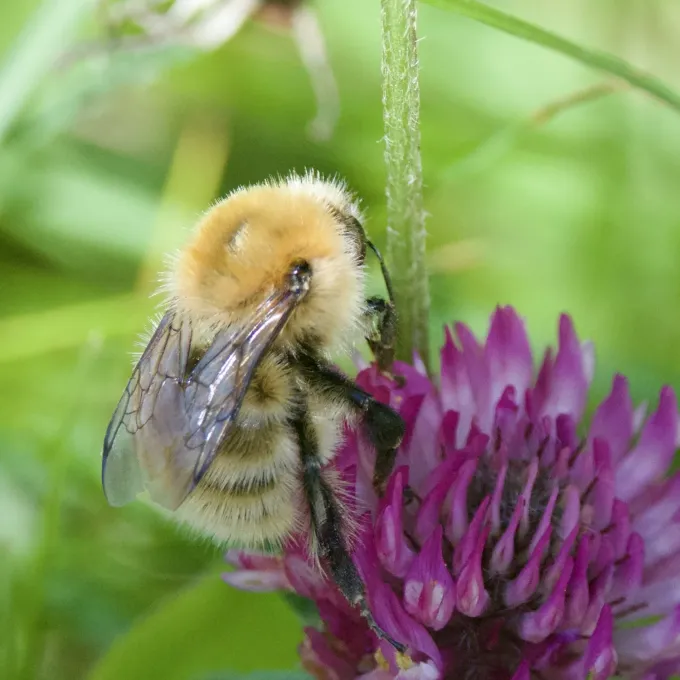
The moss carder bee (Bombus muscorum) is a species of bumblebee belonging to the family Apidae. They are easily recognized by their ginger or golden-brown thorax and abdomen, which lack black bands.
This species is unique because it nests on the surface of the ground, typically in tall grass or mossy areas, using surface vegetation to camouflage its nest structure.
Worker bees measure between 10 and 16 mm in length, while the queen is noticeably larger. Their appearance is uniform across the body, distinguishing them from other common bumblebee species.
They are generally peaceful insects but possess a defensive sting if the nest is disturbed or threatened during the nesting season.
As a declining species in many parts of the world, it is often protected by local conservation laws, requiring careful assessment before any control measures.
What it damages
While primarily a beneficial pollinator, the moss carder bee can occasionally cause issues in high-value seed production or research plots.
The primary concern is cross-pollination, where bees move between different cultivars, reducing the genetic purity of the desired seed stock.
In greenhouses, these insects may occasionally cause minor mechanical injury to sensitive flower tissues while foraging for nectar.
They can serve as biological vectors for various pathogens, potentially carrying fungal spores between diseased and healthy host plants.
However, the direct damage is generally negligible, and the ecological benefit of their pollination activity far outweighs any minor nuisance caused to farmers.
When it appears
The colony cycle initiates in early spring when mated queens emerge from hibernation to establish new nests in sheltered surface locations.
The worker force grows steadily throughout the early summer, reaching peak activity levels during the mid-summer months when flowers are abundant.
By late summer, the colony produces new queens and males, after which the old colony dies off and the new queens seek winter shelter.
The life cycle is tightly synchronized with the blooming periods of local wildflowers and agricultural crops that provide essential pollen and nectar.
Monitoring is most effective during the peak summer bloom when the bees are frequently observed foraging in meadows and crop fields.
Control measures
Control of Bombus muscorum is rarely necessary and should be limited to non-lethal methods due to their ecological importance and conservation status.
In seed production scenarios, physical exclusion via fine-mesh netting is the recommended method to prevent unwanted visitation.
Maintaining the field periphery and reducing suitable nesting habitats near sensitive crops can discourage them from establishing colonies directly in the field.
Applying insecticides is strictly discouraged, as it disrupts local biodiversity and removes crucial pollinators for both wild and agricultural ecosystems.
- Use fine-mesh netting to protect flowers.
- Remove nesting debris from high-value crop areas.
- Avoid broad-spectrum pesticide applications.
- Implement physical barriers around research plots.
Taxonomy
- Latin name
- Bombus muscorum
- Order
- Hymenoptera
- Family
- Apidae
- EPPO code
- BOMUMU
Discussion
No discussions yet — be the first.