
Garden bumblebee
Bombus hortorum
Description
How to identify
The garden bumblebee (Bombus hortorum) belongs to the family Apidae and is a common species of bumblebee found in gardens and agricultural fields across Europe.
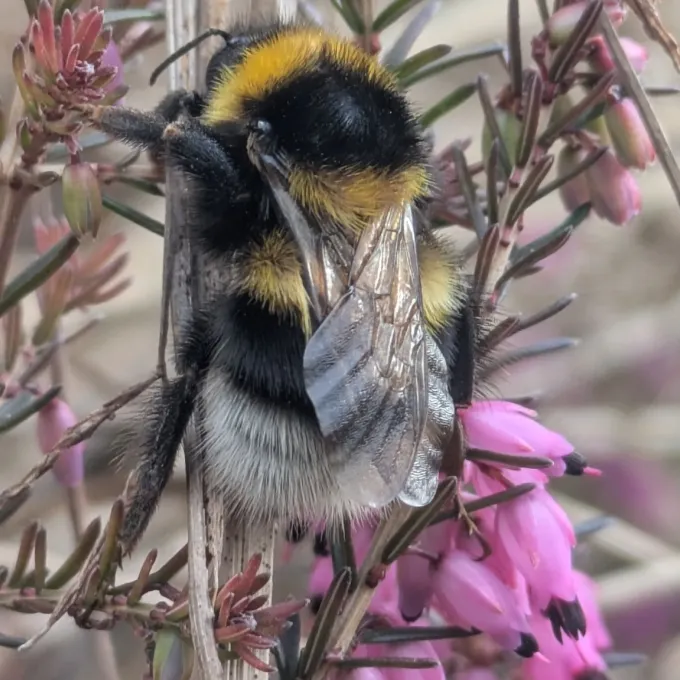
It is easily identifiable by its distinct black body with two yellow bands on the thorax and one on the abdomen, as well as its exceptionally long tongue.
This long tongue is an evolutionary adaptation that allows the bee to feed on nectar from flowers with deep corollas, such as foxgloves and various legumes.
Life cycles begin in spring with solitary queens emerging from hibernation to establish nests, typically in abandoned rodent burrows or mossy areas.
By mid-summer, the colony reaches its peak, consisting of workers dedicated to foraging and maintaining the hive.
What it damages
The garden bumblebee is not a plant pest; it does not consume foliage, stems, roots, or fruits, making it entirely harmless to crop health.
In fact, these bees are highly valued by farmers as natural pollinators, significantly boosting yields in legumes, clovers, and fruit crops.
Any negative impact attributed to them is a misconception, as they serve a strictly beneficial role within the agroecosystem.
Farmers should regard them as essential partners in production, particularly for crops that require specialized pollination mechanisms.
The presence of Bombus hortorum is a reliable indicator of a healthy and balanced local ecosystem where natural services are thriving.
When it appears
The queen bumblebee emerges from hibernation in early spring, typically starting from April depending on regional climate conditions.
Workers are active throughout the summer months, with foraging activity reaching a peak during the height of the flowering season in June and July.
One of their unique strengths is their ability to forage in cooler temperatures and lower light conditions compared to honeybees.
The colony cycle concludes in late summer or autumn when the new queens mate and locate suitable sites for overwintering.
Their flight season aligns perfectly with the growth stages of many key entomophilous crops, ensuring consistent pollination services.
Control measures
There are no control measures for the garden bumblebee because they do not cause damage; rather, protective strategies are needed to ensure their survival.
Farmers must prioritize the preservation of bumblebee habitats and implement IPM (Integrated Pest Management) practices that mitigate risks to pollinators.
- Apply insecticides only during late evening hours after foraging has ceased.
- Choose low-toxicity or bee-friendly formulations whenever possible.
- Establish wildflower strips along field borders to provide safe forage and nesting sites.
- Avoid the use of non-selective broad-spectrum pesticides during the peak bloom period.
Protecting these pollinators is a sustainable investment in crop productivity, reducing the need for chemical growth enhancers and manual pollination.
Taxonomy
- Latin name
- Bombus hortorum
- Order
- Hymenoptera
- Family
- Apidae
- EPPO code
- BOMUHO
Discussion
No discussions yet — be the first.