
Misty bumblebee
Bombus caliginosus
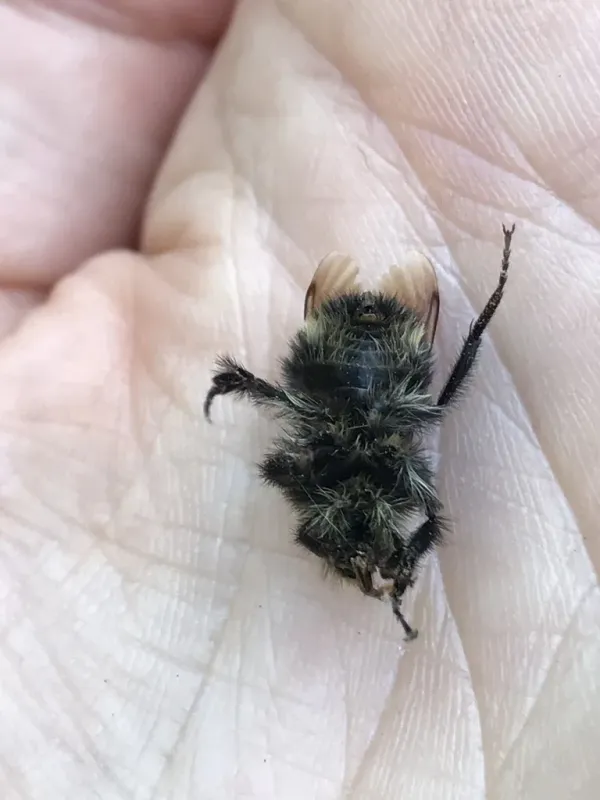
Description
How to identify
The Misty bumblebee (Bombus caliginosus) belongs to the Hymenoptera order, family Apidae. This insect has the characteristic dense pubescence of the Bombus genus, with coloration varying in black and yellow tones.
Outwardly, this species is often confused with beneficial pollinators, which complicates its identification as a harmful object. The bumblebee is medium-sized and its wings possess a specific darkening, reflected in its common name.
The biology of this species is closely linked to Pacific coastal regions, where it leads a social lifestyle. Queens hibernate in the soil or plant debris, beginning activity in early spring.
The colony's development follows standard stages: from nest establishment by the queen to the appearance of worker bees and the formation of reproductive individuals by the end of the season.
It is important to distinguish Bombus caliginosus from other bumblebees, as in some agroecosystems they can act as aggressive competitors or damage the delicate reproductive organs of plants.
What it damages
The damage caused by this species is primarily associated with mechanical injury to flowers when attempting to reach nectar by biting through the corolla tube.
Fruit and berry crops with deep flowers and long receptacles, such as garden strawberries, raspberries, and some nightshades, are mainly affected.
Punctures in the flower walls disrupt tissue integrity, leading to premature wilting of buds and reduced fruit set intensity.
A decrease in the market quality of berries is also observed due to the deformation of ovaries affected by excessive insect activity during the flowering period.
In addition to direct damage, bumblebees of this species can act as vectors for phytopathogenic spores, which penetrate plant tissues through wounds left during feeding.
When it appears
The peak activity period of the Misty bumblebee coincides with the mass flowering phase of early spring and summer crops, making its presence most noticeable in May and June.
The pest's life cycle begins with the emergence of overwintered queens when average daily temperatures exceed 10–12 degrees Celsius.
The peak of harmfulness occurs in mid-summer when the number of the worker caste in nests reaches its maximum and the colony's demand for food resources increases.
By the end of the season, the intensity of damage decreases as most worker bees die off, and fertilized queens enter hibernation.
Population monitoring is recommended during early morning hours when the insects are most active in their search for nectar.
Signs of infestation
The main diagnostic sign of infestation is the presence of clear punctures or "tears" at the base of flowers, which look like neat holes.
Massive shedding of ovaries is observed, which failed to complete the pollination stage due to the destructive influence of insects on flower components.
Around affected plants, one can often notice an increased concentration of worker bumblebees flying chaotically in search of new food sources.
Leaves near inflorescences may have traces of excrement, and damaged flowers quickly turn brown and dry out.
With systematic observation, an agronomist can document "nectar robbing," where pollination does not occur and fruits either do not form or have a severely deformed shape.
Control measures
As a preventive measure, the use of protective netting during the flowering period is recommended, especially in greenhouses or when growing berries on high beds.
The use of insecticides should be strictly limited, as bumblebees are important pollinators, and the death of beneficial species is unacceptable.
Planting distracting crops around the perimeter of the area that have a more accessible flower structure and redirect the pest's attention is considered effective.
Agrotechnical methods include the timely destruction of weeds in which insects can build nests or hide from adverse conditions.
In industrial greenhouse conditions, it is recommended to use biological control methods, including attracting natural enemies of bumblebees or creating conditions that limit their access to the production zone.
Taxonomy
- Latin name
- Bombus caliginosus
- Order
- Hymenoptera
- Family
- Apidae
- EPPO code
- BOMUCA
Discussion
No discussions yet — be the first.