
Apple pith moth
Blastodacna atra
Description
How to identify
The apple pith moth (Blastodacna atra) is a member of the Cosmopterigidae family within the order Lepidoptera, known as a specific pest of pome fruit trees.
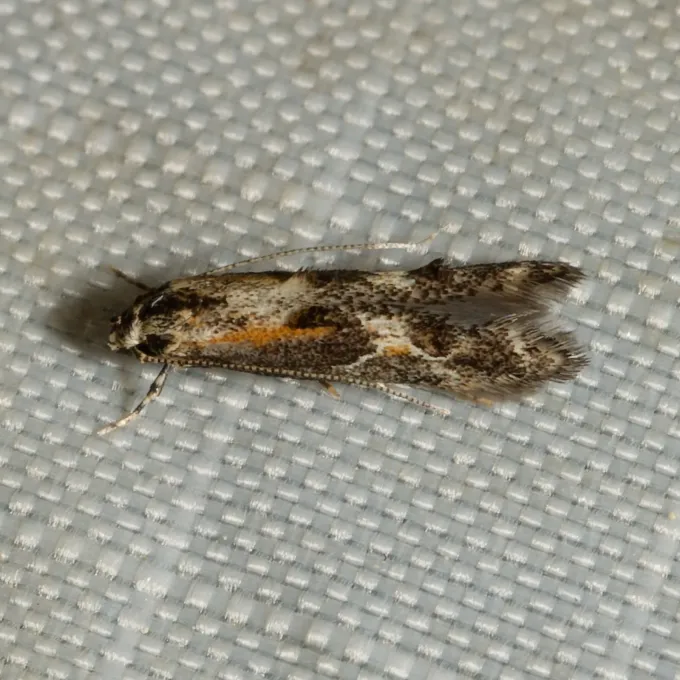
The adult moth is small, with a wingspan ranging from 10 to 12 mm. Its forewings are dark brown, displaying a metallic sheen and occasional light-colored markings.
The hindwings are distinctively narrow and lanceolate, fringed with long hairs, which is a key diagnostic feature of this species during field identification.
The larvae are typically 8–10 mm long, featuring a yellowish-white or pinkish body with a pronounced dark brown or black head capsule.
The life cycle consists of a single generation per year. The insect overwinters as a larva, typically hibernating inside a dormant bud or beneath the bark of young shoots.
What it damages
The apple tree is the primary host for Blastodacna atra, where larvae cause localized but significant damage to developing tissues.
Other host plants may include pear, quince, and occasionally hawthorn, which can serve as secondary reservoirs for the pest population in orchards.
The most severe damage occurs in spring, when overwintered larvae bore into buds, consuming the interior and causing them to fail to bloom or develop.
During the summer months, the larvae target young shoots, tunneling through the pith, which leads to the wilting and subsequent death of the shoot tips.
Chronic infestation weakens the structural integrity of young trees, stunts their growth, and can significantly reduce the potential harvest in commercial orchards.
When it appears
Larval activity resumes in early spring, synchronized with the swelling of apple buds, as the insects emerge to feed on the tissues.
Pupation takes place between late May and early June, usually within the galleries created by the larvae in the shoots or protected sites under the bark.
The flight of adult moths occurs throughout June and July, during which mating takes place and eggs are laid near the buds on one-year-old growth.
Young larvae hatch during mid-to-late summer, immediately boring into the bark to feed and establish their overwintering sites for the cold season.
Survival through the winter is highly successful, as the larvae are well-protected within their tunnels, allowing them to wait for the next spring season.
Signs of infestation
A primary indicator of infestation is the presence of brown, desiccated buds in the spring that fail to open despite adequate temperatures.
Close inspection of affected buds often reveals small entrance holes and fine, frass-filled debris accumulating near the base of the bud scale.
In summer, the telltale sign is the sudden drooping and browning of shoot tips, which look withered as if suffering from drought or vascular disease.
Splitting an infested shoot lengthwise will reveal a distinct tunnel in the pith, often filled with dark excrement left behind by the tunneling larvae.
- Withered and brown dormant buds.
- Wilting of current-season shoot tips.
- Small entrance holes at the bud base.
- Presence of larval frass within pith tunnels.
Control measures
Effective management begins with pruning and destroying infested shoots during the dormant season, which is crucial for reducing the larval population.
Chemical control measures should be timed carefully, targeting the period when larvae emerge from hibernation or when eggs are being laid in summer.
The use of pheromone traps provides a reliable method for monitoring adult moth populations, allowing growers to optimize the timing of insecticide applications.
Maintaining orchard hygiene and promoting vigorous tree growth can help trees tolerate minimal damage and recover more efficiently from pest attacks.
Biological control, including the encouragement of natural parasitoids, can also play a role in suppressing Blastodacna atra populations in integrated pest management programs.
Taxonomy
- Latin name
- Blastodacna atra
- Order
- Lepidoptera (butterflies)
- Family
- Agonoxenidae
- EPPO code
- BLAOPU
Discussion
No discussions yet — be the first.