
Blaberus fuscus
Blaberus fuscus
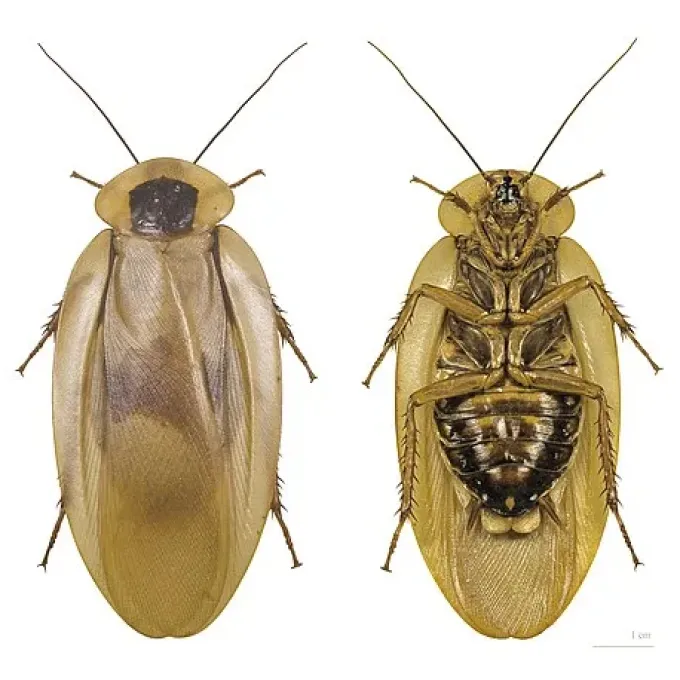
Description
How to identify
Blaberus fuscus belongs to the order Blattodea and the family Blaberidae. This species is a large tropical cockroach reaching lengths of 6–8 centimeters.
Adults exhibit a dark brown to black coloration with a distinct pattern on the pronotum. Both sexes possess well-developed wings, allowing them to travel considerable distances.
Nymphs undergo several developmental stages, gradually increasing in size and transitioning from light brown to a rich dark shade.
The species is ovoviviparous, which significantly increases the survival rate of offspring in protected environments like greenhouses.
For accurate identification, focus on the shape of the pronotum and the metallic sheen observed on the tegmina of mature specimens.
What it damages
In greenhouses and agricultural settings, Blaberus fuscus can act as an occasional pest, feeding on a wide variety of cultivated plants.
Nymphs and adults pose the greatest threat when high humidity and temperature levels favor rapid population growth.
The insects graze on vegetative parts, damaging leaves, succulent stems, and young shoots, which significantly impairs plant growth.
In the absence of preferred food sources, they may feed on roots or lower stem sections, providing entry points for secondary fungal infections.
Accumulation of fecal matter on foliage supports the growth of sooty mold, which inhibits photosynthesis and weakens the plants.
When it appears
Being a heat-loving tropical organism, it is active exclusively in indoor environments under temperate climate conditions.
Year-round reproduction is feasible if temperatures remain above +22...+25 degrees Celsius with stable humidity levels.
Population peaks typically correlate with periods of high substrate moisture, which facilitates the active development of nymphs.
In greenhouses, the seasonal factor is minimal as a consistent microclimate supports an overlapping, continuous life cycle.
Late winter and spring are critical control periods when plants are in active growth phases and insect reproduction accelerates.
Signs of infestation
A primary sign of infestation is the presence of characteristic fecal deposits resembling small black granules near the plant base.
Irregular, ragged leaf margins often indicate the activity of nocturnal pests, including large cockroaches like this species.
Damage to the lower stem or bark, often accompanied by tissue darkening, serves as evidence of large insect feeding activity.
Discovery of shed larval skins (exuviae) in the substrate or mulch confirms that the colony is actively molting and growing on-site.
Visual detection of adults or nymphs at night using a flashlight remains the most reliable method for confirming the pest's presence.
Control measures
Sanitation is the first line of defense; maintaining clean greenhouses and removing debris/plant refuse is essential for suppression.
Glue traps placed along the perimeter and near the base of crops allow for monitoring population density and executing partial captures.
Biological control options include the application of entomopathogenic nematodes, which can effectively target nymphs within the soil profile.
Chemical insecticides with contact and stomach action are effective, but their use must be strictly regulated in confined greenhouse spaces.
Gel baits containing imidacloprid or fipronil applied in harborages away from direct plant contact are recommended for efficient control.
Taxonomy
- Latin name
- Blaberus fuscus
- Family
- Blaberidae
- EPPO code
- BLABFU
Discussion
No discussions yet — be the first.