
Oak apple gall wasp
Biorhiza pallida
Description
How to identify
The oak apple gall wasp is a small insect belonging to the Cynipidae family, well-known for inducing the formation of large, apple-shaped galls on oak trees.
The species exhibits a complex life cycle involving a generational switch between a sexual generation and an asexual, all-female generation.
Adult wasps are very small, usually measuring only a few millimeters in length, and are often overlooked due to their inconspicuous appearance.
The galls themselves are complex structures created by the tree in response to the larvae's secretions, serving as both food and shelter for the developing insects.
This insect is a classic example of an organism that manipulates plant development to create a highly specialized ecological niche for its progeny.
What it damages
The wasp primarily targets the English oak (Quercus robur) and closely related species, inducing galls on twigs, leaves, and occasionally roots.
While the internal tissues of the gall are consumed by the larvae, the overall damage to a healthy, mature oak tree is usually considered minimal and cosmetic.
Young saplings or trees in poor health may suffer from reduced growth vigor if the infestation is heavy and localized on essential shoots.
The deformation of twigs and the redirection of nutrients towards gall production can stress the tree, potentially making it more susceptible to environmental factors.
High densities of galls can negatively impact the aesthetic value of ornamental oaks, which is a major concern for landscape gardeners and park managers.
When it appears
The cycle begins in spring when winged adults of the sexual generation emerge and lay eggs in the developing buds of oak trees.
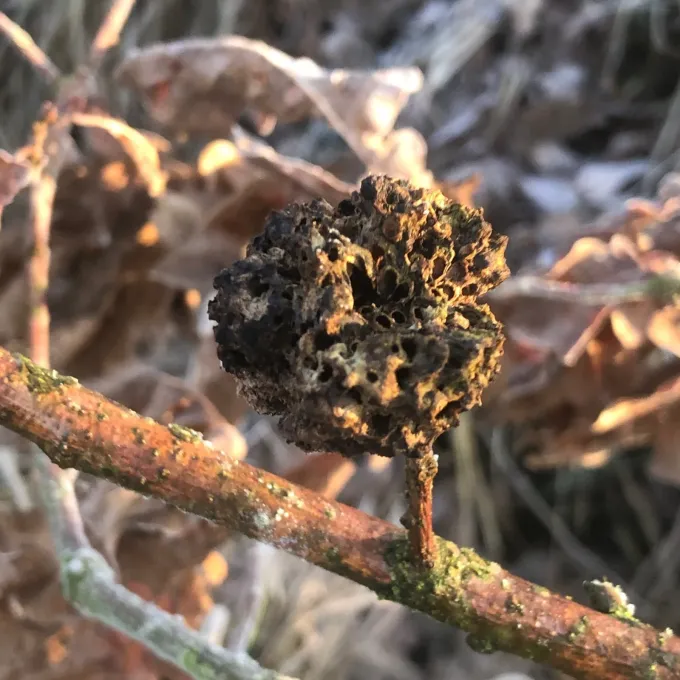
During the summer months, the galls grow rapidly as the larvae feed inside, eventually becoming hard and brown by autumn.
As the season turns to autumn, the wingless females of the asexual generation emerge from the galls and move to the base of the tree.
These females lay eggs on the roots, where the larvae will spend the winter hidden in root galls, protected from harsh temperatures.
The cycle completes in the following spring when the new generation of winged wasps emerges from the root galls to re-infest the canopy.
Signs of infestation
The most obvious signs are the round, spongy growths appearing on twigs in late spring, which gradually harden over the summer.
Young galls have a fresh, green or yellowish appearance, sometimes with reddish patches, which makes them quite noticeable against the foliage.
If you cut open an oak apple gall, you will find a central chamber containing one or more white larvae, which confirms the infestation.
In autumn, the presence of numerous small holes on the surface of the gall indicates that the wasps have successfully emerged.
Stunted twig growth or premature wilting of specific branches can also serve as indicators of heavy gall wasp activity on the host tree.
Control measures
In forest environments, natural predators such as birds and parasitic wasps keep populations in check, requiring no human intervention.
For ornamental trees, manual removal and destruction of the galls before the wasps emerge is the most effective and eco-friendly control measure.
Maintaining high plant health through consistent irrigation and soil enrichment helps the trees withstand the stress of infestation better.
Chemical control is generally not recommended, as it is difficult to time correctly and can harm beneficial insects that prey on the gall wasps.
- Prune affected twigs during early summer before emergence.
- Dispose of all collected galls by burning or deep burial.
- Encourage biodiversity in the garden to attract natural predators.
Taxonomy
- Latin name
- Biorhiza pallida
- Order
- Hymenoptera
- Family
- Cynipidae
- EPPO code
- BIORPA
Discussion
No discussions yet — be the first.