
Io moth
Automeris io
Description
How to identify
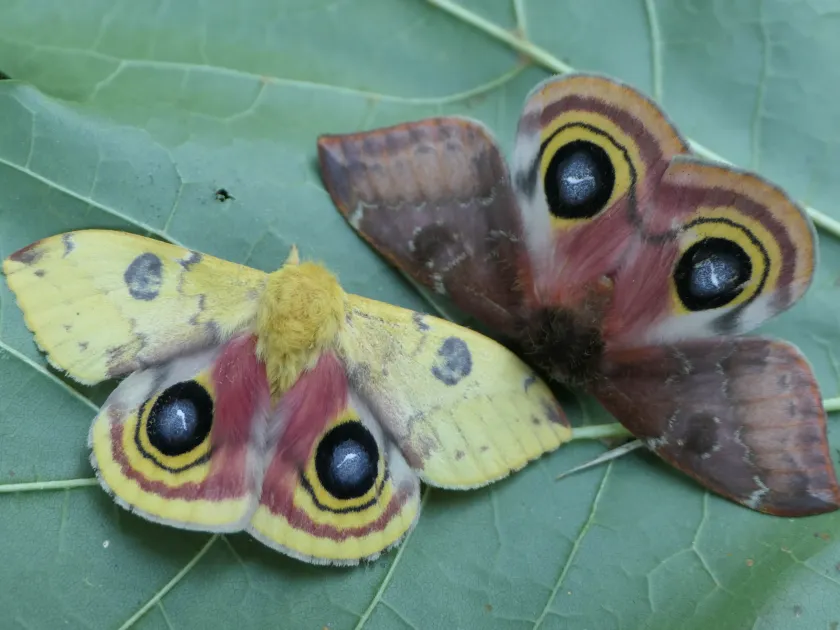
The Io moth (Automeris io) belongs to the Saturniidae family of moths. Adult moths are easily recognized by the large, eye-like spots on their hindwings, which serve as a defensive mechanism to startle potential predators.
From an agronomic perspective, the larval stage (caterpillar) is the most significant. The caterpillars pass through several instars, with their appearance changing as they grow. A defining feature across all larval stages is the presence of branched stinging spines that can cause severe skin irritation.
Young caterpillars typically feed in clusters, making them highly visible during the early stages of development. As they mature, they become solitary and develop a bright green coloration with longitudinal white and red stripes.
The life cycle encompasses the egg stage, five larval instars, a pupal stage within a dense silk cocoon, and the adult moth stage. In temperate climates, development spans a significant portion of the growing season.
This species is a polyphagous pest, meaning it adapts to a wide variety of woody plants and shrubs, frequently found in both agricultural and ornamental landscapes.
What it damages
Io moth caterpillars are generalist feeders capable of damaging a vast array of host plants. Their primary targets include fruit trees such as apple, pear, cherry, and plum, which are staples in many home orchards.
Beyond fruit trees, the pest infests various ornamental shrubs and trees, including roses, willows, and maples. In agricultural settings, larvae have been documented feeding on field crops like corn and beans.
The primary damage involves skeletonization or complete defoliation of leaves. When population density is high, caterpillars can strip branches rapidly, significantly reducing the plant's photosynthetic capacity.
Chronic leaf damage leads to stunted shoot growth, diminished fruit quality, and overall yield loss. For young saplings or seedlings, intense defoliation can be a critical factor leading to plant mortality.
Beyond the damage to flora, the caterpillars pose a direct threat to humans. The stinging hairs are a major nuisance, making manual maintenance or pruning tasks in infested areas hazardous for gardeners.
When it appears
The flight period for the first generation of adults typically begins in late spring or early summer, depending on regional temperature patterns. During this time, females lay eggs on the undersides of host plant leaves.
The caterpillar feeding period peaks in mid-to-late summer, coinciding with the phase of vigorous vegetative growth for many crops. This overlap makes detection crucial during this specific time frame.
The occurrence of this pest is highly seasonal. Monitoring should be conducted regularly from June through August to catch early larval stages before they cause significant structural damage to the plants.
The species overwinters as a pupa inside a dense cocoon. These cocoons are usually found among leaf litter or within the top layer of soil beneath the host plants, which is a key factor in planning dormant-season cleanup.
Caterpillar activity is most intense during the morning and evening hours when they feed most actively, making these times optimal for scouting and manual removal of egg masses or larvae.
Signs of infestation
The primary sign of an Io moth infestation is the presence of extensive leaf damage. Caterpillars often graze on leaves from the edges inward or create large irregular holes in the center of the leaf blades.
When inspecting trees or shrubs, gardeners should look for accumulations of frass (caterpillar excrement) on the ground or stuck to foliage. This is a reliable indicator that a colony is active in the canopy above.
Finding egg masses on the underside of leaves is an early warning sign. The eggs are typically laid in small clusters and have a distinctive cream or brownish color that blends into the foliage.
Visual inspections of the lower leaf surfaces can reveal young caterpillars feeding in tight lines. As they grow, their dispersal across the plant makes them easier to spot due to their size and coloration.
A sudden stinging sensation or skin irritation after brushing against foliage is a common anecdotal sign that Io moth larvae are present on the vegetation you are working with.
Control measures
The most immediate control method is the manual removal and destruction of the larvae. Always wear thick protective gloves to avoid the stinging spines, which can cause intense burning and itching upon contact.
Cultural control practices include the thorough cleanup of fallen leaf litter and the cultivation of the soil beneath host plants during the autumn. This destroys overwintering pupae and reduces the local population.
Biological controls such as formulations of Bacillus thuringiensis are highly effective against younger larval instars. These products are environmentally friendly and target lepidopteran larvae specifically.
In cases of significant outbreaks, registered broad-spectrum insecticides may be used as a secondary option, provided that pre-harvest intervals and labeling instructions are strictly followed.
Using pheromone traps to monitor adult flight patterns allows for the precise timing of protective measures, helping to minimize chemical usage and optimize the effectiveness of integrated pest management strategies.
Taxonomy
- Latin name
- Automeris io
- Order
- Lepidoptera (butterflies)
- Family
- Saturniidae
- EPPO code
- AUTMIO
Discussion
No discussions yet — be the first.