
Automeris illustris
Automeris illustris
Description
How to identify
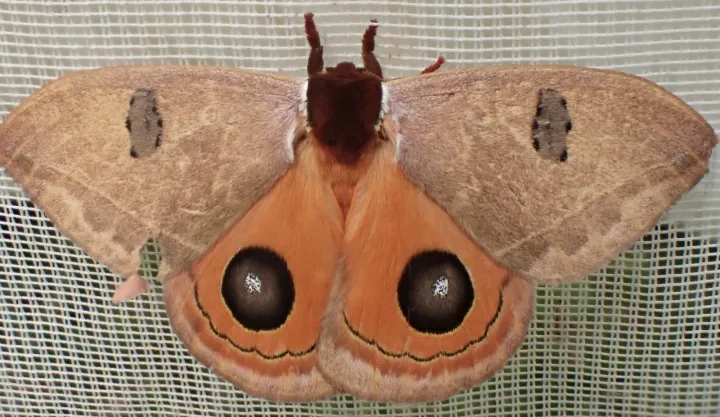
Automeris illustris is a prominent moth belonging to the Saturniidae family, often referred to as giant silkmoths. Adults are recognized by their large size and striking eyespots on the hindwings.
The larvae are particularly notorious for their appearance; they are covered in numerous branched, stinging spines that protect them from predators and cause painful irritation to human skin.
As nocturnal insects, these moths are primarily active at night, which often leads to the infestation remaining unnoticed until the larvae have reached a significant size.
The life cycle involves several larval instars, each increasing in size and density of the stinging hairs, followed by a pupal stage in a silken cocoon.
While primarily found in South America, their presence in agricultural areas can cause significant issues for both small-scale gardens and larger plantations.
What it damages
The larvae of Automeris illustris are polyphagous, meaning they feed on a wide variety of plant species, including many ornamental and fruit-bearing trees.
Feeding damage is characterized by heavy defoliation. Larvae consume the leaf tissue aggressively, often leaving behind only the veins, which drastically reduces the plant's ability to undergo photosynthesis.
In high populations, these caterpillars can strip a tree of its leaves in a very short amount of time, causing severe stress to the host plant.
Young plants or saplings are at the highest risk, as severe defoliation can stunt their growth or make them susceptible to secondary diseases and environmental stress.
The stinging hairs on the caterpillars pose a nuisance to agricultural workers, making manual maintenance and harvest operations difficult and risky.
When it appears
The seasonality of Automeris illustris is heavily influenced by the regional climate, typically peaking during the warmer, wetter months of the year.
Egg hatching usually occurs in early spring as new foliage becomes abundant, providing the necessary nutrients for the rapidly growing larvae.
Depending on the latitude and local temperatures, the moth can produce multiple generations annually, leading to overlapping life stages in the field.
Pupation often happens in protected locations such as leaf litter, crevices in tree bark, or among dense vegetation, shielding the insect from harsh conditions.
The peak feeding period for the most destructive final instar larvae usually occurs in mid-to-late summer before they prepare for pupation.
Signs of infestation
The most immediate sign of an infestation is the presence of partially consumed or skeletonized leaves, particularly in the outer canopy of trees.
Accumulated frass, or caterpillar excrement, found on leaves below or on the ground, provides a strong indicator of the larvae's current feeding activity.
Searching for egg masses on the underside of leaves is an effective way to detect the start of an infestation before the larvae emerge.
Caterpillars can often be spotted resting on stems or twigs during the day, where their bright colors and spines may be visible to a careful observer.
Silk webbing may sometimes be found holding leaves together, serving as a shelter for younger larvae while they feed in groups.
Control measures
Management begins with manual inspection and removal of egg clusters and early-stage larvae to prevent large-scale population growth.
Biological control using Bacillus thuringiensis sprays is highly effective against early instar larvae and poses minimal risk to beneficial insects and the environment.
- Regular monitoring of host plants starting from early spring.
- Installation of light traps to capture and reduce the number of adult moths.
- Application of selective insecticides only when the damage exceeds economic thresholds.
- Wearing protective gear, including heavy-duty gloves, when handling or removing infested material.
- Keeping the area around host trees clear of excessive debris where pupae might overwinter.
Integrated Pest Management (IPM) practices should be employed to balance the need for crop protection with the conservation of the local ecosystem's beneficial predators.
Taxonomy
- Latin name
- Automeris illustris
- Order
- Lepidoptera (butterflies)
- Family
- Saturniidae
- EPPO code
- AUTMIL
Discussion
No discussions yet — be the first.