
Automeris moth
Automeris
Description
How to identify
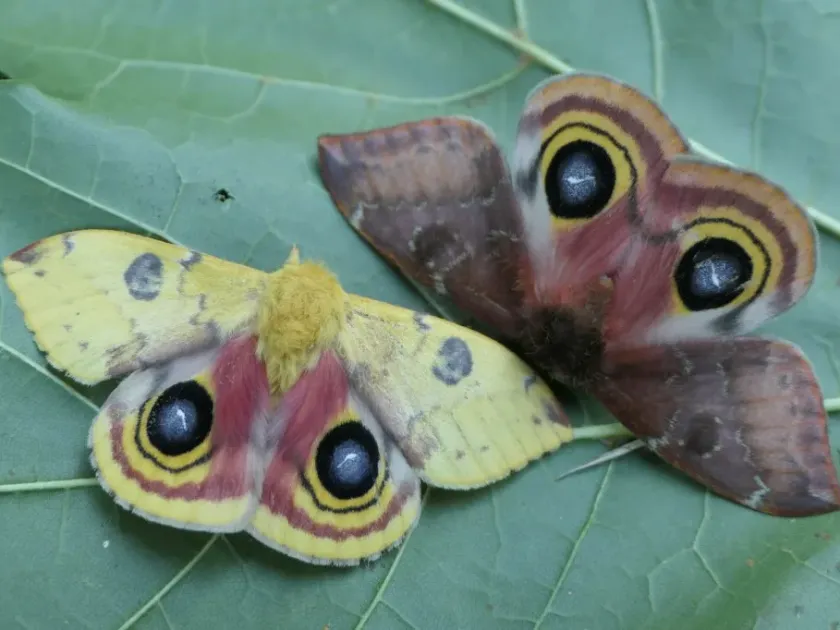
The genus Automeris belongs to the Saturniidae family, commonly known as giant silkmoths. Adult moths are easily recognized by the large, distinct "eyespots" on their hindwings, which function as a primary defense mechanism against predators.
The larvae, or caterpillars, of this genus are notable for their dense covering of branched, stinging spines. These spines are connected to venom glands and can cause severe skin irritation, burning sensations, and allergic reactions in humans upon contact.
Their coloration is generally cryptic, featuring various shades of green, brown, or tan, which provides excellent camouflage against foliage. As they grow through five distinct larval stages (instars), their size increases significantly, as does their consumption rate.
The life cycle encompasses four main stages: egg, larva, pupa within a silken cocoon, and adult. Development times are heavily influenced by ambient temperature and the availability of suitable host plants in the local ecosystem.
Behaviorally, young caterpillars often feed in gregarious groups, whereas older larvae may spread out across the host plant. This shift in behavior is critical for planning effective pest control strategies.
What it damages
Automeris larvae are polyphagous, meaning they feed on a wide variety of deciduous trees, shrubs, and sometimes field crops. Their broad diet allows them to thrive in both wild and cultivated agricultural settings.
The primary damage occurs during the later larval stages when caterpillars feed voraciously on leaves. Heavy infestations can lead to significant defoliation, which severely stresses the host plants.
Susceptible hosts include various fruit trees, ornamental landscape plants, and forest species. In agricultural landscapes, if native food sources are depleted, they may occasionally migrate to commercial vegetable or fruit crops.
Defoliation reduces the plant's photosynthetic capacity, leading to weakened growth, poor fruit set, and increased vulnerability to secondary pathogens. Young, newly planted specimens are particularly at risk of suffering permanent damage or mortality.
Beyond plant physiology, the physical presence of stinging caterpillars poses a health hazard to orchard workers and gardeners, complicating routine maintenance and harvesting operations.
Signs of infestation
One of the earliest signs of an Automeris infestation is the appearance of skeletonized or irregularly eaten leaves. Caterpillars typically start feeding at the leaf margins and work inward towards the midrib.
Accumulation of larval frass (droppings) on the leaves or the ground beneath the plant is a clear indication that a colony is present and actively feeding in the upper canopy.
Direct observation of caterpillars on the undersides of leaves or along stems is the most reliable way to confirm an infestation. Younger colonies are often found clustered together, making them easier to spot during routine inspections.
Stunted shoot growth and premature yellowing of leaves are indirect signs of heavy feeding pressure. One might also find silken cocoons attached to twigs or hidden within bark crevices once the larvae reach the pupation stage.
Monitoring should be most intense during the warmer months, as this aligns with the peak growth activity of the caterpillars and the optimal window for applying control measures.
Control measures
Mechanical control is effective for small, localized populations. It is essential to wear heavy-duty, sting-resistant gloves when manually removing caterpillars to avoid painful contact with their venomous spines.
Biological control agents, particularly microbial insecticides like Bacillus thuringiensis, are highly effective against Automeris larvae. These products target the digestive system of the caterpillars while remaining safe for beneficial insects.
Chemical insecticides should be reserved for severe infestations that exceed economic thresholds. Systemic insecticides are preferred as they ensure protection even within dense, hard-to-reach foliage.
- Regular monitoring and scouting of high-value trees and shrubs.
- Encouraging natural predators, such as birds and parasitic wasps, to inhabit the area.
- Pruning and destroying infested branches or cocoons during the dormant winter season.
Always adhere to label instructions regarding safety, application timing, and pre-harvest intervals to minimize environmental impact and protect non-target species in the garden ecosystem.
Taxonomy
- Latin name
- Automeris
- Order
- Lepidoptera (butterflies)
- Family
- Saturniidae
- EPPO code
- AUTMSP
Discussion
No discussions yet — be the first.