
Atheta longicornis
Atheta longicornis
Description
How to identify
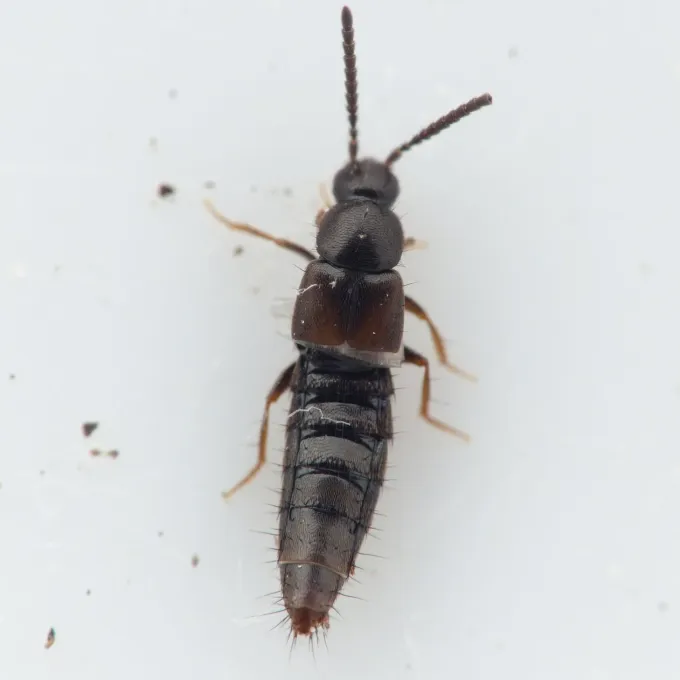
Atheta longicornis is a species of rove beetle belonging to the family Staphylinidae. These beetles are characterized by their elongated, slender bodies and typically dark brown or black coloration.
Adult beetles have short wing covers (elytra) that leave much of the abdomen exposed, yet they are fully capable of flight, allowing them to spread rapidly within enclosed environments.
The larvae are also elongated and possess active mouthparts. While they primarily function as decomposers, they can turn into pests in greenhouse settings when their food source becomes scarce.
These insects are highly agile and tend to reside in the upper layers of moist substrates, making them difficult to detect without careful inspection of the soil environment.
Distinguishing Atheta longicornis from other similar staphylinids often requires taxonomic expertise, but their presence in high densities in crop media is a key indicator.
What it damages
The primary damage occurs in greenhouse environments, particularly affecting crops grown in organic-rich media. Seedlings and young plants are most susceptible to their feeding habits.
Both adults and larvae can damage root systems and the root crown of plants. By gnawing on the soft tissues, they create lesions that inhibit nutrient and water uptake.
These feeding sites serve as entry points for various soil-borne pathogens, including Pythium and other fungi, which may lead to the total collapse of the plant.
In high-density greenhouse production, such as cucumbers, tomatoes, or ornamental seedlings, this pest can cause significant economic losses if not monitored correctly.
The interaction between the beetle's physical damage and the subsequent development of root rots creates a complex pathological condition that is difficult to treat once established.
When it appears
In greenhouse settings, Atheta longicornis does not observe a distinct seasonality. They remain active as long as the temperature and humidity remain within the favorable range.
The development of the species is accelerated by warm temperatures (20–25°C) and high moisture levels in the substrate, which are typical conditions for commercial greenhouse crops.
Population surges can occur throughout the year, especially following the introduction of organic fertilizers or fresh compost that serves as a breeding ground for the larvae.
Because these beetles are highly mobile, they can continually re-infest different greenhouse blocks, making constant vigilance necessary for year-round production.
Management should be based on ongoing monitoring rather than seasonal expectations, as the stable indoor climate prevents the species from entering any form of hibernation.
Signs of infestation
Sudden wilting of young plants, despite adequate irrigation, is often the first visible symptom of infestation in a crop of seedlings or young plants.
Careful examination of the root system often reveals superficial scarring, shallow tunnels, or decaying tissue where the larvae have been feeding.
The presence of small, dark beetles on sticky yellow cards placed near the soil level is a reliable indicator of a population present in the substrate.
Disturbing the top layer of the growth media often triggers the rapid movement of adults, which is a classic behavior of rove beetles when their habitat is exposed.
If dark, sunken lesions appear at the base of the stem at the soil-air interface, it may indicate that Atheta longicornis has damaged the protective bark of the plant.
Control measures
Effective management begins with strict irrigation control; maintaining a substrate that is not excessively wet is critical to discouraging colonization.
Biological control using entomopathogenic nematodes (such as Steinernema feltiae) is highly effective at reducing larval populations within the growing medium.
Proper sanitation, including the sterilization of potting mixes and the removal of organic debris from greenhouse floors, is essential to minimize breeding sites.
Consistent monitoring with sticky traps allows growers to identify the presence of adults early, enabling targeted intervention before the population reaches damaging levels.
- Regulate humidity to prevent soil saturation.
- Apply entomopathogenic nematodes as a biological control.
- Sterilize all growing media before use.
- Keep greenhouse surfaces clean of decaying plant matter.
Taxonomy
- Latin name
- Atheta longicornis
- Order
- Coleoptera (beetles)
- Family
- Staphylinidae
- EPPO code
- ATHTLO
Discussion
No discussions yet — be the first.