
Spotted spittlebug
Aphrophora stictia
Description
How to identify
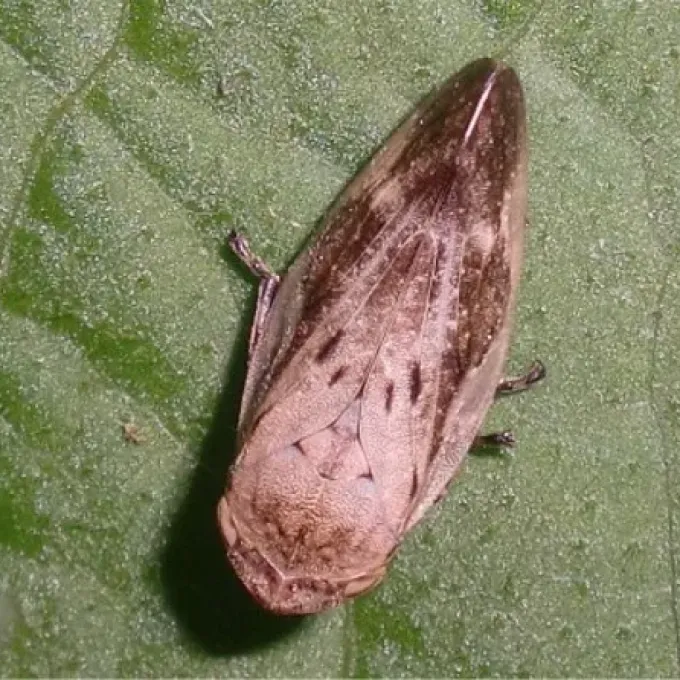
The spotted spittlebug (Aphrophora stictia) belongs to the order Hemiptera and the family Aphrophoridae. Adults are typically 9–12 mm long, featuring an elongated body and mottled wings.
The nymphs are known for their habit of secreting a froth or foam, which covers them while they feed on the sap of host plants.
This frothy substance serves as a protective layer against desiccation and predators, while also providing a stable microclimate for the growing nymph.
Spittlebugs are characterized by strong jumping legs, a feature that allows them to escape threats quickly once they reach the adult stage.
The general appearance of the insect is brownish, with patterns that mimic the texture of bark or leaves, aiding in camouflage during the day.
What it damages
As a polyphagous insect, the spotted spittlebug causes damage to a wide variety of cultivated crops, berries, and ornamental plants.
Both adults and nymphs feed by piercing the plant tissues and extracting sap, which deprives the plant of vital nutrients and water.
Severe infestations often result in stunted growth, curling of leaves, and weakened stems, leading to a significant reduction in overall yield.
Beyond physical damage, these insects are known vectors for various phytoplasmas and plant viruses that can kill sensitive crops.
In ornamental horticulture, the accumulation of foam and the resulting leaf distortion make plants unsaleable and unattractive.
When it appears
The life cycle of the spittlebug is synchronized with the seasonal growth of its host plants, starting with egg hatching in early spring.
Nymphs are most active during the late spring months, typically from May to June, when they produce the characteristic "spit" on plant shoots.
Adults emerge by mid-summer and continue to feed actively until the cooling temperatures of autumn trigger their dispersal and mating.
Eggs are typically laid in the crevices of bark or among dead plant material to survive the winter, ensuring a population for the next season.
Weather conditions significantly impact survival rates, with warm, humid spring weather creating ideal conditions for early nymph development.
Signs of infestation
The most obvious sign of infestation is the presence of white, frothy masses, often called "cuckoo spit," on stems and leaf axils.
Wilting, yellowing (chlorosis), or distorted leaves are frequently observed at the sites where nymphs have been feeding extensively.
Plants may show reduced vigor, with shoots appearing twisted or shortened in areas where sap has been continuously extracted.
Finding groups of jumping insects upon touching a shrub or crop is a clear indicator of a high population of adult spittlebugs.
Early identification of foam bubbles is critical for preventing larger infestations and protecting susceptible fruit-bearing plants.
Control measures
Maintaining a clean garden by removing weeds and tall grass around crops is the primary method for reducing initial pest populations.
Washing off the foam with a strong stream of water is an effective organic method to expose and kill nymphs before they reach maturity.
Insecticidal treatments should be applied only when necessary, focusing on systemic or contact pesticides approved for specific crops.
Encouraging natural predators such as lady beetles, spiders, and predatory hemipterans can help keep spittlebug numbers in check naturally.
- Regular monitoring of sensitive plant species during the spring months.
- Sanitary pruning of infested branches to remove clusters of nymphs.
- Removal of plant debris in the fall to destroy overwintering egg sites.
Taxonomy
- Latin name
- Aphrophora stictia
- Order
- Hemiptera (bugs, aphids, leafhoppers)
- Family
- Aphrophoridae
- EPPO code
- APHRST
Discussion
No discussions yet — be the first.