
Willow spittlebug
Aphrophora salicina
Description
How to identify
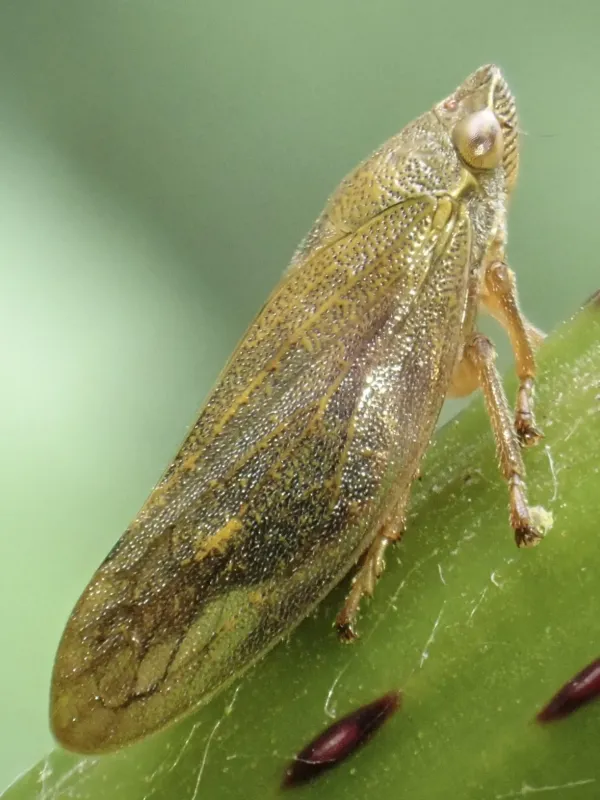
The willow spittlebug (Aphrophora salicina) belongs to the order Hemiptera, family Aphrophoridae. Adult insects are robust jumpers, measuring about 10–12 mm in length with a brownish-gray camouflage pattern that blends perfectly with tree bark.
The most distinctive feature of this pest is the nymph's ability to produce a protective foamy mass, often called "cuckoo spit." Within this froth, nymphs hide from desiccation, intense sunlight, and potential predators throughout their development.
The insect undergoes incomplete metamorphosis, consisting of three stages: egg, nymph, and adult. The adults vary in color from light brown to dark gray, which renders them nearly invisible against the twigs and stems they inhabit.
Eggs are extremely small and are typically laid by females into bark crevices on young shoots or leaf axils, where they remain safely dormant throughout the winter until favorable spring conditions arrive.
Population surges are often triggered by high humidity, making moist, temperate climates ideal environments for these insects to thrive and spread throughout willow plantations.
What it damages
The primary hosts for this pest include trees of the Salicaceae family, specifically willows, poplars, and aspens. In rare cases, they may be found on other deciduous trees if the population density is high.
Damage occurs mainly during the spring and summer months when nymphs feed intensely on the plant sap, piercing the delicate tissues of young shoots and foliage.
Severe infestations lead to general tree weakness, stunted shoot growth, and deformation of leaves, which may curl, yellow, or develop necrotic spots in the puncture areas.
Adults also feed on plant sap, but their impact on the tree is significantly less than that of the nymphs, which require high energy intake for their rapid growth and froth production.
Prolonged colonization on young saplings can reduce their winter hardiness and increase susceptibility to secondary diseases that enter through the damaged plant tissue.
When it appears
The lifecycle of the willow spittlebug is closely linked to the phenology of willow trees. Wintering eggs hatch in the spring once daily temperatures consistently stay above 10 degrees Celsius.
In May, nymphs emerge and immediately begin searching for suitable feeding spots, constructing their characteristic foamy shelters on stems and branches.
The period of active nymph development lasts from late spring to mid-summer, after which they transform into adults, which remain active until the onset of autumn.
Adults continue to feed and mate until the first hard frosts, after which the females prepare to lay their eggs for the following season.
A complete lifecycle usually takes about 2 to 3 months, and the species typically produces only one generation per year, limiting mass outbreaks to a single season.
Signs of infestation
The most reliable sign of a spittlebug infestation is the presence of white, bubbly froth on stems, branches, or leaf axils, which is easily visible to the naked eye.
Upon closer inspection, one may also notice characteristic shoot deformation, where branches appear twisted, stunted, or show signs of premature wilting due to sap loss.
- Presence of "spittle" masses on twigs.
- Curled, yellowing, or stunted leaves.
- Small necrotic spots where feeding punctures occurred.
- Reduced growth in terminal shoot sections.
- Visible jumping insects when branches are disturbed or shaken.
Infested areas often attract ants, which feed on the honeydew secreted by the nymphs, serving as an additional indicator of the pest's presence.
Control measures
Management of the willow spittlebug should be integrated, combining physical, cultural, and chemical methods to effectively suppress the population in gardens and nurseries.
For low infestations, simply washing the foam off with a strong jet of water can be very effective, as it exposes the nymphs to drying conditions or predators, killing them.
In cases of severe infestation, systemic or contact insecticides can be applied during the nymph emergence phase to quickly reduce the number of insects.
Maintaining tree health through proper irrigation, fertilization, and the pruning of dead or damaged branches is crucial for increasing the tree's natural resistance to pests.
Biological control methods include encouraging natural predators, such as parasitic wasps and predatory bugs, which play a vital role in keeping spittlebug populations in balance.
Taxonomy
- Latin name
- Aphrophora salicina
- Order
- Hemiptera (bugs, aphids, leafhoppers)
- Family
- Aphrophoridae
- EPPO code
- APHRSL
Discussion
No discussions yet — be the first.