
Four-spotted froghopper
Aphrophora quadrinotata
Description
How to identify
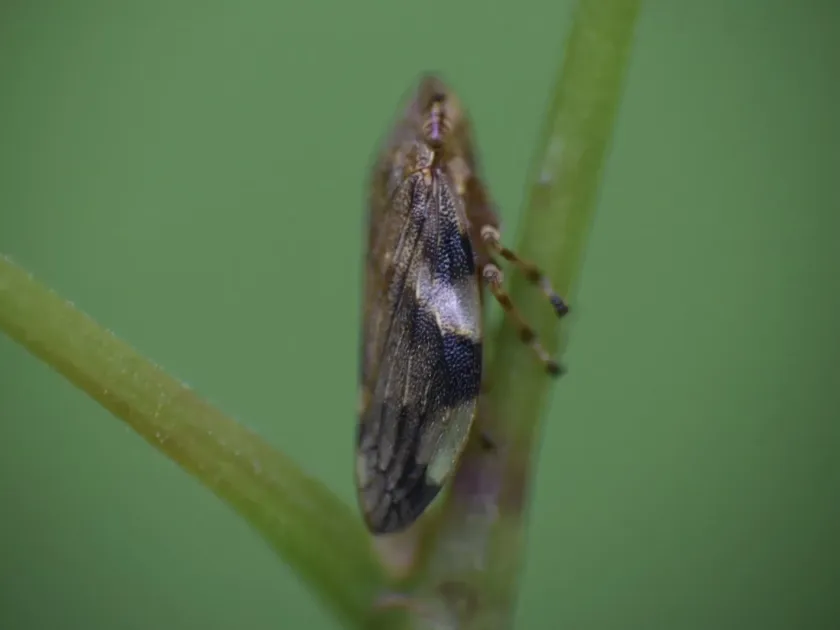
The four-spotted froghopper (Aphrophora quadrinotata) is a member of the Aphrophoridae family, known for its distinctive appearance and jumping ability. Adult insects measure between 9 to 11 millimeters in length.
The body is characterized by a brownish to yellowish coloration, providing excellent camouflage against tree bark. Its name comes from four dark, distinct spots arranged in pairs on the wings.
The most recognizable feature of this species during its nymph stage is the production of white, frothy foam. This "spittle" acts as a protective barrier against predators and extreme weather conditions.
The insect possesses a piercing-sucking mouthpart designed to feed on xylem sap. Their body shape is stout with a wide head and robust legs, which allow for sudden and long-distance jumps.
Like other froghoppers, they undergo incomplete metamorphosis. This means the nymphs look like smaller versions of the adults, though they lack fully developed wings until their final molting stage.
What it damages
These insects primarily infest trees and shrubs, showing a preference for birch, willow, and alder. In cultivated areas, they may cause stress to decorative plants and young orchard saplings.
By extracting sap, the froghoppers cause physiological damage to the host plant. Continuous feeding can weaken the plant, resulting in reduced nutrient transport and stunted terminal shoot growth.
Leaves on infested plants often show signs of curling, yellowing, and deformation. In severe cases, the vitality of the plant significantly decreases, making it more susceptible to environmental stress.
The foam produced by the nymphs can promote the growth of sooty mold, which blocks sunlight and impairs the photosynthesis process on the leaves' surface.
While an individual bug causes little harm, large populations can lead to aesthetic degradation of the plant, often causing heavy wilting and premature leaf drop during dry summer months.
When it appears
The lifecycle begins in the spring when eggs, which have overwintered in woody tissues, hatch into nymphs. This process is synchronized with the start of the plant's active growing season.
Nymphs remain active throughout the late spring and early summer, consistently creating frothy masses on stems and branches. This is the period when they are most easily noticed.
Adults typically emerge by mid-summer, usually around July, when the environment is warm. Once they become adults, their mobility increases, and they begin to disperse to other hosts.
As the season nears its end, the female froghoppers deposit their eggs under the bark of branches. These eggs remain dormant through the winter, protected from cold temperatures.
Successful development of the nymphs is highly dependent on sufficient plant sap flow. If the plant becomes too dry, the nymphs may fail to reach the adult stage, limiting the population growth for that year.
Signs of infestation
The primary sign of infestation is the appearance of white, saliva-like foam on branches and leaf petioles. Seeing these "spittle" masses is a definitive indicator of the insect's presence.
Unexpected wilting of shoots that does not respond to irrigation is another sign. This usually indicates that a nymph is feeding near that specific section, diverting essential plant nutrients.
Leaves that are abnormally curled or show mosaic-like yellowing suggest long-term feeding by a colony of froghoppers. Regular inspections can reveal these damaged areas early.
The presence of adult froghoppers on foliage is hard to ignore, as they quickly jump away when a branch is disturbed. Their sudden movement is a common sign for any observant gardener.
If you notice the accumulation of sticky honeydew or black fungal growth on the leaves below the foam, it confirms the activity of sap-sucking insects in the upper parts of the canopy.
Control measures
For small infestations, a strong blast of water is often enough to knock the nymphs off the plant and destroy their protective foam, which usually leads to their demise.
Pruning damaged branches during the dormant winter season is a highly effective way to remove egg-laying sites, reducing the potential population size for the following spring.
Systemic insecticides are recommended only in cases of severe outbreaks. Products containing active ingredients like acetamiprid can effectively protect the plant by making the sap toxic to the insects.
Promoting a healthy garden ecosystem by encouraging birds and predatory insects will help keep the froghopper population in check naturally, reducing the need for chemical interventions.
Proper plant care, including balanced fertilization and adequate hydration, increases the host plant's internal resistance to damage and promotes faster recovery from insect feeding.
Taxonomy
- Latin name
- Aphrophora quadrinotata
- Order
- Hemiptera (bugs, aphids, leafhoppers)
- Family
- Aphrophoridae
- EPPO code
- APHRQU
Discussion
No discussions yet — be the first.