
Polyphemus moth
Antheraea polyphemus
Description
How to identify
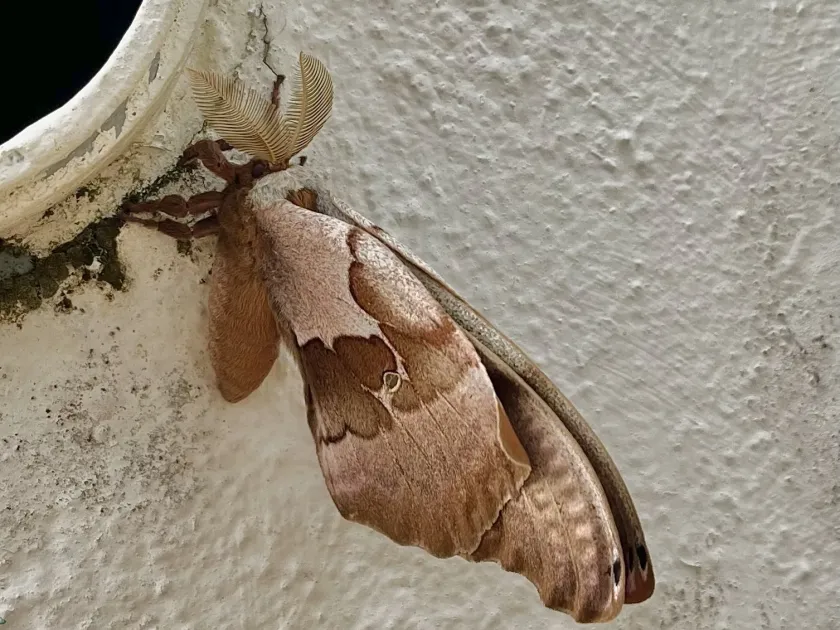
The Polyphemus moth (Antheraea polyphemus) belongs to the Saturniidae family, order Lepidoptera. The adult is a large moth with a wingspan of up to 6 inches, featuring distinctive transparent eyespots on its wings.
The larvae, or caterpillars, are large, reaching up to 4 inches in length. They are typically bright green with rows of small bumps and fine setae, providing effective camouflage.
The life cycle encompasses the egg stage, five larval instars, pupation inside a tough silken cocoon, and the adult stage, which does not feed and focuses solely on reproduction.
Identification of the larvae involves looking for red and blue spots along the body, which helps distinguish this species from other defoliators in the environment.
Adult moths are short-lived and non-feeding, meaning the primary impact on vegetation is strictly limited to the feeding activity of the caterpillar stage.
What it damages
The Polyphemus moth is polyphagous, meaning it feeds on a wide range of host plants, including various broadleaf trees and shrubs found in gardens and forests.
Key host plants often include species from the Rosaceae family, as well as birch, maple, and oak trees, which are common targets for larval feeding.
In garden settings, these caterpillars can consume significant amounts of foliage on fruit trees such as apple, pear, plum, and peach, causing visible damage to the canopy.
Heavy feeding by large caterpillars leads to rapid defoliation, which can stress the tree, hinder photosynthesis, and reduce the overall vigor and health of the plant.
While individual caterpillars rarely kill mature trees, localized outbreaks can severely impact young saplings, leading to stunted growth or increased vulnerability to secondary pests.
When it appears
Caterpillar activity is observed during the warmer summer months, correlating with the peak growth period of their host plants' foliage.
Eggs are typically deposited in late spring, with larvae hatching and feeding actively through the early and mid-summer periods as they pass through successive instars.
After reaching maturity, the larvae spin cocoons to pupate, usually remaining in this protective stage through the later part of the season.
The adult moth usually emerges once per season in most climates, although southern ranges may show evidence of a partial second generation depending on weather conditions.
Monitoring efforts should be focused on June and July, when the caterpillars are growing rapidly and their feeding requirements are at their highest.
Signs of infestation
The most evident sign of an infestation is the presence of large, irregular holes in the leaf blades, often with entire sections of the leaf tissue consumed.
Frass (larval droppings) in the form of large, dark, barrel-shaped pellets under the canopy is a clear indicator that caterpillars are feeding above.
Closer inspection of branches may reveal the caterpillars themselves, though they are often well-hidden due to their effective green mimicry against the leaves.
Thinning of the canopy and exposed leaf stalks are common indicators that the caterpillar population is dense enough to require attention.
Hardened, fibrous cocoons attached to twigs are visible during the winter months, providing a reliable way to identify past infestations and potential carryover populations.
Control measures
Physical removal of caterpillars and gathering of cocoons during the dormant season is a highly effective, low-impact strategy for small-scale infestations.
Biological control using Bacillus thuringiensis (Bt) is recommended for younger larval stages, providing a targeted approach that preserves beneficial insect populations.
When infestation levels are high, horticultural insecticides may be used, provided that application follows all safety protocols and timing guidelines.
Maintaining healthy tree growth through proper irrigation, fertilization, and pruning reduces the tree's susceptibility to caterpillar colonization and damage.
- Regular tree monitoring during early summer.
- Promoting biodiversity to support natural bird and wasp predators.
- Using pheromone traps for monitoring adult moth populations.
Taxonomy
- Latin name
- Antheraea polyphemus
- Order
- Lepidoptera (butterflies)
- Family
- Saturniidae
- EPPO code
- ANTAPO
Discussion
No discussions yet — be the first.