
Chinese oak silkmoth
Antheraea pernyi
Description
How to identify
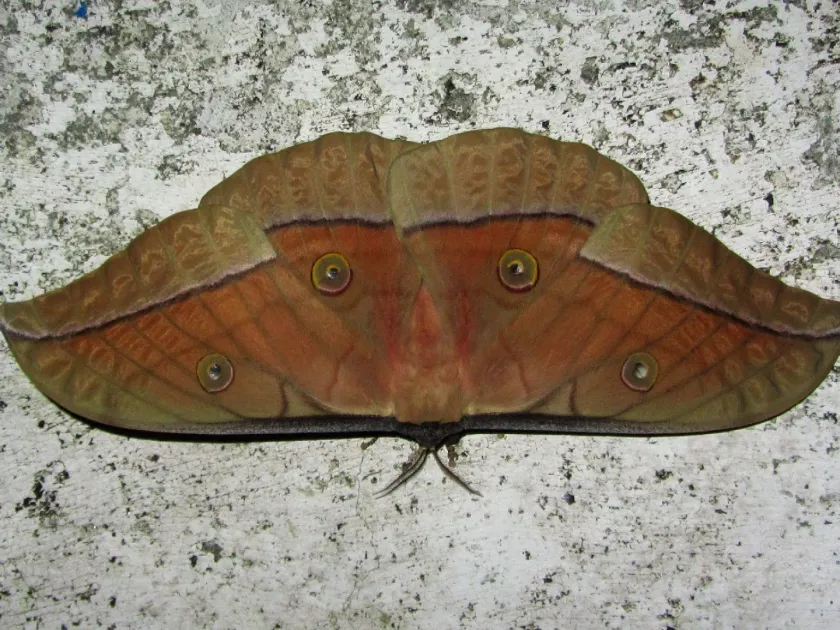
The Chinese oak silkmoth (Antheraea pernyi) belongs to the Saturniidae family. It is a large moth with an impressive wingspan reaching up to 16 centimeters.
The wings exhibit a color palette ranging from yellow to reddish-brown, decorated with distinctive translucent eye-spots that are surrounded by dark rings.
As larvae, these insects undergo five instars. The mature caterpillar is bright green, featuring small tubercles and bristles that help it blend into the foliage.
The pupal stage is spent inside a very tough, brownish silk cocoon, which is suspended from the branches of the host tree by a long, sturdy stem.
The biological cycle is well-adapted to temperate climates, with the species usually completing one or two generations per year depending on the geographic location.
What it damages
The primary food source for Antheraea pernyi larvae is the foliage of various oak species. They consume leaves voraciously, often causing significant defoliation.
While oak is the preferred host, larvae may also feed on birch, poplar, and chestnut, especially when high population densities force them to seek alternative food sources.
The most severe damage occurs during the later larval stages, where the increased size of the caterpillar leads to high consumption rates of the host plant's canopy.
Massive infestations result in the loss of a large portion of the canopy, which hampers the tree's ability to photosynthesize and survive periods of stress.
Continued heavy defoliation over multiple seasons can lead to severe tree decline, reduced timber growth, or even tree mortality, especially in younger saplings.
When it appears
Adult moths emerge in the spring once temperatures have consistently risen. The timing of emergence is often synced with the flush of new oak leaves.
After mating, females lay eggs on the underside of host leaves. These eggs hatch after a period of one to two weeks depending on thermal conditions.
Larval development takes place throughout the summer months. The caterpillars feed aggressively, growing rapidly through their five distinct developmental stages.
Pupation occurs in late summer or early autumn, with the insects forming their cocoons on the branches where they will remain throughout the winter.
The pupae enter diapause to survive the winter, waiting for the return of warmer weather to complete their metamorphosis and restart the lifecycle.
Signs of infestation
The earliest signs of infestation are ragged leaf edges and small holes in the foliage that expand as the larvae grow larger.
Frass (caterpillar droppings) accumulating on the forest floor or on lower branches is a common indicator that larvae are present in the canopy above.
During the winter, the cocoons are the most obvious sign of the pest. They are easily spotted on leafless branches due to their characteristic shape and firm attachment.
General tree stress, characterized by mid-summer yellowing or premature leaf drop, can indicate that the tree is suffering from significant pest pressure.
In quiet conditions, the sound of active feeding by a large number of caterpillars can be audible, resembling a soft rustling or pattering of falling debris.
Control measures
Biological control using Bacillus thuringiensis sprays is highly effective against larvae while being selective and environmentally friendly.
Mechanical control, such as the manual removal and destruction of cocoons during the dormant season, is a simple and effective way to lower the population.
Promoting local populations of predatory birds and parasitic wasps helps keep silkmoth populations in check naturally within healthy ecosystems.
Chemical intervention should be reserved for outbreaks that threaten the health of valuable plantings, ensuring all safety protocols are strictly followed.
- Monitor adult flight using light or pheromone traps.
- Inspect young trees for egg clusters in the early season.
- Prune and destroy heavily infested branches.
- Maintain tree health to improve natural resistance.
Taxonomy
- Latin name
- Antheraea pernyi
- Order
- Lepidoptera (butterflies)
- Family
- Saturniidae
- EPPO code
- ANTAPE
Discussion
No discussions yet — be the first.