
Antheraea paphia
Antheraea paphia
Description
How to identify
Antheraea paphia is a large moth species belonging to the Saturniidae family (giant silkworm moths). It is widely recognized for its silk-producing larvae, commonly known as wild silkworms.
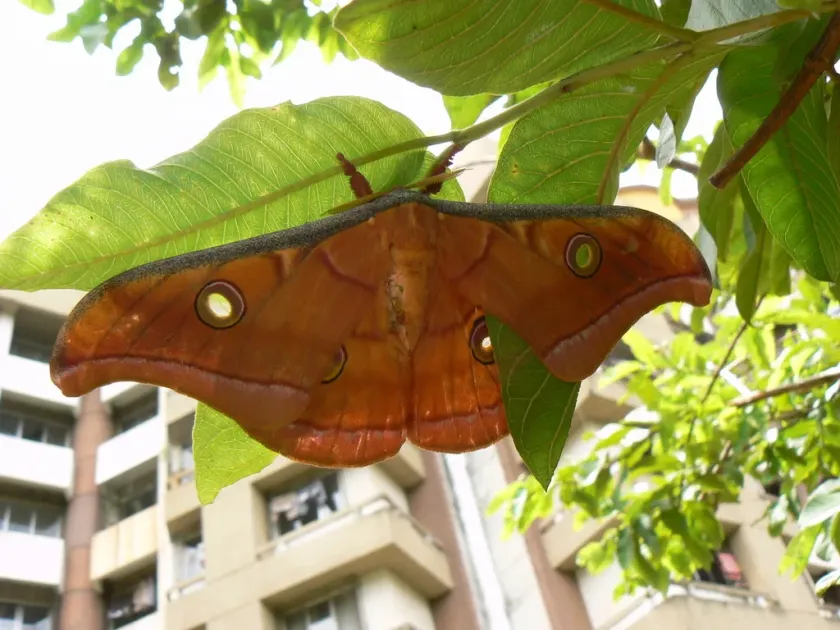
The adult moth is distinguished by its impressive wingspan, which can reach up to 15 centimeters, featuring distinct eye-spots on the wings used as a deterrent against avian predators.
The larvae progress through five distinct instars, evolving from small hatchlings into large, green, spiky caterpillars that are voracious leaf consumers.
The pupal stage occurs within a robust, brown silk cocoon, which is uniquely attached to host plant twigs by a long, resilient silken peduncle that secures it against environmental stress.
The life cycle encompasses several distinct stages including egg, larva, pupa, and adult, with the overall duration highly dependent on local climatic and temperature patterns.
What it damages
This species primarily targets a variety of broad-leaved trees, with a strong preference for host plants such as Terminalia species, Shorea, and various oak varieties.
The primary damage is caused by the larvae, which exhibit high feeding rates, often leading to total defoliation of the host tree if the infestation density is high.
Severe defoliation negatively impacts the tree's photosynthetic capacity, causing significant stress that stunts growth and reduces wood production in forestry applications.
For ornamental or industrial plantations, the damage inflicted by these caterpillars can lead to substantial economic losses and increased vulnerability to secondary diseases.
Repeated yearly infestations can lead to long-term decline in tree health, making the trees susceptible to wood-boring insects and opportunistic fungal infections.
Signs of infestation
The presence of large, pellet-like frass on the ground beneath the canopy is one of the most reliable indicators of active feeding by late-instar caterpillars.
Visual inspection of the foliage often reveals skeletonized leaves or irregularly chewed margins, leaving behind only the primary leaf veins and midribs.
The presence of abandoned or active cocoons attached to branches is a definitive sign of an established population and successful completion of the larval development cycle.
During peak feeding times, a faint but audible munching sound can often be detected in heavily infested groves, indicating a high concentration of larvae in the canopy.
Cluster-like egg masses located on the underside of leaves serve as early warning signs, allowing for intervention before the larvae emerge and begin feeding.
Control measures
Mechanical control, such as the manual removal and destruction of cocoons during the dormant season, is an effective way to suppress the next generation of the pest.
Biological control using microbial insecticides, specifically Bacillus thuringiensis (Bt) based formulations, provides selective larval management without harming beneficial predators.
Implementation of light traps is highly effective for monitoring the adult population flight periods, which helps in timing subsequent management actions more precisely.
- Encouraging local populations of birds and parasitic wasps to act as natural biological regulators.
- Pruning and removing heavily infested branches to reduce the total larval load on the tree.
- Avoiding the establishment of extensive monoculture stands that provide ideal conditions for population outbreaks.
Chemical control should be considered a last resort in professional settings, requiring adherence to safety regulations and integrated pest management (IPM) guidelines.
Taxonomy
- Latin name
- Antheraea paphia
- Order
- Lepidoptera (butterflies)
- Family
- Saturniidae
- EPPO code
- ANTAPA
Discussion
No discussions yet — be the first.