
Chinese oak silkmoth
Antheraea hartii
Description
How to identify
The Chinese oak silkmoth (Antheraea hartii) is a member of the Saturniidae family, order Lepidoptera. Adult moths are large, with a wingspan reaching 10–12 cm, featuring yellowish-brown wings adorned with distinctive eyespots.
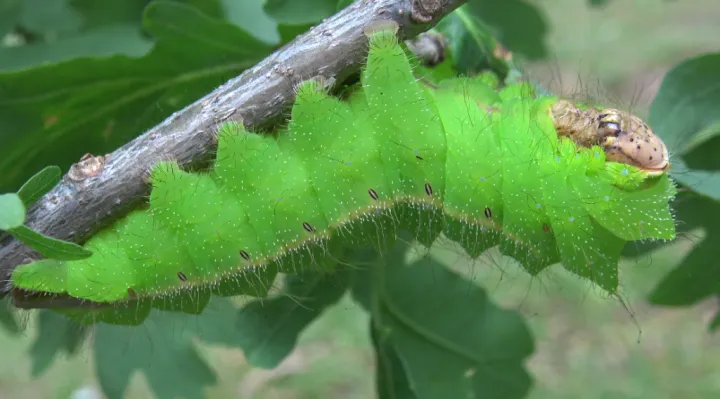
The larvae are characterized by their significant size and the presence of prominent tubercles with setae covering their bodies. As they progress through their larval stages, they change color, which serves as a natural camouflage within the foliage.
The life cycle involves complete metamorphosis, consisting of the egg, larva, pupa, and adult stages. Overwintering typically occurs during the pupal stage inside a robust, silken cocoon attached to branches or fallen leaves.
Females exhibit high fecundity, allowing the population to expand rapidly under favorable environmental conditions. Adults are primarily nocturnal, flying long distances to locate mates during the breeding season.
Early identification is challenging because young larvae often feed in secluded areas; therefore, regular scouting of the underside of leaves is recommended during the hatching season.
What it damages
The primary host plants are trees of the Quercus (oak) genus, though in high-density conditions, the larvae may feed on other deciduous tree species.
Damage is caused exclusively by the larvae, which are voracious feeders. They rapidly skeletonize leaves, leaving only the primary veins, leading to significant or total defoliation of trees.
Mass infestations severely impact the tree's photosynthetic capability, leading to reduced annual growth and a weakened physiological state that hinders long-term development.
Defoliated trees become increasingly susceptible to secondary stressors, including boring insects like wood borers and various fungal pathogens that exploit the weakened host.
In nurseries and young forest stands, extensive larval feeding can be lethal to saplings, as they lack sufficient energy reserves to recover from total leaf loss.
When it appears
Adult moths typically emerge in late spring or early summer, with exact timing highly dependent on local climate conditions and accumulated heat units.
Following mating, females deposit eggs in clusters on the bark or leaves of host trees, with larvae hatching after 10–14 days to begin active feeding.
The peak of damage occurs in mid-summer, when the larvae reach their final instars and consume the largest volume of foliage before preparing to pupate.
As summer draws to a close, larvae finalize their feeding stage and spin their cocoons, where they will remain protected throughout the dormant winter months.
Monitoring programs should focus on the initial hatching periods, as timely intervention at the early larval stages significantly reduces the need for heavy pesticide usage.
Control measures
Biological control using Bacillus thuringiensis-based products is the preferred management strategy, as these agents effectively target larvae while remaining safe for non-target organisms.
In large-scale forest or plantation management, the application of systemic insecticides may be considered if population surveys indicate a high risk of complete defoliation.
Promoting natural biological control through the encouragement of insectivorous birds and the release of parasitic wasps, such as Trichogramma, is highly effective in managing egg populations.
For ornamental landscapes or small-scale sites, manual removal and destruction of cocoons during the winter season can significantly curb local population growth for the following year.
Maintaining tree health through proper fertilization and selective sanitation pruning helps trees withstand potential damage and limits the structural spread of the larvae.
Taxonomy
- Latin name
- Antheraea hartii
- Order
- Lepidoptera (butterflies)
- Family
- Saturniidae
- EPPO code
- ANTAHA
Discussion
No discussions yet — be the first.