
Assam silkmoth
Antheraea assamensis
Description
How to identify
The Assam silkmoth (Antheraea assamensis) is a large moth species belonging to the Saturniidae family. It is widely recognized for its contribution to the production of golden Muga silk, though it can become a pest when its population exceeds agricultural or forestry management thresholds.
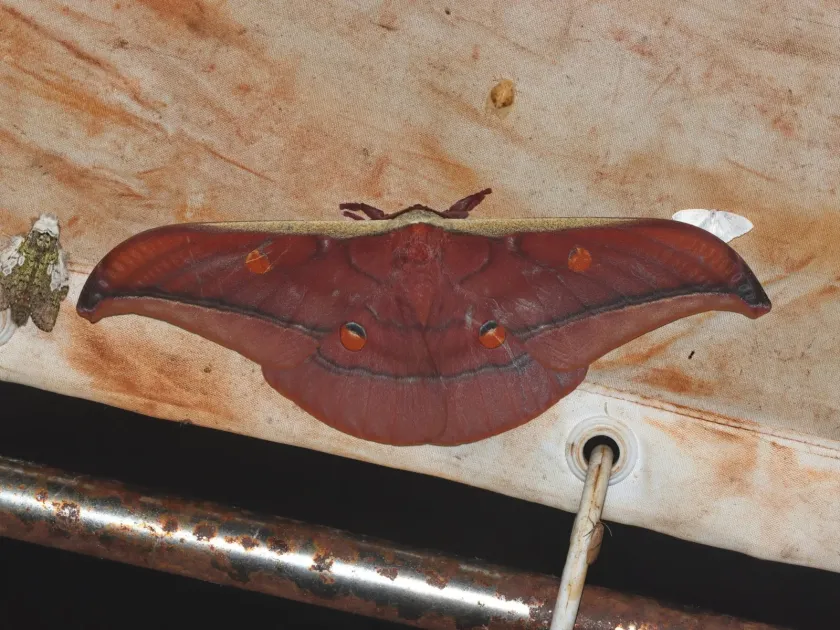
Adult moths possess a wingspan ranging from 12 to 15 centimeters. The wings display characteristic eyespots, which are a defense mechanism used to startle potential predators in the wild.
The larvae undergo five larval stages (instars) before pupating. During these stages, the caterpillars are vivid green, which serves as camouflage amidst the leaves of their host plants, making them difficult to detect in the early stages of infestation.
The life cycle is complete, consisting of eggs, larvae, pupae, and adults. In tropical climates, multiple generations can occur annually, which contributes to the species' potential for rapid population growth.
Correct identification involves observing both the adult moth's morphology and the distinct feeding patterns left by the larvae on host foliage during their active phases.
What it damages
The primary host plants for this species include members of the Lauraceae family, such as Litsea and Machilus species. When these trees are cultivated for silk production or forestry, the larvae can cause significant defoliation.
The caterpillars possess strong mandibles that allow them to consume large quantities of leaf tissue daily. Heavy infestations can lead to complete defoliation of the trees, significantly reducing the plant's capacity for photosynthesis.
Growth retardation is a common outcome for younger trees attacked by the larvae, as the loss of leaf area limits the energy available for root development and stem elongation.
Persistent feeding injury leaves the host plants vulnerable to secondary fungal and bacterial infections, which can further jeopardize the health of the plant population over several seasons.
In intensive monoculture systems, the concentration of host plants facilitates the rapid spread of the moth, leading to substantial economic loss if preventive measures are not taken.
When it appears
The activity of the Assam silkmoth is highly dependent on environmental variables, primarily temperature and humidity. Their activity peaks during the warm and humid months, often aligning with the rainy season.
The first generation usually emerges when temperatures become conducive to host plant growth. The synchrony between moth emergence and the availability of tender leaves is critical for the survival of the neonate larvae.
In tropical conditions, the generation interval can be as short as 30 to 40 days, allowing the insect to complete multiple cycles before the onset of cooler or drier weather.
Larval activity tends to decrease during periods of extreme heat or lack of precipitation, which may force the population into a quiescent phase, though they remain present in the ecosystem.
Agronomists must monitor the plantation regularly, especially after periods of rainfall, as these environmental shifts often trigger the emergence of new generations.
Signs of infestation
One of the earliest indicators of an infestation is the presence of frass (larval droppings) on the leaves or the forest floor beneath the canopy, which signals the presence of feeding larvae above.
Notching of leaf margins or skeletonized leaves, where only the main veins remain, are classic signs of advanced larval feeding and warrant immediate inspection.
The presence of silken cocoons attached to the branches or folded within leaves indicates that the population is transitioning into the pupal stage, marking a critical window for control before the next moth emergence.
Yellowing or premature senescence of leaves, resulting from localized damage to the plant's tissues, provides further evidence of sustained larval activity in the canopy.
- Visual confirmation of egg clusters on the underside of host leaves.
- Observation of green caterpillars at various growth stages.
- Noticeable webbing or silk strands amidst the damaged foliage.
Control measures
Manual removal of egg masses and larvae is a labor-intensive but highly effective control measure, especially in smaller plantations where chemical intervention is discouraged.
Biological control using microbial insecticides, such as Bacillus thuringiensis, offers an environmentally friendly solution that targets the larvae without harming beneficial insect predators.
If chemical control is unavoidable, the application of selective insecticides must be timed carefully to minimize impacts on local biodiversity and to ensure residue-free harvests.
Sanitation practices, such as pruning heavily infested branches and maintaining clean orchard floors, are essential to prevent the spread of the insect to healthier parts of the plantation.
Implementing an integrated pest management (IPM) strategy, which includes regular monitoring and the preservation of natural predators, provides long-term stability and minimizes the risk of significant pest outbreaks.
Taxonomy
- Latin name
- Antheraea assamensis
- Order
- Lepidoptera (butterflies)
- Family
- Saturniidae
- EPPO code
- ANTAAS
Discussion
No discussions yet — be the first.