
Spiny oakworm
Anisota stigma
Description
How to identify
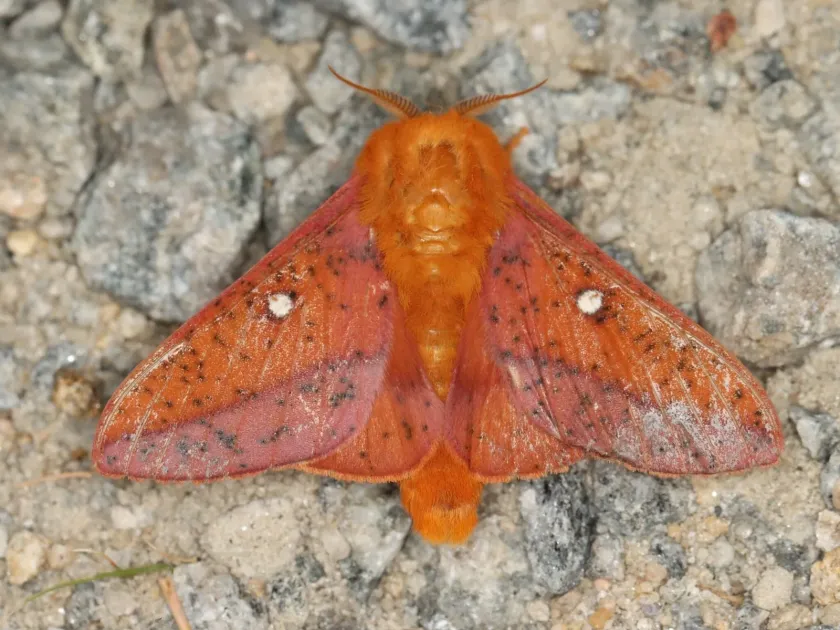
The spiny oakworm (Anisota stigma) is a moth belonging to the family Saturniidae. These moths are characterized by a moderate wingspan, typically ranging from 5 to 7 centimeters.
Adult moths exhibit sexual dimorphism: females generally display an ochre-yellow to brownish color with a distinct dark spot on each wing, while males are typically smaller and darker in appearance.
The larvae, known as oakworms, grow significantly in size throughout their development, reaching up to 6 centimeters in length. They are easily recognizable by their orange-brown color dotted with small white spots.
A key identifying feature of the caterpillar is the presence of short, stiff spines along the body. Despite their intimidating appearance, these spines are not harmful to humans.
The species is primarily found throughout North America, where it has evolved to specialize in feeding on oak foliage, making it a well-known inhabitant of hardwood forests.
What it damages
The primary host plants for Anisota stigma are oak trees (Quercus species). Both white and red oak groups are frequently targeted by this insect.
Young larvae feed gregariously, initially skeletonizing leaves by consuming the tissue between veins. As they reach later instars, they disperse throughout the tree canopy to feed more independently.
In outbreaks, the larvae can cause severe defoliation, consuming entire leaves and leaving only the petioles intact. This mass defoliation is a significant stressor for the host tree.
For mature trees, occasional moderate feeding is usually tolerated, but repeated heavy infestations significantly reduce the tree's vigor and annual growth rate.
The damage caused by these insects can also make the affected trees more susceptible to secondary attacks from wood-boring beetles and various pathogens that thrive on weakened hosts.
When it appears
Anisota stigma completes one generation per year. Its life cycle is tightly synchronized with the phenology of oak trees, ensuring that peak larval feeding matches the availability of foliage.
The insect overwinters as a pupa, which remains dormant in the soil or beneath the leaf litter surrounding the host tree throughout the winter months.
Adult moths emerge in late spring or early summer. Following mating, females lay large batches of eggs on the underside of oak leaves, providing a protected site for the next generation.
Larvae typically appear and begin feeding in mid-summer, specifically throughout July and August, which is when the most noticeable damage to the canopy occurs.
By early autumn, the caterpillars complete their development, descend from the trees, and burrow into the soil to pupate, where they will remain until the following season.
Signs of infestation
One of the most obvious signs of infestation is the presence of groups of caterpillars feeding on the leaves, especially during the mid-summer months when they are most active.
An accumulation of frass (caterpillar droppings) on the ground underneath the tree is a classic indicator that a significant population is feeding in the upper canopy.
Leaves showing irregular, ragged edges or complete stripping down to the veins provide clear evidence of oakworm activity, even if the larvae are hidden among the foliage.
During quiet periods, especially in the evening, one might hear the distinct sound of feeding—the rhythmic rasping of thousands of caterpillars consuming leaf tissue.
Finding molted skins or remains of caterpillars on the bark or nearby surfaces can also alert landowners to the presence of an active infestation within the tree crown.
Control measures
Integrated Pest Management (IPM) for this species begins with monitoring. Light traps can be used to track adult activity and predict the timing of the next larval season.
Biological control is highly recommended, specifically the use of Bacillus thuringiensis (Bt), which is effective against young larvae while sparing beneficial insects.
Encouraging natural enemies, such as parasitic wasps and tachinid flies, is a sustainable way to keep Anisota stigma populations below economically damaging levels.
In high-value ornamental landscapes, contact insecticides can be applied when larvae are in early instars; however, this is rarely necessary in large forest settings.
Sanitation practices, such as raking and removing leaf litter beneath susceptible trees in late autumn, can destroy pupae and reduce the overwintering population for the following year.
Taxonomy
- Latin name
- Anisota stigma
- Order
- Lepidoptera (butterflies)
- Family
- Saturniidae
- EPPO code
- ANITST
Discussion
No discussions yet — be the first.