
Orange-striped oakworm
Anisota senatoria
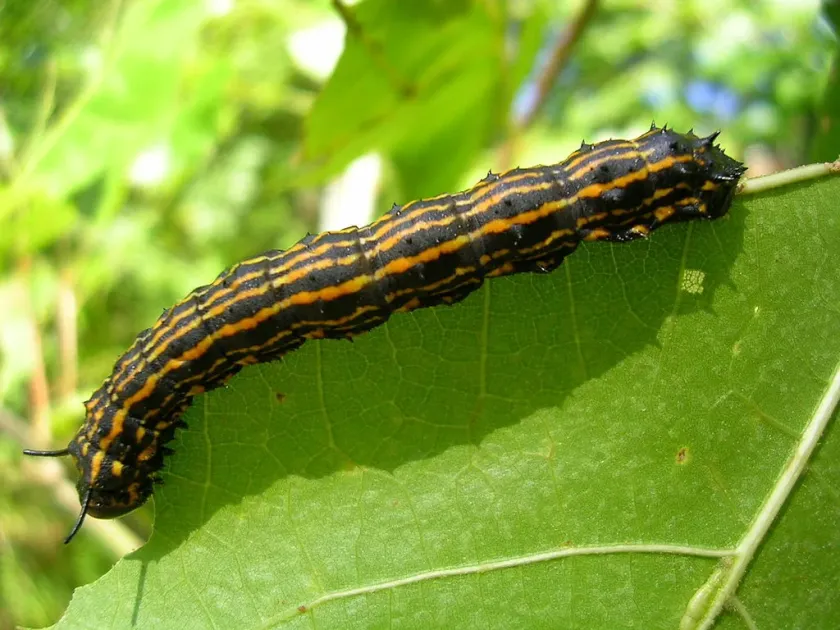
Description
How to identify
The orange-striped oakworm (Anisota senatoria) is a moth species belonging to the Saturniidae family. Adult moths are medium-sized with ochre-yellow to orange-brown wings, typically featuring a small, distinctive white spot on the forewings.
The larvae, or caterpillars, undergo distinct developmental stages. Early instars are yellow and social, while mature larvae are jet-black with orange longitudinal stripes and two prominent, long, horn-like projections near the head.
The life cycle involves a single generation per year. The insect overwinters in the pupal stage, buried in the soil beneath the host tree. Moths emerge in early to mid-summer to mate and lay eggs on the undersides of host leaves.
Females deposit eggs in large clusters, sometimes numbering up to 500 per mass. This high-density egg-laying strategy allows for rapid colonization of branches, which is a characteristic feature of this species.
Larval social behavior is a critical identification marker. During their earlier stages, they remain in groups, feed collectively, and exhibit synchronized movement, making them highly visible to foresters and tree care professionals.
What it damages
The primary hosts for Anisota senatoria are trees in the Quercus (oak) genus. They show a clear preference for various oak species, which often serve as both food sources and mating sites for the population.
While oaks are the preferred host, in instances of extreme population outbreaks, larvae may feed on other hardwoods such as chestnut or hazel. However, their impact remains most severe in oak-dominated landscapes.
Damage begins as leaf skeletonization, where larvae consume the softer leaf tissue, leaving only the vascular veins behind. This significantly reduces the tree's photosynthetic capability and overall energy production.
As the larvae mature into final instars, they become increasingly ravenous. They are capable of complete defoliation, stripping branches of all leaf matter, which stresses the tree and makes it prone to secondary infections.
Chronic infestation weakens the tree's health over several years. Trees that are repeatedly defoliated become susceptible to opportunistic wood-boring insects and pathogenic fungi, often leading to decline and premature tree mortality.
When it appears
Adult moth activity typically occurs during June and July. During this time, they are nocturnal and attracted to light sources, which is a useful period for monitoring population density via light traps.
Larval emergence from egg masses usually takes place in mid-July. This is the optimal window for management, as early-stage larvae are more susceptible to biological control methods and environmental stressors.
The peak feeding period is observed from August through September. During this late summer phase, caterpillars grow rapidly and cause the most significant visual damage to the tree canopy before preparing for pupation.
By autumn, mature larvae descend from the host trees to the ground. They burrow into the soil and leaf litter to form pupae, where they will remain dormant throughout the harsh winter months.
Population dynamics are highly influenced by environmental factors. Mild winters can lead to higher survival rates for pupae, potentially resulting in larger infestations in the following spring and summer seasons.
Signs of infestation
One of the earliest signs of infestation is the presence of egg clusters on the undersides of leaves. Regular canopy checks during July can reveal these clusters before the caterpillars begin intensive feeding.
Frass (caterpillar excrement) accumulating on the ground beneath the tree canopy is a clear indicator of a large population feeding in the upper branches. The presence of dark, granular pellets is a warning sign for arborists.
Leaf skeletonization is a prominent visual symptom. When leaves turn into transparent, vein-only structures, it indicates the presence of an active colony of Anisota senatoria larvae within the tree.
The clustering behavior of the larvae is impossible to miss. Even at significant heights, one can identify these groups of caterpillars by the localized thinning or browning of the leaves in specific sections of the crown.
During September, observing the migration of larvae down the tree trunk toward the soil is a final indicator of the season's cycle. This behavior is a key opportunity to implement physical barriers for control.
Control measures
Biological control is the most recommended approach for managing these pests. Products containing Bacillus thuringiensis (Bt) are highly effective against larvae and pose minimal risk to non-target insect species or the environment.
Physical removal of colonies is practical for small, ornamental, or individual trees. Because the caterpillars feed in dense groups, pruning and destroying a single affected branch can drastically reduce the local population.
Insecticide applications should be reserved for high-value trees or areas where defoliation threatens tree survival. Applications must be timed precisely with the larval development stages to ensure maximum efficacy.
Promoting natural biodiversity helps keep populations in check. Predators such as parasitic wasps, flies, and insectivorous birds play a crucial role in suppressing the oakworm population naturally.
- Monitor canopies in July for egg masses.
- Use light traps to track moth activity levels.
- Encourage bird habitats to increase natural predation.
- Tilling the soil around the base of trees in late fall to disrupt pupal overwintering.
Taxonomy
- Latin name
- Anisota senatoria
- Order
- Lepidoptera (butterflies)
- Family
- Saturniidae
- EPPO code
- ANITSE
Discussion
No discussions yet — be the first.