
Knopper gall wasp
Andricus quercuscalicis
Description
How to identify
The Knopper gall wasp, known scientifically as Andricus quercuscalicis, is a tiny parasitic insect belonging to the Cynipidae family. It specifically targets the English oak, Quercus robur, for its reproduction.
The life cycle of this wasp is complex, involving two generations. One generation produces these distinctive galls on acorns, while the other generation develops on the catkins of the oak tree.
The adult wasps are very small and often go unnoticed by tree owners. Their morphology is adapted for precision egg-laying within the sensitive tissues of developing acorns.
Systematically, this insect is a Hymenopteran. The species requires the presence of both the oak tree and an alternative host or stage to complete its full life cycle successfully.
Identification is primarily focused on the gall stage, as the adult insects themselves are rarely encountered during routine garden or forestry inspections.
What it damages
The primary damage caused by the Knopper gall wasp is the destruction of oak acorns. The larva feeds inside the developing fruit, causing it to distort into a strange, woody, or sticky gall.
These deformed acorns are rendered sterile, meaning they cannot germinate or produce new oak trees. This has a significant impact on natural oak regeneration in woodlands.
For forestry and nursery operations, this pest can cause massive losses in seed stock, severely limiting the ability to cultivate new saplings from local acorn harvests.
While the wasp does not usually kill the mature oak tree, the loss of fruit affects the local food chain, as acorns are a vital resource for wildlife such as jays, squirrels, and deer.
Severe infestations can lead to a complete lack of viable acorns in an area for several seasons, causing ecological stress in forest habitats.
When it appears
The life cycle begins in spring when adult wasps emerge and lay eggs in the developing flowers of the oak tree, which later become the acorns.
During the summer months, the galls grow rapidly. They start as soft, sticky, and green structures, eventually turning hard and brown as they mature towards autumn.
In late autumn, the galls fall to the ground, usually attached to the acorns. This is the stage where the larvae spend the winter, protected inside the woody structure.
Emergence of the adult wasps occurs in the following spring, coinciding with the flowering of the oak, allowing the cycle to repeat.
Environmental factors, particularly humidity and temperature during the spring months, are critical for the survival rate of the emerging wasp generation.
Signs of infestation
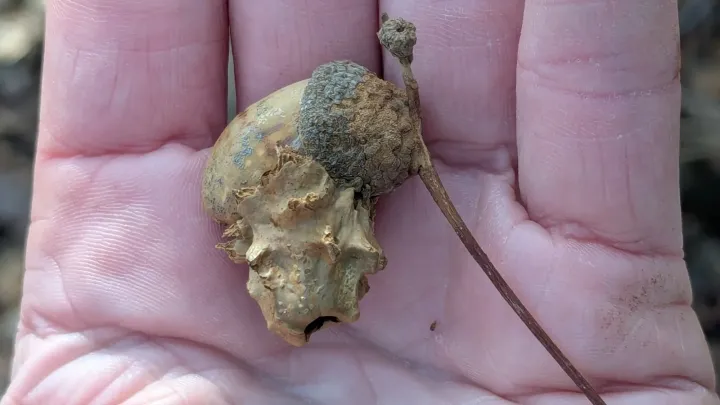
The most visible sign of an infestation is the presence of distorted, woody, 'Knopper' galls on the acorns. These often resemble distorted leaves or scaly, sticky protrusions.
During autumn, check the ground beneath oak trees for fallen acorns that exhibit these strange, hard, and often resin-covered gall growths.
Small holes found on the surface of these galls indicate that the adult wasp has already emerged, confirming that the infestation cycle has reached its conclusion.
If you split open a fresh gall in summer, you will find a small, white larva occupying a central chamber, which is a definitive indicator of the pest's presence.
Sticky, clear or dark residue found on the tree branches or on the acorns themselves is another common symptom of active gall formation.
Control measures
For smaller areas, such as private gardens or nurseries, the most practical control method is the manual collection and disposal of fallen galls before the wasps emerge in spring.
Sanitation practices are essential. Ensuring that all infected acorns are removed and destroyed prevents the population from surviving the winter in the soil.
Biological control through the preservation of natural predators and parasitoids is the preferred approach in large woodland settings, as chemical treatments are usually ineffective.
Chemical control is generally not recommended for large forest areas due to environmental risks and the difficulty of applying pesticides to large tree canopies.
- Monitor tree health and acorn production annually
- Remove fallen debris under infected trees
- Encourage local bird populations that feed on wasps
Taxonomy
- Latin name
- Andricus quercuscalicis
- Order
- Hymenoptera
- Family
- Cynipidae
- EPPO code
- ANDIQU
Discussion
No discussions yet — be the first.