
Common green darner
Anax junius
Description
How to identify
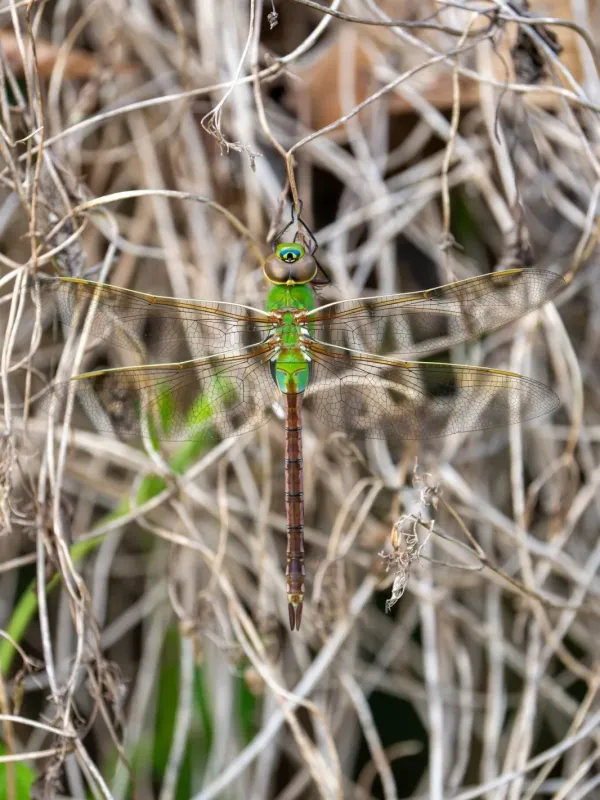
The Common green darner (Anax junius) belongs to the order Odonata, family Aeshnidae. It is one of the most recognizable and widespread dragonfly species in North America.
Adults are characterized by a large size, with a wingspan reaching up to 11 centimeters, and vivid green and blue coloration that serves as a diagnostic feature.
They possess a powerful thorax and large, complex eyes that provide excellent vision, allowing them to track prey with high precision during flight.
The nymphs are aquatic and feature a retractable labium (mask), which is a specialized mouthpart used to ambush and capture small prey items.
This species is highly migratory, with populations capable of traveling across vast distances to reach suitable habitats for breeding and feeding.
What it damages
It is crucial to state that the Common green darner is not a plant pest. It does not feed on crops, vegetables, or ornamental plants in any life stage.
On the contrary, this species is a highly efficient natural predator that provides valuable services to agricultural and garden ecosystems.
Both adults and nymphs are voracious predators that feed on a variety of small insects, including potential pests such as flies, midges, and mosquitoes.
By keeping insect populations in check, they serve as a natural biological control agent, which helps maintain ecological balance in cultivated areas.
Their presence in an agricultural field is a positive indicator of a healthy and diverse local ecosystem that is capable of natural pest regulation.
When it appears
The flight season for adult green darners typically begins in the late spring and continues throughout the summer until early autumn, depending on local climate.
The life cycle involves an aquatic nymph stage, which can last several months, during which the larvae grow by molting multiple times in ponds or lakes.
Migration is a defining characteristic of this species, often occurring in large swarms when seasonal conditions change or food resources become scarce.
The transition from aquatic nymph to aerial adult usually takes place during the warmer months, allowing the species to capitalize on peak insect availability.
As temperatures drop, the metabolic activity of the dragonflies decreases, and the remaining individuals either migrate or complete their reproductive cycle.
Control measures
Since the Common green darner is a beneficial predator, no control measures are necessary. Any attempt to eliminate them would be detrimental to farm health.
The best practice for managing this species is the conservation of their habitats, specifically the permanent or semi-permanent freshwater bodies where they breed.
Agricultural managers should avoid the use of broad-spectrum insecticides, as these chemicals negatively impact dragonfly populations and disrupt natural pest control.
Promoting a balanced environment by maintaining vegetation around farm ponds encourages the presence of these beneficial insects throughout the growing season.
By protecting these natural predators, farmers can effectively reduce their reliance on synthetic pesticides, moving toward more sustainable and eco-friendly farming practices.
Taxonomy
- Latin name
- Anax junius
- Family
- Aeshnidae
- EPPO code
- ANXXJU
Discussion
No discussions yet — be the first.