
Grape hawk moth
Ampelophaga rubiginosa
Description
How to identify
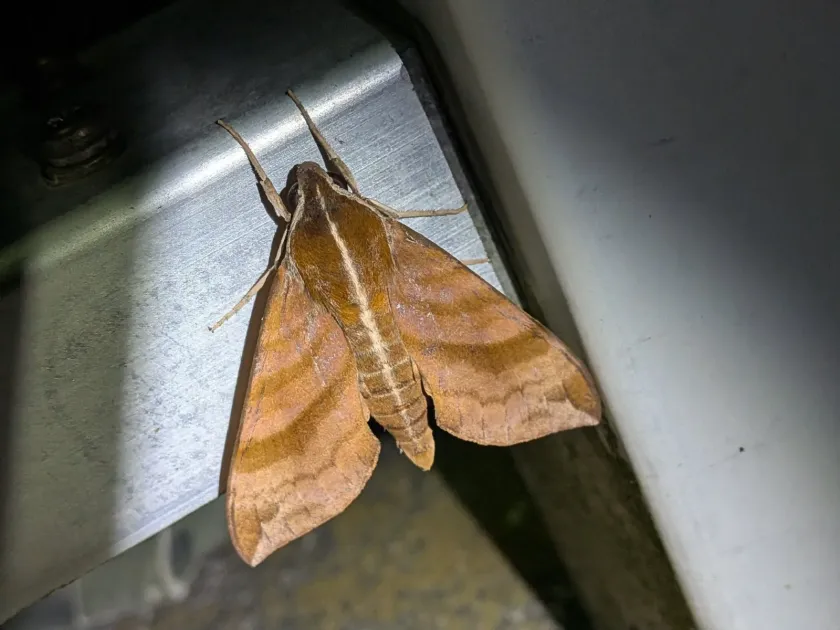
The Grape hawk moth (Ampelophaga rubiginosa) belongs to the family Sphingidae. It is a large nocturnal moth with a wingspan of approximately 70–80 mm, featuring brownish-grey wings that mimic tree bark patterns.
The larvae, or caterpillars, are easily identified by a prominent horn at the posterior end of the body, a common characteristic of the Sphingidae family. They range in color from green to brownish, often with oblique side stripes for camouflage.
The pupae overwinter in the soil or under debris. They are dense and dark brown, adapted to survive cold temperatures during the winter season before emerging as adults in late spring or summer.
Adult moths are nocturnal, feeding on nectar, while their larvae are the primary stage responsible for the damage caused to host plants, specifically vineyards in their native habitats across Eastern Asia.
The biological cycle is well-synchronized with the growing season of the host plant, ensuring that the larvae emerge precisely when the foliage is most abundant and succulent for consumption.
What it damages
The primary host plant for Ampelophaga rubiginosa is the grapevine (Vitis vinifera). The caterpillars are voracious feeders and can strip a leaf down to its main veins, causing significant damage.
Beyond cultivated grapes, the caterpillars may infest wild grapevines and other Vitaceae family members, which often serve as reservoirs for the pest population in the vicinity of vineyards.
Heavy feeding leads to massive defoliation, which severely reduces the vine's ability to photosynthesize, leading to weakened plants and a significant reduction in fruit quality and yield.
Young vines are particularly vulnerable, as sustained damage during the critical growth phase can lead to stunt development and increased susceptibility to fungal diseases and frost damage.
In mature vineyards, the reduction in leaf area prevents the proper sugar accumulation in grape berries, leading to uneven ripening and lowered commercial value of the final harvest.
When it appears
The flight of the first-generation adults typically begins in late spring or early summer, following the accumulation of sufficient heat units in the environment for moth emergence.
Eggs are deposited on the undersides of leaves, and caterpillars hatch within about one to two weeks, initiating the active feeding phase that continues throughout the mid-summer period.
Depending on the climatic zone, a second generation may occur in late summer, posing a persistent threat to late-harvest grape varieties before the larvae pupate in the soil.
The timing of the larvae activity is highly dependent on local weather conditions, particularly temperature and humidity, which influence the development rate from egg to pupa.
Growers should monitor the vineyard during the post-blooming stage to detect the early signs of larval feeding, which is critical for timely intervention before large-scale damage occurs.
Signs of infestation
Visible signs of infestation include large, irregular holes along the leaf margins, which are characteristic of the large caterpillars' aggressive feeding pattern on grape foliage.
Large, dark pellets of frass (caterpillar droppings) found on the ground beneath the vines are a clear indicator of the presence of these pests hiding in the canopy above.
The caterpillars themselves are masters of camouflage; they often sit motionless along the vine stems or leaf petioles, making them difficult to spot without careful inspection.
Yellowing or premature shedding of leaves, resulting from severe skeletonization, is often the most noticeable sign of a well-established and large population of hawk moths.
Nighttime inspections using flashlights or the use of pheromone and light traps can help identify the moth's presence long before physical foliage damage becomes severe.
Control measures
Effective management requires an integrated approach that combines cultural, biological, and chemical methods to minimize the impact of the Grape hawk moth on the vineyard.
- Manual removal of caterpillars in small gardens or organic vineyards to control early-stage infestations.
- Deep cultivation of the soil between rows in autumn to disturb and kill the overwintering pupae.
- Application of biological insecticides containing Bacillus thuringiensis during the early larval stages for effective control with low environmental impact.
- Strategic use of chemical insecticides if thresholds are exceeded, ensuring compliance with pre-harvest intervals for safety.
- Elimination of wild grapevines and alternate host plants in the immediate vicinity to remove potential breeding sites for the moths.
Rotating insecticide modes of action is crucial to prevent the development of resistance in the population and to maintain the long-term effectiveness of chemical control tools.
Regular field scouting is the most effective cultural practice, allowing growers to address infestations early and avoid the need for broad-spectrum chemical applications.
Taxonomy
- Latin name
- Ampelophaga rubiginosa
- Order
- Lepidoptera (butterflies)
- Family
- Sphingidae
- EPPO code
- AMPARU
Discussion
No discussions yet — be the first.