
Agrilus solieri
Agrilus solieri
Description
How to identify
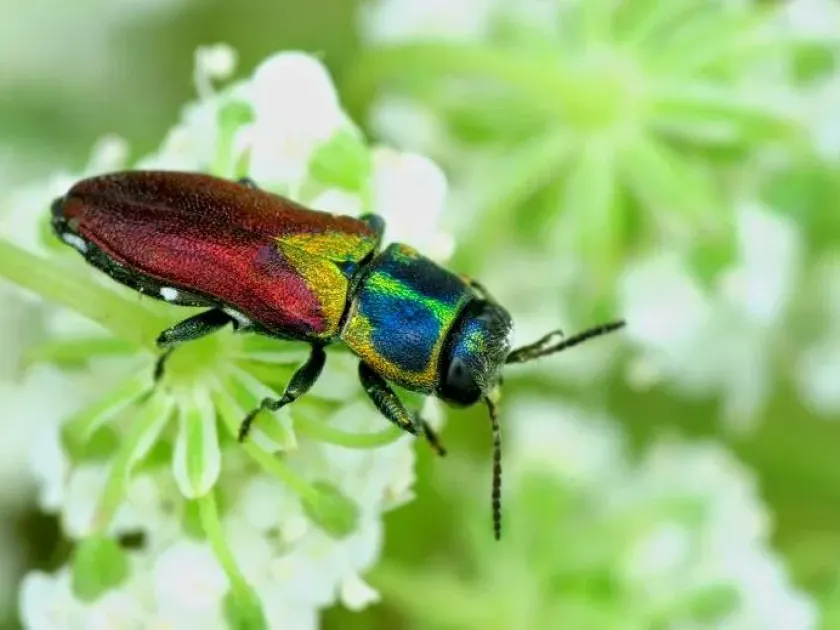
Agrilus solieri belongs to the Buprestidae family, commonly known as jewel beetles or flat-headed borers. Adults are slender, metallic beetles measuring between 6 and 9 mm in length, typically displaying bronze or greenish hues.
The larvae, often referred to as flat-headed borers, are white, legless, and have a noticeably flattened thoracic segment. This body shape allows them to move efficiently through the narrow spaces between the bark and the wood.
Adult beetles are diurnal and active during sunny summer days. They are known for their rapid flight, seeking out stressed or injured coniferous trees, particularly pines, for feeding and oviposition.
The taxonomic classification places this beetle within a genus notorious for its destructive impact on forest health. Precise identification is vital for developing effective management strategies in Mediterranean and surrounding regions.
While identifying the adult beetle is possible during the peak flight season, the most common way to detect the presence of Agrilus solieri in a grove is by observing their characteristic exit holes and the subsequent tree decline.
What it damages
Agrilus solieri primarily attacks pine species (Pinus). It tends to target weakened, drought-stressed, or mechanically damaged trees, taking advantage of the reduced physiological defense mechanisms of the host.
The larvae are specialized wood-borers that create galleries beneath the bark. By feeding on the phloem and cambium layers, they effectively disrupt the tree's vascular system, preventing the transport of water and nutrients.
As the galleries expand and interconnect, they cause girdling of the branches or the main trunk. This results in progressive yellowing of needles, canopy thinning, and eventually the death of the tree if the infestation is severe.
The damage caused by these beetles often acts as a precursor to secondary infestations. Once weakened by Agrilus solieri, trees become highly susceptible to bark beetles and other wood-boring insects that accelerate mortality.
In economic terms, this pest poses a significant risk to forestry and timber production by reducing the quality of wood and increasing the mortality rate of young pine plantations.
When it appears
The adult flight period generally occurs from May to July. During this time, the beetles emerge, feed on pine needles to mature, and mate before looking for suitable host trees to deposit their eggs.
Larval development takes place throughout the summer and autumn. The flat larvae tunnel extensively under the bark, which provides them with a stable and nutrient-rich environment for growth.
Overwintering occurs at the larval stage within the host tree. Protected deep beneath the bark, the larvae are capable of surviving harsh winter conditions before they complete their life cycle in the spring.
Pupation typically begins in the early spring, followed by the emergence of new adults. Depending on local temperature and climate, the life cycle may be completed in one or two years.
Understanding these seasonal dynamics is crucial for foresters and gardeners to time their monitoring efforts and interventions effectively during the beetle's most vulnerable life stages.
Signs of infestation
The most distinctive symptom of an infestation is the presence of D-shaped exit holes on the bark, approximately 3–4 mm in size. These holes are characteristic of the Agrilus genus.
Needle discoloration, ranging from yellow to reddish-brown, is a common external signal. This often starts on single branches before spreading to larger sections of the canopy as the larval damage progresses.
Evidence of boring activity, such as frass (fine wood powder) pushed out from under the bark or around the base of the trunk, often indicates that a colony of larvae is actively feeding inside.
Resinosis (excessive resin flow) is another common sign as the tree attempts to defend itself. However, in heavily infested trees, this resin production is insufficient to prevent the larvae from completing their development.
Ultimately, branch dieback and "top-kill" (when the top of the tree dies first) are clear indicators that the infestation is advanced, signaling an urgent need for corrective action.
Control measures
Sanitation is the most effective control method. Infested branches or entire trees should be removed and destroyed before the adult beetles emerge in the spring to prevent the spread to neighboring trees.
Maintaining tree vigor is a key cultural practice. Providing adequate irrigation during droughts and ensuring proper soil nutrition helps trees maintain their natural defenses against borer attacks.
Systemic insecticides may be used as a protective measure in high-value ornamental gardens, applied during the adult flight period to kill the beetles before they successfully oviposit on the bark.
Mechanical injuries to the trunk should be avoided, as these open wounds serve as entry points for female beetles, which are often attracted to the chemical signals released by damaged tissues.
Integrated Pest Management (IPM) programs should incorporate regular monitoring with pheromone traps, allowing for early detection and targeted management of Agrilus solieri populations.
Taxonomy
- Latin name
- Agrilus solieri
- Order
- Coleoptera (beetles)
- Family
- Buprestidae
- EPPO code
- AGRLSO
Discussion
No discussions yet — be the first.