
Acacia buprestid
Agrilus prionurus
Description
How to identify
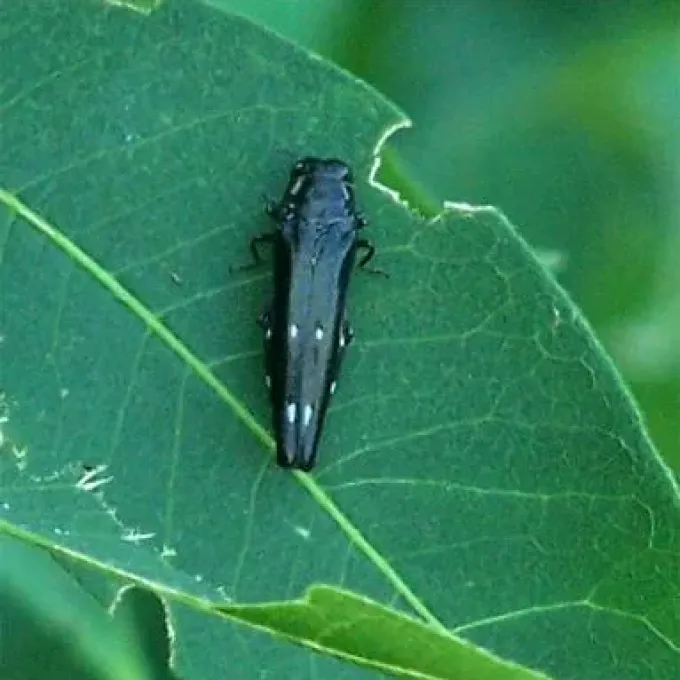
The acacia buprestid (Agrilus prionurus) belongs to the order Coleoptera and the family Buprestidae. This beetle is characterized by an elongated, slightly flattened body with a distinct metallic luster typical of jewel beetles.
Adult beetles usually measure between 7 and 10 millimeters in length. Their coloration ranges from bronze-brown to dark green-black, which provides effective camouflage against the bark of host trees.
The larvae are typically buprestid in form: legless, white-colored, and featuring a broadened thoracic segment. This larval stage is the most destructive to the host plant due to its internal feeding behavior.
Identifying the adult beetle is difficult as they are often found high in the canopy and lead a secretive lifestyle. Most infestations are only detected once physical damage becomes apparent on the trunk.
It is important for arborists to distinguish this species from other Agrilus members, as host preferences and ecological impacts can vary significantly between species.
What it damages
The primary hosts for the acacia buprestid are trees in the Robinia genus, particularly the black locust (Robinia pseudoacacia). The pest predominantly attacks trees that are already stressed or weakened.
Beyond the primary host, if the population density is high, the beetle may attack other broad-leaved tree species, damaging the cambium and phloem layers of the stem.
Larvae excavate winding galleries beneath the bark, which severely disrupt the tree's vascular system and nutrient transport, leading to localized tissue necrosis.
Severe and repeated infestations often result in the gradual dieback of individual branches, and in cases of heavy infestation, can lead to the total death of the tree within a few growing seasons.
This pest is a significant concern for forest parks and ornamental plantings, where it can drastically reduce the health, longevity, and visual appeal of the trees.
When it appears
Adult flight usually occurs during late spring and the first half of summer. This is when the beetles mate and females lay eggs in bark crevices.
The entire life cycle of the buprestid can take between one and two years, depending heavily on regional climate conditions and the physiological state of the host tree.
Larval development peaks during the hot summer months, especially when trees are suffering from drought stress, making them less capable of mounting an effective defense.
Overwintering typically occurs in the larval stage inside the wood, safely tucked away in specially constructed chambers that protect them from freezing winter temperatures.
Following the winter, pupation takes place in the spring. Shortly after, the new generation of adult beetles emerges to begin the cycle of reproduction anew.
Signs of infestation
One of the most diagnostic signs of infestation is the presence of D-shaped (semi-circular) exit holes on the bark, created by newly emerged adult beetles.
Patches of dead or discolored bark are frequently observed on the trunk, often accompanied by cracking or lesions caused by the extensive internal feeding of the larvae.
Progressive crown dieback, starting from the upper or outer branches, serves as a major indicator that the trunk's vascular integrity has been compromised.
In some cases, sap oozing (bleeding) may occur at entry points as the tree attempts to defend itself and seal off the damaged areas.
- Yellowing and premature shedding of leaves
- Distinct D-shaped exit holes on the bark
- Bark peeling and localized cracking
- Reduced annual shoot growth
- Dieback of individual branches in the canopy
Control measures
Maintaining tree vigor is the most critical preventative strategy. Adequate irrigation and balanced nutrition help trees resist successful colonization by the pest.
Sanitary pruning and the prompt removal of heavily infested or dead trees are essential practices to limit the spread of the beetle to healthy parts of the landscape.
For early-stage infestations, systemic insecticides can be applied as trunk injections or surface sprays during the peak adult flight period to effectively reduce populations.
Pheromone traps are useful tools for monitoring beetle activity, allowing for targeted and timely intervention before an infestation becomes severe.
Biological control methods, involving natural predators, may be integrated into management plans, though they are rarely sufficient as a standalone solution for total eradication.
Taxonomy
- Latin name
- Agrilus prionurus
- Order
- Coleoptera (beetles)
- Family
- Buprestidae
- EPPO code
- AGRLPR
Discussion
No discussions yet — be the first.